

디아 비컨: 윤이상 콘서트 'Isang Yun: Images'(10/10)
Isang Yun: Images
Saturday, October 10, 2026, 2 pm
Dia Beacon: 3 Beekman St. Beacon, New York
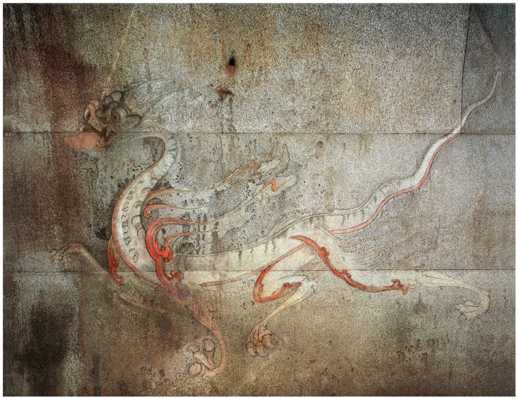
The White Tiger, one of the Four Guardian Deities (사신도, Sasindo) depicted in the mural of the Great Tomb of Gangseo, North Korea. Courtesy Northeast Asian History Foundation
Free with museum admission. Seating is limited; register for the event here.
Program
Remarks by Mina Lee, musicologist
Isang Yun, Images, 1968
For flute, oboe, violin, and cello, approx. 20 min.
Performed by Sejong Soloists, ensemble in residence (Sooyun Kim, flute; Noah Kay, oboe; Chee-Yun, violin; and Gaeun Kim, cello)
Program notes
To mark the opening of Haegue Yang: Through, Dia presents a concert of avant-garde composer Isang Yun’s quartet Images (1968) by ensemble-in-residence Sejong Soloists. The concert is preceded by remarks by musicologist Mina Lee, introducing Images and contextualizing Yun’s artistic legacy within the historical and biographical circumstances of his life while drawing parallels between Yun and Haegue Yang.
Yang’s sustained engagement with the remembrance of Yun’s political biography led her to repeatedly return to his musical oeuvre. Over more than a decade, this engagement has gradually unfolded into a constellation of historical, conceptual, and artistic concerns—described by Yang as an asymmetry. The disproportional understanding of Yun either as a composer or as a political figure prompted Yang to question how an artistic legacy is shaped and obliterated as a product of lived history.
Composed during Yun’s imprisonment by South Korean forces and inspired by the Goguryeo-dynasty murals of the Great Tomb of Gangseo, Images embodies and abstracts layers of historical time. Interweaving traditional Eastern philosophical concepts with Western compositional techniques, Images assigns musical instruments to the Four Guardian Deities depicted in the murals, each symbolizing an element, color, and cardinal direction in East Asian cosmology: the flute to the Black Tortoise (north), the oboe to the Blue Dragon (east), the violin to the Red Phoenix (south), and the cello to the White Tiger (west). As the ancient cosmological system seeks wholeness through interrelation, the deities emerge in Yun’s fluid soundscape without fixed boundaries; their distinctions are blurred yet their singularity is preserved.
During its approximately 20 minutes, Images employs a 12-tone row and unfolds in two parts, each comprising three formal sections and separated by a caesura (a pause) in all four instruments. Within each section, Yun developed relatively static fields of sound in several phases, building toward points of culmination before returning to lower registers. The instruments often form heterophonic pairs that reflect their distinct qualities, while individual timbres emerge in soloistic or duet passages. In the second part, these contrasts intensify toward extremes of chaos and order. Toward the end, a forceful dispersal of the four voices gradually unifies in sustained tones in the upper registers, as the instruments approach one another in gesture and sound. Articulated through sustained rising tones and contrasting rapid movements, Yun associated this convergence of the instruments’ distinct timbres with Taoist harmony and the balance of yin and yang. Throughout, the composition moves between divergence and convergence, dispersion and unity.
Yang’s lingering contemplation of Yun’s struggle amid political division and conflicts reflects her continuous effort to bring music to the center of her practice without reducing it to illustration. Across two floors at Dia Beacon, Haegue Yang:Through transfigures and rescores Images as a dispersed field of distinct yet interconnected sculptural and time-based elements.
*Note: For the concert, the full choreography of Yang’s Axial Flow is adapted to a 20-minute sequence to correspond with the duration of the live performance and minimize any mechanical sound that might interfere with the music.
Isang Yun was born near Tongyong, Korea, in 1917, and received his first musical training in cello and composition in Korea and Japan. Yun’s opposition to the Japanese occupation led to his imprisonment until the end of World War II, after which he taught music at high schools and universities in Korea. In 1956, Yun immigrated to Europe to continue his studies at the Conservatoire National de Musique, Paris; the Hochschule für Musik, West Berlin; and, in 1958, the International Summer Courses for New Music in Darmstadt, Germany. From 1964 onward, he was based in West Berlin, becoming a West German citizen in ’71. In 1967, Yun was abducted by the Korean authoritarian regime as part of the East Berlin Affair (also known as Dongbaekrim Incident), which targeted Korean expatriates in Europe and accused them of spying for North Korea. Central to the charges against Yun was his 1963 visit to North Korea, where he had traveled to see the Goguryeo-dynasty murals of the Great Tomb of Gangseo, which would later inspire his pivotal work Images (1968). After his release in 1969, Yun returned to Germany, teaching at several institutions and receiving numerous prestigious accolades. Throughout his lifetime, Yun composed more than 120 works, ranging from chamber music to operas and symphonies. Yun died in Berlin in 1995.
Mina Lee is a musicologist and professor of music history at the Juilliard School, New York. Specializing in 20th- and 21st-century music with a focus on Korean and East Asian composers as well as the Darmstadt avant-garde, her research draws on postcolonial and globalization studies to explore how music circulates across borders through individuals, institutions, and ideas. Her work has appeared in journals and edited volumes such as The Cambridge Companion to K-Pop (2023), Digital Revolution and Music (2021, in Korean), Music and Politics, and Twentieth-Century Music. Lee’s forthcoming monograph, Creating a Korean Avant-Garde: Music and Diaspora from Isang Yun to Unsuk Chin, examines five Korean composers whose careers were shaped by diasporic trajectories and transnational networks and who have transformed the course of modern music in Korea. She earned her PhD in musicology from Duke University, Durham, where she subsequently taught in the department of Asian and Middle Eastern studies for six years.
Sejong Soloists is a New York–based chamber orchestra that has performed over seven hundred concerts in 120 cities worldwide since its founding in 1994 by Juilliard professor Hyo Kang. These include repeated appearances at Carnegie Hall, New York; the John F. Kennedy Memorial Center for the Performing Arts, Washington, D.C.; Lincoln Center for the Performing Arts, New York; Seoul Arts Center; Suntory Hall, Tokyo; and Wigmore Hall, London, among others. They have also commissioned and premiered numerous works, including Tod Machover’s Overstory Overture (2023) and Flow Symphony (2024), and collaborated with artists such as Ian Bostridge, Unsuk Chin, Joyce DiDonato, Texu Kim, Vadim Repin, Gil Shaham, and Augusta Read Thomas. Sejong Soloists is currently the ensemble in residence at Dia.
Sooyun Kim, described by Libération as “a rare virtuoso of the flute,” made her concerto debut at age ten with the Seoul Philharmonic Orchestra and has since performed with leading ensembles, including the Bavarian Radio Symphony Orchestra, Boston Pops, KBS Symphony Orchestra, and Munich Philharmonic. Kim has appeared in recital at major venues such as the Kennedy Center, Washington, D.C.; Kobe Bunka Hall, Japan; Liszt Academy, Budapest; Louvre Museum, Paris; Seoul Arts Center; and Sibelius Academy, Helsinki. A recipient of a Solti Foundation Career Assistance Award and a prizewinner at the ARD International Music Competition in Munich, Kim is an alumna and Artist Member of the Chamber Music Society of Lincoln Center’s Bowers Program, New York. Kim studied at the New England Conservatory of Music, Boston, and is an assistant professor of flute at the University of Cincinnati College-Conservatory of Music. She performs on a rare 18-karat-gold flute made for her by Powell Flutes. Her critically acclaimed album, Confluence, was released in 2025.
Noah Kay, noted in EarRelevant for his “expressive tone color and deft technique,” previously served as principal oboe of the Colorado Springs Philharmonic and Symphony in C and has appeared as guest principal with the Princeton Symphony, Saint Paul Chamber Orchestra, and Winnipeg Symphony. Kay has also recorded and toured internationally with Orpheus Chamber Orchestra, including a Deutsche Grammophon recording made in Warsaw with pianist Jan Lisiecki. In 2024, Kay joined WindSync as the ensemble’s core oboist, with recent appearances in Chautauqua, Cooperstown, and Woodstock, all New York, as well as with pianist Jon Kimura Parker in Houston. As a soloist, he has performed with the Chamber Orchestra of the Springs and Colorado Springs Philharmonic, in addition to the Chautauqua Symphony Orchestra, where he has held the second oboe position since 2024. Kay holds degrees from Eastman School of Music, Rochester, and Yale University, New Haven, and received his DMA from the State University of New York at Stony Brook. Kay lives in Queens.
Chee-Yun, an Avery Fisher Career Grant recipient, has performed with leading orchestras, including the London Philharmonic, New York Philharmonic, NHK Symphony, Pittsburgh Symphony, San Francisco Symphony, and Seoul Philharmonic, collaborating with conductors such as Myung-Whun Chung, Manfred Honeck, Michael Tilson Thomas, and Jaap van Zweden. Her discography includes eight albums, among them the platinum-selling Serenata Notturno (2008). Career highlights include performances at the White House, Washington, D.C., and the United Nations Headquarters, New York. A long-standing partner of Sejong Soloists, Chee-Yun recently launched the Sejong Soloists Chamber Music Series, which she hosts with the ensemble. Chee-Yun plays the 1669 Francesco Ruggieri violin.
Gaeun Kim, hailed by the New York Concert Review as a “cellist with a warm and rich sound, combining playfulness with impeccable technique,” made her international debut at age ten after winning the first prize and Special Award at the Antonio Janigro International Cello Competition in Croatia in 2012. Her recent honors include top prize at the 2023 Paulo International Cello Competition; first prize at the 2024 National Schadt String Competition; first prize at the 2024 Juilliard Concerto Competition Finals; and first prize and the 2022 Pablo Casals Award at the Irvin M. Klein String Competition. As a soloist, Kim has performed with the Allentown Symphony Orchestra, Helsinki Philharmonic Orchestra, Lahti Symphony Orchestra, Santa Cruz Symphony, Seoul Chamber Orchestra, and Zagreb Soloists, and regularly performs with Sejong Soloists. She has also appeared at venues including Carnegie Hall, New York; Lincoln Center for the Performing Arts, New York; Lotte Concert Hall, Seoul; Musiikkitalo, Helsinki; and Seoul Arts Center. She earned her BM and MM from the Juilliard School, New York, where she is pursuing the Artist Diploma. She performs on a 1697 Giovanni Grancino cello on loan from the Samsung Foundation.
This program is presented in conjunction with Haegue Yang: Through, on view from October 10, 2026, to June 12, 2028, at Dia Beacon, New York.
https://www.diaart.org
 2026 뉴욕 발트 영화제 라인업 New York Baltic Film Festival(11...
 조지아 오키프 오페라 'O’Keeffe: Kiss the Sky' 발췌 공연(10/18...