

NYFF64: The Day She Returns/ 그녀가 돌아온 날 ★★★★☆
[NYFF64] 9/25-10/12
그녀가 돌아온 날(The Day She Returns, 2026) ★★★★☆
Absurd Questions, Variations of Sincerity
Black-and-White Long Takes Capture the Impermanence of Language and Life
*[NYFF 64] 홍상수 감독의 '그녀가 돌아온 날(The Day She Returns)' ★★★★☆ <Korean version>
https://www.nyculturebeat.com/?document_srl=4193194
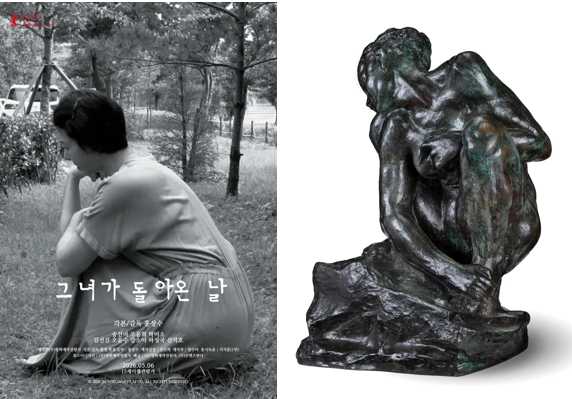
A poster of Hong Sangsoo's The Day She Returns (2026) (left) / Auguste Rodin, The Crouching Woman (La Femme accroupie), c. 1880–1882, Bronze, cast 1963. Los Angeles County Museum of Art (right)
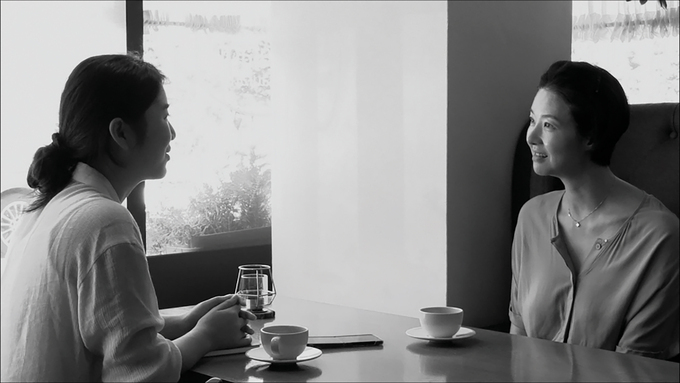
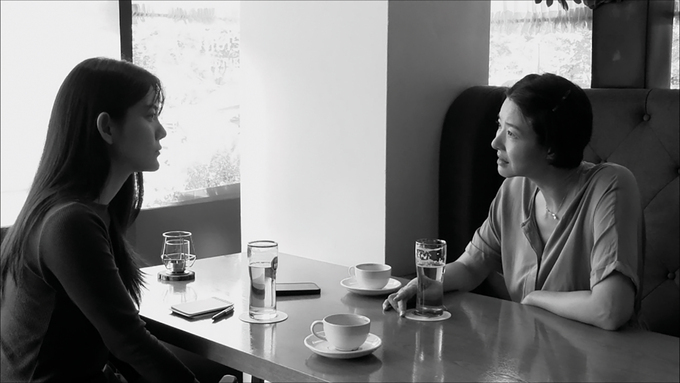
Bae Jeong-soo (played by Song Seon-mi), a once-popular actress who raised her daughter alone after a marriage and divorce, makes her comeback in an independent film after 12 years. To promote the film, she undergoes consecutive interviews with three female reporters at a German restaurant. The young reporters seem far more interested in her physical appearance and private life than in the film itself. Across the table, as their drinks shift from coffee to beer, the actress's answers subtly change depending on who she is talking to.
In the afternoon, during an acting class, she follows the instructor’s (played by Cho Yun-hee) directions to transcribe what was said during those interviews and reenacts them with a fellow student. However, the script written from her memory is embellished and differs from the actual interviews, forcing her to peek at her own notes to carry on the dialogue. Although the table from the interview is gone, the actress remains lost in the chasm between her thoughts, memories, and statements.
Hong Sangsoo's 34th feature film, The Day She Returns (2026), is a black-and-white film composed of static long takes. The camera silently captures the actress from the front and the reporters in profile from the side of the table. While the actress strives to answer sincerely, she repeatedly delivers self-censored responses in the face of the reporters' superficial and formulaic questions.
This creates a vast rift between her thoughts and spoken words, her true heart and her statements. Any attempt to reenact past moments can never fully restore the original. The actress constantly vacillates between her genuine self and the image she wishes to project to others. The black-and-white cinematography obsessively observes her subtle facial expressions.
The reporters probe into her personal life rather than the film's "theme", and each time, the actress tries to evade the conversation by offering them German beer. In that space of evasion, "variation" takes root. The camera is recording her words, but what, truly, is her real sincerity?
The Day She Returns, NYFF64
The Day She Returns, NYFF64
The actress's responses across the three interviews bring to mind the testimonies of the samurai, the bandit, and the wife in Akira Kurosawa’s Rashomon (1950). Just as their statements diverge based on egoism and subjectivity surrounding a single murder incident, the Greek philosopher Heraclitus famously stated, "You cannot step into the same river twice." The actress during the interviews and the actress in the acting class are by no means the same "self." Within the fleeting moments that flow like a river, no single, fixed truth or memory exists—it is bound to be varied every single time.
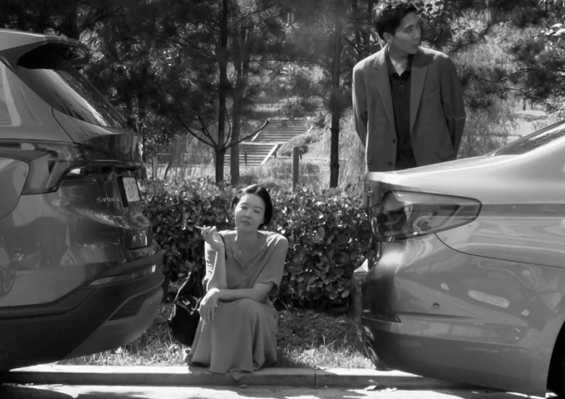
The scene where the actress steps outside the restaurant between interviews to crouch on the lawn evokes Auguste Rodin's sculpture The Crouching Woman. Inspired by the Inferno in Dante’s Divine Comedy, Rodin conceived the monumental The Gates of Hell, featuring over 190 figures including The Thinker, falling souls, and Adam and Eve expelled from the Garden of Eden; The Crouching Woman was one of those figures in hell.
The Day She Returns, NYFF64
Her crouching posture comes across as a defensive gesture of resistance—a attempt to completely safeguard herself from the impolite questions and gazes of the world. For a former star returning through an independent film, the onslaught of reporters' questions prying into her private life must have felt like a massive gate of hell itself. The public and the media continue to view her as an "object of desire," obsessing over her looks and personal history.
Through this crouching mise-en-scène, Hong Sangsoo exposes the levity of a world that chases mere shells while failing to see the essence—art, the human soul, or genuine sincerity. Following the standard formula for celebrity interviews, the three female reporters wrap up their sessions with the exact same question: "Is there anything you'd like to say to the younger generation?" Only to this question does the actress offer a prepared, model answer: "Please love yourself." Along with her earlier remark during an interview that "fake love is rejected," this line naturally calls to mind the music of BTS.
Ultimately, in The Day She Returns, the reporters conclude their interviews without ever asking a fundamental question about the film within the film. As a result, we as the audience gain no information about it either, other than the actress considering its director to be a "serious and kind person." Thus, that very independent film she chose for her comeback—the one we are watching on screen—becomes Hong Sangsoo's The Day She Returns itself.
The restrained black-and-white visuals, fixed long takes, and static setting of a restaurant blocked from sunlight allow the audience to focus entirely on the characters' words, silences, and the air flowing between them. This static gaze of Hong's camera is itself the sharpest philosophical tool that confronts the impermanence (anicca) of language and life. The film calmly and mournfully demonstrates the truth that everything in the world is constantly changing, never staying in one place, and destined to disappear. 84 minutes.
https://www.filmlinc.org/nyff2026/films/the-day-she-returns
*홍상수 영화는 왜 나를 슬프게 하나: 지금은맞고그때는틀리다
*'소설가의 영화(The Novelist's Film) ★★★★☆
*The Novelist's Film review <English version>
*NYFF61: 홍상수 감독의 변(Artist Statement) '물 안에서(In Water)' ★★★★☆
*NYFF61: Hong Sangsoo's Artist Statement 'In Water' ★★★★☆
*NYFF63: 홍상수 감독 '그 자연이 네게 뭐라고 하니' ★★★★
*'필름코멘트' 선정 2022 베스트 영화 20: 홍상수(7, 9위), 박찬욱(12위)