

디아 비컨: 양혜규 개인전 'Haegue Yang: Through'(10/10-6/12, 2028)
Haegue Yang to Present Major Commission Spanning Both Levels of Dia Beacon
Haegue Yang: Through
Long-term view, Dia Beacon
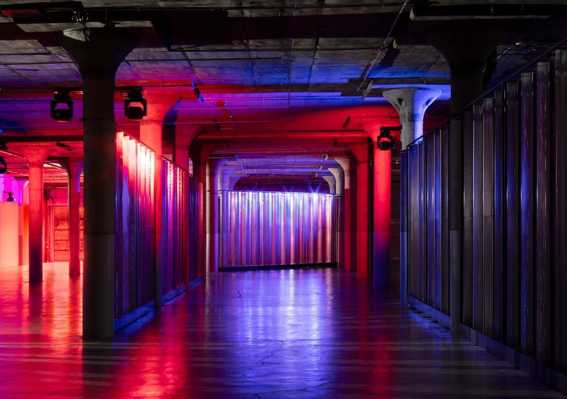
Beacon, New York, September 10, 2026—This fall, Dia Art Foundation presents Haegue Yang: Through, a major commission at Dia Beacon. Yang’s exhibition is staged across the museum’s two levels, marking the first time an artist has conceived of a new body of work spanning the building’s stacked architectural volumes. Opening on October 10, 2026, the exhibition will be on long-term view through June 12, 2028.
“Dia has long invited artists to respond to the scale, light conditions, and material presence of our distinctive spaces. In Through, Haegue Yang extends this history while reframing it through her singular lens. Yang’s engagement with seriality, temporality, and material dialogue both resonates with and reorients the art-historical legacies that have shaped Dia’s program,” said Jessica Morgan, Dia’s Nathalie de Gunzburg Director. “With nearby exhibitions of work by Roni Horn, Lee Ufan, and Kishio Suga, among others, visitors will encounter an exciting international trajectory of artists with these shared concerns.”
Working with a range of media, from paper collage and performance to sculpture and large-scale installations, Yang combines visual abstraction with sound, light, and tactility to create immersive sensory experiences. Her versatile practice often brings industrial fabrication into dialogue with folk craftsmanship, using the affective distinctions between them to complicate the notion of modernity. Through these material investigations, Yang also engages broader historical, philosophical, and political issues, alongside recurring themes of migration, displacement, and cultural translation.
At Dia Beacon, Through harnesses the architecture’s distinct dualities as relational, oscillating dynamics—natural and artificial light, the elevated and the subterranean—and draws on the ancient Five Phases theory (五行思想). Throughout the exhibition, Yang maps her works according to cardinal axes and their chromatic associations in East Asian philosophy, supplemented by the true north orientation of the industrial building, providing a conduit between Dia’s spaces.
Central to the presentation is the radical composer and activist Isang Yun, who serves as a surrogate for Yang’s transnational and interdisciplinary imaginings. Intertwined into all four works, Yun’s quartet Images (1968) is sculpturally rescored by Yang, echoing the composer’s approach to giving new form to ancient entities through contemporary media as well as synthesizing avant-garde Western techniques and East Asian traditions.
This bilateral presentation involves four discrete yet integrated works. Tidal Field (2026), on the ground floor, is an installation of dark, draped venetian blinds, representing an innovation in Yang’s signature installations with the introduction of curvilinear forms. Also on the first floor, the soft, tentacular forms of Fallen Field (2026) evoke the imoogi—a mythical creature between a serpent and a dragon, eternally caught in mid-transformation—which represents a state of becoming between ascent and descent, nature and mythology. This presentation is the largest of Yang’s imoogi installations to date. Sonic Field (2026) is an expansive layer of bells atop a string of light bulbs, creating a landscape of luminous opacity.
The horizontal topology of works on the ground floor is counterpointed by the dynamic vertical louver installation, Axial Flow (2026), in the lower level. Here, a choreographed interplay of moving lights, keyed to the directional colors of the Five Phases theory, and shuttering metal slats are scaled and aligned to the uniquely columned space. Yang’s commission complements and challenges both Minimalism’s unit-based geometries and Postminimalism’s fluid forms as the works’ structural logic is undone by the fluidity of movement and lived experience.
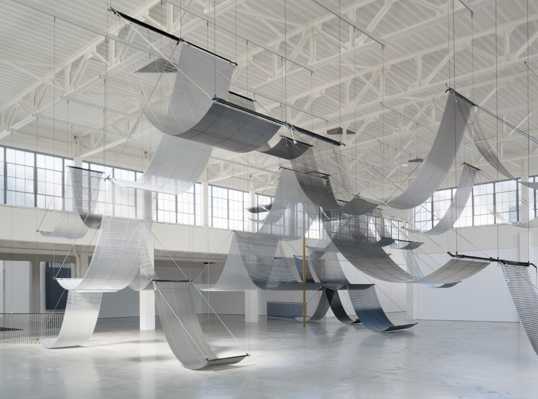
Haegue Yang, Tidal Field (조석장潮汐場), 2026. Haegue Yang: Through, installation view, Dia Beacon, New York, 2026–28. © Haegue Yang. Photo: Bill Jacobson Studio, New York
Marking the opening of Through, Dia will present a chamber concert of Yun’s Images in the lower-level gallery, performed by ensemble-in-residence Sejong Soloists on October 10, 2026. The concert will be preceded by a contextual lecture by musicologist Mina Lee, who will address the composition and Yun’s musical legacy within the historical and biographical circumstances of his life, while drawing parallels between Yun’s and Yang’s practices.
“Through stages dialogues between doubles: transparent and opaque, aerial and subterranean, modern and prehistoric, minimal and maximal. Anchored by Yang’s extended engagement with composer Isang Yun, this exhibition meditates on how histories are transmitted through abstraction and recasts the notion of site as a field of material, cultural, and symbolic relations. Indeed, as the title suggests, Yang’s work becomes both an architectural conduit and positions Yun as a proxy for her diasporic logic. Yang also complicates the formal languages of Minimalism and Postminimalism through myth, musicality, and movement, implicating the viewer in an unfolding drama across time and space,” said Jordan Carter, curator.
“Yang’s decade-long posthumous collaboration with Isang Yun explores how the composer’s experiences of violence and exile during the political upheavals of 20th-century Korea became both embedded within, and at times obscured by, his music. In Through, Yang translates Yun’s Images—in which instrumental voices represent the Four Guardian Deities and coexist within a continuous sonic flux—into forms, color, and movement across two levels at Dia Beacon. In doing so, she creates a field in which disparate periods, geographies, and cultures continually intersect and reconfigure,” said Min Sun Jeon, assistant curator.
Haegue Yang: Through is curated by Jordan Carter, curator, and Min Sun Jeon, assistant curator.
Haegue Yang: Through is made possible by major support from Korea Foundation and Samsung Foundation of Culture. Underwriting support by Kukje Art & Culture Foundation. Significant support by Art Mentor Foundation Lucerne, Dia’s Director’s Council, and Every Page Foundation. Generous support by Jung and Nelson Chai, CNCITY Foundation, Jacques and Natasha Gelman Foundation, and Jay Smith. Additional support by Peter H. Kahng; Chloe H. Kim; kurimanzutto, Mexico City/New York; Esther Lee and Thomas Jong Lee; Miyoung Lee and Neil Simpkins; Wendy Lee; Yang Won Sun Foundation; and those who wish to remain anonymous.
Symposium and public programs are co-presented with the Shen Foundation. Performances by Sejong Soloists, ensemble in residence.
All exhibitions at Dia are made possible by the Economou Exhibition Fund.
About Haegue Yang
Haegue Yang was born in Seoul in 1971. She works across media, ranging from room-size sensorial installations, conceptual works, and performative sculptures to paper collages and staging projects, while engaging broad cultural, philosophical, and historical concerns. In her prolific and versatile practice, Yang juxtaposes seemingly oppositional elements, such as industrial fabrication and folk craftsmanship, to explore the affective power of materialities and methodologies and critically examine the notion of modernity. Recent solo exhibitions have been held at Hayward Gallery, London (2024–25), and the Museum of Contemporary Art, Los Angeles (2026). Yang’s work has been included in numerous group exhibitions, in addition to the Venice Biennale (2009); Documenta, Kassel, Germany (2012); Sharjah Biennial, United Arab Emirates (2015); Singapore Biennale (2022–23); and Shanghai Biennale (2025). Yang was awarded the 2018 Wolfgang Hahn Prize by Museum Ludwig, Cologne, and the 2022 Benesse Prize at the Singapore Biennale. Yang teaches at her alma mater, the Städelschule, Frankfurt am Main. She lives in Berlin and Seoul.
About Dia Art Foundation
Taking its name from the Greek word meaning “through,” Dia was established in 1974 with the mission to serve as a conduit for artists to realize ambitious new projects, unmediated by overt interpretation and uncurbed by the limitations of more traditional museums and galleries. Dia’s programming fosters contemplative and sustained consideration of a single artist’s body of work, and its collection is distinguished by the deep and longstanding relationships that the nonprofit has cultivated with artists whose work came to prominence particularly in the 1960s and ’70s.
In addition to Dia Beacon, Dia Bridgehampton, and Dia Chelsea, Dia maintains and operates a constellation of commissions, long-term installations, and site-specific projects, notably focused on Land art, nationally and internationally. These include:
Walter De Maria’s The New York Earth Room(1977) and The Broken Kilometer (1979), Max Neuhaus’s Times Square (1977), and Joseph Beuys’s 7000 Eichen (7000 Oaks, inaugurated in 1982 and ongoing), all in New York
De Maria’s The Lightning Field(1977), in western New Mexico
Robert Smithson’s Spiral Jetty(1970), in the Great Salt Lake, Utah
Nancy Holt’s Sun Tunnels(1973–76), in the Great Basin Desert, Utah
De Maria’s The Vertical Earth Kilometer(1977), in Kassel, Germany
Cameron Rowland’s Depreciation (2018)
https://www.diaart.org
*양혜규 외 스토리라인@구겐하임뮤지엄, 2015
https://www.nyculturebeat.com/index.php?document_srl=3276658&mid=Art2
*뮤지엄의 한인 작가들 (4)양혜규(Haegue Yang)의 '살림(Sallim)'@MoMA, 2015
https://www.nyculturebeat.com/index.php?mid=Art2&document_srl=3236844
*양혜규@볼티모어미술관, 2017
https://www.nyculturebeat.com/index.php?mid=Art2&document_srl=3539091
*MoMA 재개관, 양혜규의 Handles, 2019
https://www.nyculturebeat.com/index.php?mid=Art2&document_srl=3852589
 메트뮤지엄 베르메르 특강 'Retracing Vermeer's Legacy'(9/27)
 2026 아모리쇼(The Armory Show, 9/24-27 @자비츠센터) 프로그램