

맨해튼 파리 시어터(Paris Theater) 루이스 브뉘엘(Luis Buñuel) 감독 회고전(6/20-7/7)
Around the World with Luis Buñuel
La vuelta al mundo con Luis Buñuel
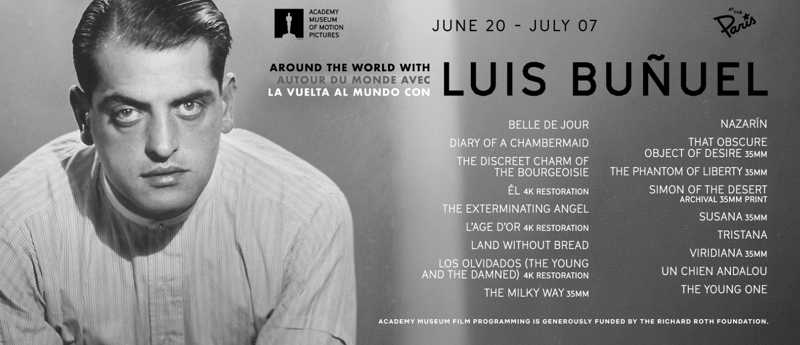
Following this year’s collaboration on Academy Museum Branch Selects in New York, the Academy Museum of Motion Pictures and the Paris Theater announce a new summer series, Around the World with/Autour du monde avec/La vuelta al mundo con Luis Buñuel, presenting a snapshot of one of the last century’s most radical populist artists.
Screenings will take place from Saturday, June 20, until Tuesday, July 7, 2026.
Born in Spain in the first months of a new century, filmmaker Luis Buñuel (1900–1983) was as prolific as he was peripatetic. Across some three dozen short and feature-length films over six decades, Buñuel worked in his native Spain, as well as France, Mexico, and the United States, often fleeing to a new country due to tumultuous geopolitical circumstances.
While his filmography may be bookended by his most radical and celebrated works, including Un chien Andalou (1929, with Salvador Dalí) and That Obscure Object of Desire (1977, his final film as director), his most consistent period occurred in Mexico, where he became a citizen in 1949 after renouncing the Franco dictatorship in his home country.
While in Mexico, Buñuel directed 21 films, many of which uphold the Surrealist roots fostered during his formative years in Paris at the legendary Le Cyrano café, as well as his fascination with taking the bourgeoisie—a class to which he begrudgingly belonged—to task.
Originally programmed at the Academy Museum of Motion Pictures in Los Angeles in 2025 to celebrate 125 years since the director’s birth, this series considers Buñuel’s films made in France, Mexico, and Spain, presenting a snapshot of one of the last century’s most radical populist artists.
Academy Museum film programming is generously funded by the Richard Roth Foundation.
CURRENT AND UPCOMING FILMS
#Sat Jun 20, 잊혀진 사람들 Los Olvidados (The Young and the Damned)
CAST: Stella Inda, Miguel Inclán, Alfonso Mejía, Roberto Cobo
Made during Luis Buñuel’s prolific two-decade period in Mexico, Los olvidados won the country’s second major prize at Cannes, following the landmark win of María Candelaria (1944). This against-formula juvenile crime drama showcases the power of Indigenous actress Estela Inda, recipient of a Silver Ariel for Best Supporting Actress for her memorable performance as the mother of the film’s young, impressionable protagonist; both characters try their damnedest to rise above the crime festering in the slums of Mexico City.
#Sat Jun 20, 황금시대 L'Age d'Or (with Un Chien Andalou)
CAST: Gaston Modot, Lya Lys
After the success of Un chien andalou, Buñuel and Dalí were commissioned to collaborate on a follow-up to their landmark short film, resulting in their first talkie. “There was no going back after making Un chien andalou,” Buñuel wrote in his 1982 autobiography. “Making a commercial film was totally out of the question.” While not a direct sequel, L’Age d’Or is a sister film to its predecessor, as it continues themes of sexual repression and bourgeoise moral hypocrisy, demonstrated through the story of two lovers whose ardent attempts to consummate their desire for each other are thwarted by religion and society. The film caused an uproar from conservative groups following its premiere at Studio 28 in Paris, resulting in... it being banned in France for 51 years.
Preceded by: 안달루시아의 개 Un Chien Andalou
A seminal film in the cannon of Surrealist cinema, Luis Buñuel’s directorial debut is the first collaboration and brainchild between the filmmaker and Surrealist Salvador Dalí. While the film seemingly lacks a plot, it was inspired by a conversation Buñuel and Dalí had about dreams they had experienced. This exchange motivated them to write the irrational and often shocking sequences that make up the film. Using the medium to challenge traditional narrative structure, they explore the concept of repressed desire and the subconscious.
#Sun Jun 21, 사막의 시몬 Simon of the Desert
CAST: Claudio Brook, Silvia Pinal, Enrique Álvarez Félix, Hortensia Santoveña
Inspired by the fifth-century Syrian saint, renowned for his devotion to asceticism while living on the platform of a pillar, Simon of the Desert is Buñuel’s satirical take on the legend, executed with his signature surreal flair. When Simon (Claudio Brook) reaches a 6-year, 6-month, 6-day period of living in prayer at the top of a column, his faithfulness is challenged by the shape-shifting Satan (Silvia Pinal). Simon of the Desert was the last Mexican film production the director worked on, as well as his final collaboration with acclaimed cinematographer Gabriel Figueroa.
Preceded by: 빵 없는 세상 Land Without Bread
Shooting for less than a month with borrowed equipment and editing the film himself on his kitchen table, Luis Buñuel made something close to a straightforward documentary in Land Without Bread, a lightly fictionalized document of the Las Hurdes region in the autonomous Spanish community of Extremadura. A stark portrait of extreme poverty and the population who refuses to leave a seemingly “breadless” land, the director originally provided live narration with its initial silent exhibitions, later adding sound through music and his own voice as one of the narrators.ert (with Land Without Bread), 35MM
#Sun Jun 21, 수산나 Susana, 35MM
CAST: Rosita Quintana, Fernando Soler, Víctor Manuel Mendoza, María Gentil Arcos
The titular heroine, a beautiful young woman with a disturbed and tempestuous nature, escapes a women’s reform school during a stormy night. Finding refuge in the hacienda of a prosperous and respectable family, Susana (Rosita Quintana) soon destabilizes the relationship dynamics of the ranch as she seduces the men who inhabit it. While Susana is less overtly surreal in comparison to the rest of Luis Buñuel’s filmography, the film highlights the director’s subversive style as he explores social critique by demonstrating the fragility of morals through a well-to-do Mexican family.
#Tue Jun 23, 은하수 La voie lactée/ The Milky Way, 35MM
CAST: Delphine Seyrig, Michel Piccoli, Paul Frankeur
Two tramps travel across France - and through time - on a pilgrimage to the tomb of St. James in Spain, encountering the Devil, Jesus Christ, the Virgin Mary, the Marquis de Sade, and a roadside prostitute along the way.
#Wed Jun 24, 절멸의 천사 The Exterminating Angel
CAST: Silvia Pinal, Jacqueline Andere, José Baviera, Augusto Benedico
With a name borrowed (with his permission) from Spanish writer José Bergamín’s unproduced play, and inspired by the apocalyptic Angel of Death, Luis Buñuel’s original script is a pitch-black satire about a wealthy group of friends who find themselves unable to leave a well-appointed living room after a dinner party. One of the director’s most inspired takedowns of the bourgeoisie, The Exterminating Angel is a tense exploration of inertia, extravagance, complacency, repetition, and mounting hysteria, and was the last full-length film he made in his adopted nation of Mexico.
#Sat Jun 27, 어느 하녀의 일기 Diary of a Chambermaid
CAST: Delphine Seyrig, Michel Piccoli, Paul Frankeur
Two tramps travel across France - and through time - on a pilgrimage to the tomb of St. James in Spain, encountering the Devil, Jesus Christ, the Virgin Mary, the Marquis de Sade, and a roadside prostitute along the way.
#Sat Jun 27, 엘 Él
CAST: Arturo de Córdova, Delia Garcés, Aurora Walker, Carlos Martínez Baena
4K Restoration! As Luis Buñuel describes in his 1982 autobiography My Last Sigh, Él is “the portrait of a paranoiac, who, like a poet, is born, not made.” Its initial screenings at Cannes left audiences outraged, likely for being made to bear witness to the violent outbursts of an entitled chauvinist, portrayed by the lauded Arturo de Córdova in a role against type for such a beloved actor. This brutal takedown of toxic masculinity was hated by fellow Surrealist Jean Cocteau, who believed Buñuel had “committed [career] suicide” by making it, though embraced by Jacques Lacan, who appreciated Buñuel’s bravery in depicting what the philosopher saw as “psychological truths.”
#Sun Jun 28, 젊은 이 The Young One
CAST: Zachary Scott, Bernie Hamilton, Key Meersman
The second and last English-language film directed by Luis Buñuel was co-written by Hugo Butler, also known as H. B. Addis, who was blacklisted in Hollywood during the 1950s. Starring Zachary Scott, Bernie Hamilton, and Key Meersman, this 1960 drama explores themes of oppression and morality through the explicit measures manifested and taken by the characters driven by racism and pedophilia. One of the director’s least appreciated films, The Young One takes a poetic approach in its cinematic language, sensibly narrating questions of humanity while dealing candidly with difficult subject matters.
#Sun Jun 28, 부르주아의 은밀한 매력 The Discreet Charm of the Bourgeoisie
CAST: Fernando Rey, Jean-Pierre Cassel, Stéphane Audran, Delphine Seyrig
Luis Buñuel orchestrates consistent unpredictability through narrative pivots and tonal shifts in his satirical masterpiece that won France an Oscar for International Feature Film and received a nomination for Original Screenplay, co-written by Jean-Claude Carrière. A series of happenings sewn together amid a relatively consistent motif is driven by the six French bourgeois who persistently pursue a dinner plan that is repeatedly interrupted by random incidents. In this repetitive digression, the value of the earnest pursuit becomes trivial, exposing the absurdity of the characters’ thoughtless actions.
#Mon Jun 29, 자유의 환상 The Phantom of Liberty, 35MM
CAST: Jean-Claude Brialy, Julien Bertheau, Monica Vitti, Michel Piccoli
Following the success of The Discreet Charm of the Bourgeoisie (1972), Luis Buñuel and Jean-Claude Carrière collaborated on another satirical comedy as co-writers, which became Buñuel’s penultimate cinematic work as director. Starring such greats as Julien Bertheau, Monica Vitti, and Jean-Claude Brialy, to name a few, this surrealist masterpiece comprises nonlinear episodes moving from the early 1800s during Napoleon’s colonial occupation in Spain and monks gambling while drinking and smoking to an upper-class gathering with guests seated on toilet seats. A scent of absurdity permeates the air of these episodes despite the naive earnestness of the characters.
#Tue Jun 30, 세브린느 Belle de Jour
CAST: Catherine Deneuve, Jean Sorel, Michel Piccoli, Geneviève Page
Unable to consummate her marriage, the beautiful yet distant young Séverine (Catherine Deneuve), wife of the wealthy Dr. Pierre Serizy (Jean Sorel), is overcome with kink fantasies. To explore her sexuality, Séverine begins working at an upscale brothel during the afternoons as their “beauty of the day” while her husband is at the office. Through Séverine, Luis Buñuel delves into the complexities of desire and identity, adding his signature touch of surrealism to her fantasies. Like many of Buñuel’s other works, Belle de Jour skewers bourgeoise hypocrisy while challenging societal norms.
#Sun Jul 05, 나자린 Nazarín
CAST: Marga López, Francisco Rabal, Rita Macedo, Ignacio López Tarso, Ofelia Guilmáin, Luis Aceves Castañeda, Noé Murayama, Rosenda Monteros
In a seedy, plague-ridden corner of turn-of-the-century Mexico, a pious priest, Nazarín, takes in mentally ill Beatriz and her prostitute sister, Andara. At odds with the other members of his clergy, he decides to go on a religious journey with the two women, but manages to accidentally alienate or ruin almost everyone he meets. As Nazarín attempts to bring goodwill and faith to a decaying society, he's met with scorn, suspicion and persecution.
#Sun Jul 05, 비리디아나 Viridiana, 35MM
CAST: Silvia Pinal, Francisco Rabal, Fernando Rey, Margarita Lozano
Preparing to devote her life as a nun, novitiate Viridiana (Silvia Pinal) is summoned to pay her uncle Don Jaime (Fernando Rey) one last visit before taking her vows. To make Viridiana, Luis Buñuel returned to his homeland of Spain, following his 22-year self-exile during the rise of Francisco Franco’s fascist regime. The film had its world premiere at the 14th Cannes Film Festival, winning the Palme d’Or. Following the premiere, the Vatican denounced the film as blasphemous, and the Spanish government banned the controversial film—Viridiana didn’t premiere in the country until 1977, two years after Franco’s death.
#Mon Jul 06, 욕망의 모호한 대상 That Obscure Object of Desire, 35MM
CAST: Fernando Rey, Carole Bouquet, Angela Molina
As terrorists bomb Seville, worldly Mathieu Faber (Fernando Rey) boards the Paris train, promptly dumping a bucket of water on a young woman trying to board. As his fellow passengers look on aghast, Faber proceeds to explain "the worst of all women." Faber's encounter with his maid Conchita (Carole Bouquet, Angela Molina), who will never allow him to consummate his passion, is made doubly bizarre by Buñuel's matter of fact casting of two actresses; and by the lack of reaction from Faber and the rest of the cast to their seeming interchangeability.
#Tue Jul 07, 트리스타나 Tristana
CAST: Catherine Deneuve, Fernando Rey, Franco Nero
Catherine Deneuve plays Tristana, a virginal young girl who goes to live with her guardian, eventually breaks through his own facade of respectability and seduces her. She repays him a hundred-fold, preying on his jealousy and taunting him with perverse whimsies.
https://www.paristheaternyc.com/series/academy-museum-luis-bunuel
*맨해튼 파리 시어터(Paris Theater)
https://www.nyculturebeat.com/?mid=FunNY2&document_srl=3713882
 2026 브라이언트 파크 '피크닉 퍼포먼스' 화이트웨이브 김영순무...