

게르하르트 리히터의 풍경화 'Gerhard Richter: Landschaften'@데이빗 즈워너(5/7-7/10)
풍경 사진은 어떻게 리히터에 영향을 주었나?
Gerhard Richter: Landschaften
May 7–July 10, 2026
@David Zwirner (537 West 20th St. NYC)
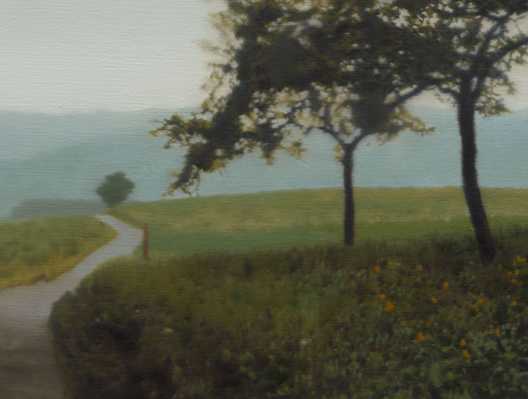
Gerhard Richter, Apfelbäume (Apple Trees), 1987. Private Collection. © Gerhard Richter 2026 (0017)
"만약 '추상 회화(Abstract Pictures)'가 나의 현실을 보여준다면, 풍경화들은... 나의 갈망을 보여준다."
-게르하르트 리히터-
'현존하는 최고의 추상화가'로 불리우는 독일 작가 게르하르트 리히터의 풍경화를 소개하는 전시 'Gerhard Richter: Landschaften'가 5월 7일부터 7월 10일까지 첼시 데이빗 즈워너(David Zwirner)에서 열린다. 이 전시에선 포토리얼리즘 풍경화와 그의 연작인 '추상 회화 (Abstrakte Bilder, 1976–2017)' 중 엄선된 작품들이 함께 전시된다.
리히터는 1960년대 후반부터 풍경을 주제로 다루기 시작했다. 여행 중 찍은 스냅사진을 바탕으로 분위기 있는 구도의 작품들을 창작했다. 이 작품들은 특히 독일 풍경화가 카스파 다비트 프리드리히(Caspar David Friedrich)의 작품 세계를 환기시키면서도, 동시에 '숭고(sublime)'에 대한 전통적인 미학적 관념에서는 벗어나 있다. 그 후 수년간 리히터는 사진 자료를 기반으로 풍경화를 계속해서 그리게 된다. 그는 종종 추상회화 작업과 병행하여 진행함으로써 두 작업군이 서로에게 영향을 주고받으며 각기 내재된 회화적 탐구의 지평을 넓힐 수 있도록 했다.
작가의 경력 중 특정 시기를 전담하는 방들로 구성된 공간들을 따라 연대기 순으로 배치되어 서로 대화하듯 전시되는 리히터의 추상 및 구상 작품들은 이미지의 본질과 현실에 대한 지각—즉 현실이 어떻게 개인적으로 해석되고, 외부 세계를 통해 매개되며, 회화를 통해 시각적으로 형상화되는가—에 대한 작가의 끊임없는 탐구를 종합적으로 보여준다.
이 전시에 선보이는 가장 초기작인 '기자의 대스핑크스(Grosse Sphinx von Gise, 1965)'는 리히터의 호평받는 연작인 '포토빌더(Fotobilder, 사진 회화)'의 일부다. 포토빌더 연작은 주로 우연히 발견한 스냅사진, 엽서, 그리고 뉴스 사건이나 일상생활의 풍경을 담은 언론 스크랩 자료를 바탕으로 제작됐다. 마치 책의 삽화에서 발췌한 듯, 고대 이집트의 기념비를 포토리얼리즘 기법의 흑백 화면으로 묘사하고 그 아래에 설명 문구를 덧붙인 이 작품은 일종의 ‘원형적 풍경화’로서의 역할을 한다. 이는 사진의 역사와 이미지의 수집 및 확산 과정에 대한 작가의 탐구, 그리고 여행이라는 주제에 대한 그의 관심을 보여준다. 이러한 관심사는 이후 그가 제작한 풍경화와 해경화(바다 풍경화) 연작에도 영감을 주게 된다.
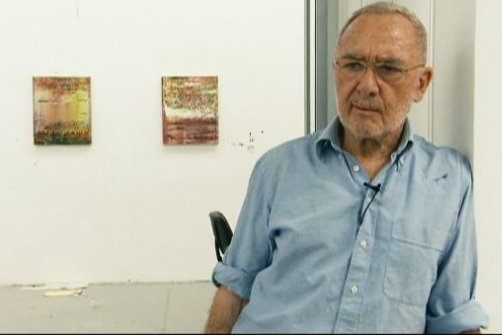
*현존 최고 화가 게르하르트 리히터가 그리는 법 GERHARD RICHTER 'PAINTING'
https://www.nyculturebeat.com/?mid=Art2&document_srl=3878296
"If the Abstract Pictures show my reality, then the landscapes … show my yearning."
—Gerhard Richter, 1981
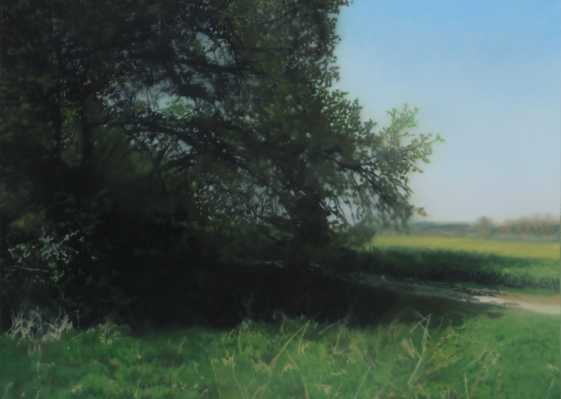
Gerhard Richter, Buche (Beech Tree), 1987 (detail). © Gerhard Richter 2026 (07052026).
David Zwirner is pleased to present an exhibition of Gerhard Richter’s celebrated photorealist landscape paintings from the 1960s to the 2000s, which are displayed alongside a considered selection of works from his series of Abstrakte Bilder (Abstract Paintings, 1976–2017). On view at the gallery’s 537 West 20th Street location in New York, Gerhard Richter: Landschaften is curated by David Zwirner and David Leiber, a partner at the gallery, in close collaboration with the artist. The exhibition features loans from significant private and museum collections, including paintings that were recently on view in the artist’s acclaimed retrospective at the Fondation Louis Vuitton, Paris, in 2025–2026, as well as works lent from Richter’s personal collection.
Richter began to engage the subject of landscape almost six decades ago in the late 1960s, creating atmospheric compositions based on snapshots from his travels. These paintings evoke art-historical precedents—particularly the work of Caspar David Friedrich—while eschewing traditional notions of the David Zwirner aesthetic sublime. Over the following years, Richter continued to paint landscapes from photographic sources, often working on them at the same time as his Abstract Paintings so that each body of work might inform the underlying pictorial concerns expressed by the other. Displayed in dialogue through a chronological series of rooms each dedicated to a period of the artist’s career, these abstract and representational aspects of Richter’s oeuvre together illustrate his enduring investigation into the nature of images and the perception of reality—how it is personally interpreted, mediated by the external world, and visually portrayed through painting.
The earliest painting on view, Grosse Sphinx von Gise (Great Sphinx of Gizeh, 1965; Glenstone Museum, Potomac, Maryland), is part of Richter’s acclaimed series of Fotobilder (Photo Paintings), which are largely based on found snapshots, postcards, and media clippings of news events and scenes from everyday life. Depicting a photorealistic black-and-white view of the ancient Egyptian monument accompanied by a written caption, as if excerpted from a book illustration, this painting serves as a kind of proto-landscape; it speaks to the artist’s interrogation of the history of photography and the collection and dissemination of images, as well as his interest in themes of travel—a topic that would similarly inspire his subsequent landscapes and seascapes.
In 1968, following a formative visit to the French island of Corsica, Richter used the photos he had taken on his trip as the basis for a group of large-scale square seascapes showing views of open seas framed by cloudy skies or vast mountain ranges—marking his first in-depth engagement with the genre of landscape. Furthering his conceptual experiments with the iterative translation and interplay of mediums, Richter created some of these paintings—including Seestück (Gegenlicht) (Seascape [Contre-jour], 1969; private collection), featured in the exhibition—by collaging two photographs of sea and sky and using the resultant composite as a reference for the final work. Atmospheric and evocative, these manipulated landscapes investigate the existence of a subjective visual reality that exceeds the bounds of real-world perception.
Throughout the 1970s, Richter created several series depicting expansive natural views: icebergs, volcanoes, Alpine mountains, and open waters. Whilst sharing a visual affinity with Friedrich’s Romantic depictions of human figures dwarfed by forests and oceans, Richter’s works engender a modernized alteration of reality that is detached from person and place and often blurred to the precipice of unrecognition. These paintings possess a subversive undercurrent, complicating how a landscape—in the artistic and sociopolitical sense—can be visually and culturally understood. Moreover, Richter’s landscapes from this period led to the genesis of his earliest Abstract Paintings, which evolved out of a collage technique in which the artist pieced together painterly layers and shadows from several photographic sources. In Richter’s words, these abstractions served as “fictive models, because they make visible a reality that we can neither see nor describe, but whose existence we can postulate.”
Richter would return to landscapes across the 1980s and 1990s, each time depicting anonymized locations with his signature sfumato surface treatment. Paintings such as Lichtung (Clearing, 1987) also see him overlaying scenes of nature with abstract brushstrokes, effectively collapsing these two fundamental pillars of his oeuvre in a single canvas. At the same time, Richter began titling some of his Abstract Paintings after real-world objects, including Fenster (Window, 1985) and Wolken (Clouds, 1982; The Museum of Modern Art, New York), further playing on what he identifies as the viewer’s inherent desire to read into abstraction and create a personal understanding of the marks made therein.
As David Zwirner Richter once noted: “When I look out of the window … truth for me is the way nature shows itself in its various tones, colors and proportions. That’s a truth and has its own correctness. This little slice of nature, and in fact any given piece of nature, represents to me an ongoing challenge, and is a model for my paintings.”
Gerhard Richter (b. 1932) was born in Dresden, Germany. He studied art at the Dresden Hochschule für Bildende Künste from 1951 to 1956, with mural painting as his main area of study. In 1959, he visited Documenta II, held in Kassel, West Germany, an experience that inspired him to alter his artistic trajectory. After his escape from East Germany in 1961, he completed a second course of study at the Staatliche Kunstakademie in Düsseldorf. There, he united with fellow students Sigmar Polke, Konrad Lueg (later known as the gallerist Konrad Fischer), and Manfred Kuttner to collectively form the short-lived “capitalist realism” group.
From 1964 onward, Richter has had many solo exhibitions in renowned galleries and museums worldwide. The artist’s first solo exhibition in a public institution was held at the Gegenverkehr, Zentrum für aktuelle Kunst, in Aachen, West Germany, in 1969. In 1972, he was selected as the only artist to represent Germany in its national pavilion at the Venice Biennale. Richter has exhibited at Documenta more times than any other artist (1972, 1977, 1982, 1987, 1992, 1997, 2007, and 2017).
Richter’s work has been presented in numerous solo shows and retrospective exhibitions at important institutions worldwide, including the Kunstverein für die Rheinlande und Westfalen, Düsseldorf (1971, 1986); Kunsthalle Bremen, West Germany (1975); Centre Pompidou, Paris (1977, 2012); Städtische Kunsthalle, Düsseldorf (1986); Neue Nationalgalerie, Staatliche Museen zu Berlin (1986, 2012); Hirshhorn Museum and Sculpture Garden, Washington, DC (1988, 2003); San Francisco Museum of Modern Art (1989, 2002); Tate, London (1991, 2011); Moderna Museet, Stockholm (1993); Art Institute of Chicago (2002); The Museum of Modern Art, New York (2002); Queensland Art Gallery, Brisbane (2017); The Met Breuer, New York (2020); and The National Museum of Modern Art, Tokyo (2022). In April 2023, the Neue Nationalgalerie in Berlin opened Gerhard Richter: 100 Works for Berlin. This special long-term presentation features works that the Gerhard Richter Foundation gave to the museum on permanent loan in 2021, including Richter’s Birkenau (2014) cycle of large-scale abstract paintings. A major retrospective of Richter’s oeuvre, with works on view spanning more than sixty years of the artist’s practice, was presented at the Fondation Louis Vuitton, Paris, in 2025–2026.
Richter has been honored with a number of significant awards, among them the Kunstpreis Junger Westen, Kunsthalle Recklinghausen, West Germany (1967); Arnold-Bode-Preis, Kassel, West Germany (1982); Oskar-Kokoschka-Preis, Vienna (1985); Goslarer Kaiserring, Goslar, West Germany (1988); Golden Lion at the 47th Venice Biennale (1997); Praemium Imperiale Award, Japan Art Association, Tokyo (1997); Wexner Prize, Wexner Center for the Arts, Columbus, Ohio (1998); Foreign Honorary Membership of the American Academy of Arts and Letters, New York (1998); Staatspreis des Landes Nordrhein-Westfalen, Düsseldorf (2000); and the Kunst- und Kulturpreis der deutschen Katholiken, Deutsche Bischofskonferenz, Bonn (2004). In 2007, Richter received honorary citizenship in Cologne, and in the same year, he designed a spectacular stained-glass window for the Cologne Cathedral.
David Zwirner began representing the artist in 2023. The same year, the gallery presented a solo exhibition in New York of new and recent abstract works by Richter. The presentation was accompanied by a fully illustrated catalogue with a new essay by Dieter Schwarz. In early 2024, a solo exhibition of Richter’s work was on view at David Zwirner London, and in 2025 his work was presented in a solo show
at David Zwirner Paris. Prior exhibitions organized by the gallery in New York include Gerhard Richter: Prints & Multiples 1966–1993 (1994), Gerhard Richter: Early Paintings (2000), and Gerhard Richter: Landscapes (2004). The artist’s work is held in important public and private collections worldwide. Richter lives and works in Cologne.
https://www.davidzwirner.com/exhibitions/2026/gerhard-richter-landschaften
 뉴욕시 재즈싱어 빌리 할러데이 퀸즈 조각 후보작 6점 대중 의견 ...
 크리스티 경매: 잭슨 폴락, 브랑쿠시 1천만 달러 클럽 등극