

링컨센터 1970년대 한국영화전 'Korean Cinema’s Celluloid Fever: The 1970s' (5/15-26)
Korean Cinema’s Celluloid Fever: The 1970s
May 15–26
Film at Lincoln Center
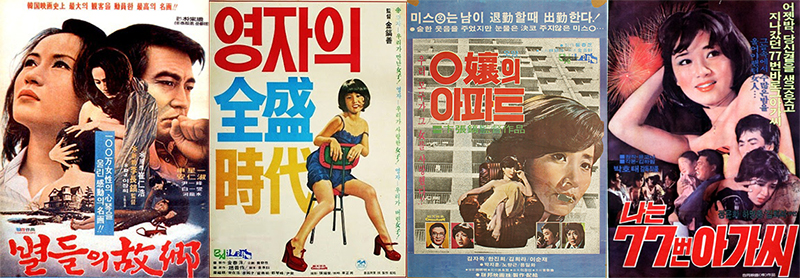
In the years following South Korea’s widely celebrated cinematic renaissance of the 1960s, a new generation of filmmakers inherited an industry under siege. Television had decimated theatrical attendance, and Park Chung Hee’s Yushin regime transformed state censorship into a stranglehold over what could be made, shown, or said on screen. Yet despite these constraints—or because of them—the 1970s yielded some of the most daring and emotionally charged filmmaking in Korean history.
This long-dismissed decade produced extraordinary works by Ha Gil-jong(하길종), Kim Ki-young(김기영), Kim Soo-yong(김수용), Lee Doo-yong(이두용), Lee Jang-ho(이장호), and Lee Man-hee(이만희), alongside genre innovations that permanently reshaped the industry’s DNA. The era witnessed the emergence of two prominent artistic movements: the Visual Age, a cohort of directors inspired by the French New Wave; and Kaidu Club, Korea’s first feminist film collective, founded by Han Okhi.
Contemporary Korean cinema’s extraordinary genre sophistication and its affinity for embedding social critique within the forms of popular entertainment, as exemplified by the works of Bong Joon Ho and Park Chan-wook, were forged under duress over this turbulent period. This May, Film at Lincoln Center and Subway Cinema are proud to present rare archival prints and new restorations of films whose significance to world cinema is only now being fully recognized.
Organized by Young Jin Eric Choi, Goran Topalovic, and Madeline Whittle. Co-presented by Subway Cinema in collaboration with the Korean Cultural Center New York and the Korean Film Archive.
Korean Cinema’s Celluloid Fever: The 1970s is sponsored by MUBI, the global streaming service, production company, and film distributor dedicated to elevating great cinema.
*한류를 이해하는 33가지 코드: BTS, 기생충, 오징어 게임을 넘어서
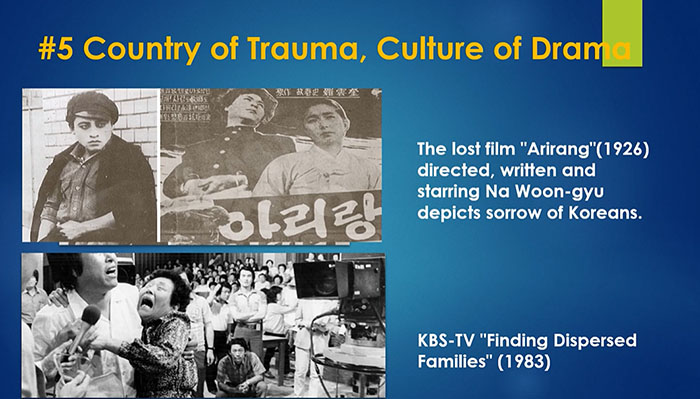
#5 한(恨)과 한국영화 르네상스 Country of Trauma, Culture of Drama
Koreans have a unique sentiment of 'han'. The ethnic trauma of Koreans, such as separated families due to the division of the two Koreas after the war and the Ferry Sewol disaster, were more dramatic reality than the movies. Koreans who share their national sad feelings want more dramatic narratives and unforgettable characters. We are hungry for that. It is also the reason why Korean directors such as Park Chan-wook, Bong Joon-ho and Hwang Dong-hyeok have developed brutal aesthetics.
http://www.nyculturebeat.com/index.php?mid=Zoom&document_srl=4072876
*한국영상자료원 유튜브 채널 1930-90년대 한국 고전영화 100여편 무료
https://www.nyculturebeat.com/?mid=Film2&document_srl=4102921
5. K-Cinema: Country of Trauma, Culture of Drama 68
Arirang: The Ballad of Han (恨) 68
Arirang: The Birth of Korean Cinema 69
Han and the Renaissance of Korean Film 71
Brief History of Korean Film 72
The Dark Age of the 1970s 72
The “3S” Policy in the 1980s 73
Hong Kong Cinema’s Influence on Korea 75
June 1987 Uprising and the New Waves 76
Post-Olympics Shift and Corporate Investment 77
Seopyeonje and the Rise of Artistic Cinema 79
Han Seok-kyu: The Box Office King 80
Korean Cinema Renaissance: 2000s 80
Global Recognition: The 2000s and Beyond 81
Rise of Gangster Movies as Blockbuster Hits 82
Art Films vs. Action Epics: The 2010s 83
After Parasite: Minari, Squid Game, and Beef 84
 NYU ISAW 무료 특강 (3/11): '이집트 미술 속 숨겨진 신체(The Se...