

헝가리 거장 벨라 타르(1955-2026) 회고전 'Farewell to Béla Tarr'(3/27-31)
FILM AT LINCOLN CENTER PRESENTS "FAREWELL TO BÉLA TARR," MARCH 27–31
Tribute to the late Hungarian auteur Béla Tarr, featuring seven films, many in 2K and 4K restorations
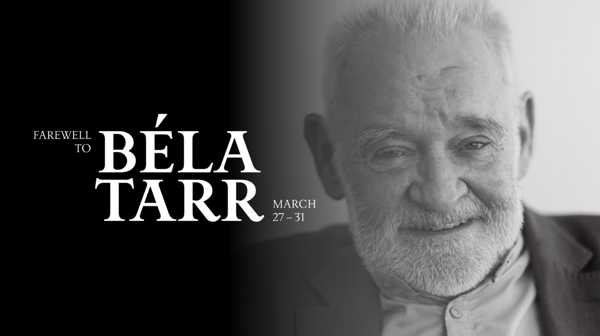
“Without light in the darkness, you cannot make movies.”
–Béla Tarr
New York, NY (February 25, 2026) – Film at Lincoln Center announces “Farewell to Béla Tarr,” a tribute to the late Hungarian filmmaker whose singular body of work stands among the most rigorous and influential in modern cinema. Presented from March 27 through March 31, the series brings together seven features, many in 2K and 4K restorations, tracing Tarr’s evolution from the bracing immediacy of his striking debut to the elemental starkness of his final work.
Few filmmakers reshaped our sense of cinematic time as radically as Béla Tarr. “Film isn’t the story,” he once said. “It’s mostly picture, sound, a lot of emotions.” Across a body of work at once severe and deeply humane, Tarr turned duration into structure, forging a cinema in which slowness and circularity exposed lives caught in unbreakable patterns. With his passing in January 2026, Film at Lincoln Center returns to a filmmaker who did not simply depict the pressures of modern life but made us inhabit them.
Tarr emerged in the late 1970s with unflinching portraits of working-class Hungary under its late Kádár era, as in Family Nest (1979) and The Outsider (1981). In the decades that followed, working in close creative partnership with editor and later co-director Ágnes Hranitzky, as well as novelist László Krasznahorkai and composer Mihály Víg, his cinema deepened in scope and intensity. Films such as Damnation (1988), Sátántangó (1994), Werckmeister Harmonies (2000), and The Man from London (2007) unfold in extended black-and-white takes, their rain-soaked towns and gathering crowds held in sustained attention as narrative momentum recedes and atmosphere gathers weight and presence—an approach carried to its austere conclusion in The Turin Horse (2011).
This March, audiences are invited to FLC’s Walter Reade Theater to encounter these major works in the space they demand, and to gather in remembrance of a filmmaker who trusted the image, the sound, and the time it takes to truly see.
Organized by Florence Almozini, Vice President of Programming, Film at Lincoln Center and Tyler Wilson Senior Programmer, Film at Lincoln Center.
Tickets will go on sale on Thursday, February 26 at 2pm, with an early access period for FLC Members beginning at noon. Tickets are $18; $15 for students, seniors (62+), and persons with disabilities; and $13 for FLC Members. See more and save with a 3+ Film Package ($16 for GP; $13 for students, seniors (62+), and persons with disabilities; and $11 for FLC Members). Learn more here.
FILMS & DESCRIPTIONS
All films will screen at the Walter Reade Theater (165 W. 65th St.)
2K Restoration
패밀리 네스트 Family Nest
Béla Tarr, 1979, Hungary, 108m
Hungarian with English subtitles
Béla Tarr’s striking debut feature, begun when he was just 22 at the Balázs Béla Studio, unfolds in the cramped confines of a Budapest apartment shared by three generations amid a national housing shortage. The overcrowding intensifies the fragile marriage between Laci, newly discharged from military service, and his wife, Irén, whose search for a home of their own becomes a daily confrontation with an unforgiving public housing bureaucracy and with Laci’s domineering father. Shot with bracing immediacy and performed largely by nonprofessional actors, Family Nest captures domestic life at a breaking point, exposing the constraints of patriarchy in all its forms and the quiet indignities of navigating a rigid state system, all rendered with a command of duration and real-time tension that would define Tarr’s later work. A Janus Films release.
Friday, March 27 at 6:15pm
Monday, March 30 at 3:30pm
2K Restoration
아웃사이더 The Outsider
Béla Tarr, 1981, Hungary, 124m
Hungarian with English subtitles
Expanding the domestic tensions explored in Family Nest, Béla Tarr’s second feature widens its focus to a drifting young violinist whose fragile ambitions buckle under economic strain and personal irresponsibility. András (András Szabó) moves between factory shifts, smoky bars, and an uneasy marriage to Kata, alienating his estranged brother and struggling to provide for a child from a previous relationship. Shot in color and shaped by handheld close-ups that press into faces and fraying tempers alike, The Outsider traces how social pressure and self-doubt converge, deepening Tarr’s portrait of lives stalled between desire and constraint. A Janus Films release.
Friday, March 27 at 8:45pm
Monday, March 30 at 8:45pm
4K Restoration
파멸 Damnation
Béla Tarr, 1988, Hungary, 116m
Hungarian with English subtitles
A key turning point in Béla Tarr’s career, the first of the director’s six collaborations with novelist László Krasznahorkai signaled a visible shift away from the vérité realism of his early features and toward the highly stylized, black-and-white otherworldliness that would become his signature. The story is a kind of desiccated film noir, focusing on the efforts of a dour loner, Karrer (Miklós Székely B.), to steal back his estranged lover—a lounge singer (Vali Kerekes) in a funereal bar named Titanik—from her debt-addled husband. Karrer lures the husband into a smuggling scheme that will force him to leave town, but these well-laid plans soon go awry, and the characters play out their doomed destiny through enveloping layers of rain, shadow, and despair. 4K restoration by the Hungarian National Film Institute – Film Archive. An Arbelos release.
Sunday, March 29 at 1:30pm
Tuesday, March 31 at 6:00pm
4K Restoration
사탄탱고 Sátántangó
Béla Tarr, 1994, Hungary/Germany/Switzerland, 439m
Hungarian with English subtitles
Béla Tarr’s international breakthrough and perhaps his defining achievement, Sátántangó adapts László Krasznahorkai’s novel into a monumental meditation on belief, manipulation, and the collapse of a rural collective in the waning days of state socialism. Structured in 12 interlocking chapters that advance and retrace one another like the steps of a tango, the film unfolds over seven and a half hours in glacial, precisely choreographed long takes. At its center is the return of the enigmatic Irimiás (played by Tarr’s longtime composer Mihály Víg), a silver-tongued schemer who promises a bright future in a new promised land while exploiting despair. By turns mordantly funny and devastating, Sátántangó transforms social decay into an epic study of repetition, hope, and the inexorable passage of time. Presented in the 4K restoration undertaken by Arbelos in collaboration with the Hungarian Filmlab. An Arbelos release.
Saturday, March 28 at 2:00pm (with one 20-minute intermission and one 30-minute intermission)
4K Restoration
베크마이스터 하모니즈 Werckmeister Harmonies
Béla Tarr, Ágnes Hranitzky, 2000, Hungary, 145m
Hungarian with English subtitles
Werckmeister Harmonies stands among the defining achievements of Béla Tarr’s late period and remains, alongside Sátántangó, one of his most widely celebrated works. Directed with Ágnes Hranitzky and adapted from a novel by László Krasznahorkai, the film unfolds as a sustained immersion in a weather-beaten provincial town unsettled by the arrival of a traveling circus bearing a colossal stuffed whale—and rumors of a shadowy “Prince.” At its center is the quietly perceptive postman János (Lars Rudolph), whose wide-eyed curiosity contrasts with the mounting paranoia around him. Composed in precisely choreographed long takes and animated by Mihály Víg’s incantatory score, the film transforms rumor and unrest into a searching meditation on harmony, disorder, and the fragility of civic life. A Janus Films release.
Sunday, March 29 at 4:00pm
Tuesday, March 31 at 8:30pm
런던에서 온 사나이 The Man from London
Béla Tarr, Ágnes Hranitzky, 2007, Hungary/Germany/France/Italy, 35mm, 137m
English, French, and Hungarian with English subtitles
In his penultimate film, Béla Tarr brings his formidable stylistic arsenal—a combination of impossibly choreographed camera moves, astonishingly precise chiaroscuro lighting, and hypnotic, wordless scenes—to bear on a Georges Simenon thriller about a railway switchman who retrieves a suitcase filled with stolen money. Adapted from Simenon’s 1934 novel and codirected by Ágnes Hranitzky, The Man from London follows the solitary operator Maloin (Miroslav Krobot), whose elevated signal tower affords him a commanding view of the docks—and an unwelcome glimpse of a murder that entangles him in a quiet spiral of guilt. What begins as a chance windfall gradually estranges him from his wife (Tilda Swinton) and daughter, even as a visiting British inspector closes in. Set amid fogbound wharves and cavernous portside interiors, the film refracts noir through Tarr’s long-take formalism, transforming crime into a study of moral isolation and the slow corrosion of certainty. A Janus Films release.
Monday, March 30 at 6:00pm
Tuesday, March 31 at 3:00pm
트로이의 말 The Turin Horse
Béla Tarr, Ágnes Hranitzky, 2011, Hungary/France/Germany/
Hungarian with English subtitles
In 1889, Friedrich Nietzsche witnessed a carriage driver beating his horse, embraced the animal, and soon after fell into the silence that marked the final decade of his life. Béla Tarr and Ágnes Hranitzky begin where that anecdote ends, turning their attention to the driver and his daughter as they endure six days of wind, labor, and dwindling light on a desolate plain. Based on a screenplay by Tarr and novelist László Krasznahorkai, the film reduces narrative to repetition: dressing, fetching water, boiling potatoes, waiting. Composed in rigorously measured long takes and photographed by Fred Kelemen in stark black-and-white, Tarr’s final feature is an elemental meditation on endurance, exhaustion, and the limits of belief. A Cinema Guild release.
Friday, March 27 at 3:00pm
Sunday, March 29 at 7:00pm
 매춘부 '포주' 부업해온 퀸즈 초등학교 교감(Bond Ng) 체포
 마이클 파인스타인, 토니 베넷 탄생 100주년 헌정 콘서트@퀸즈칼...