

줄리엣 비노쉬 회고전 'Juliette Binoche: Emotion in Motion'@메트로그라프(3/6-28)
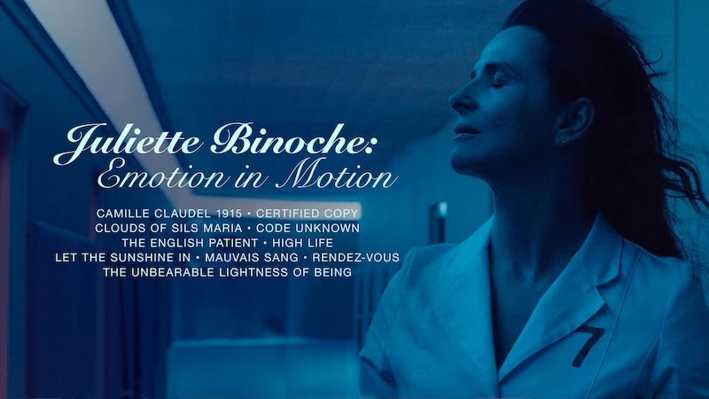
JULIETTE BINOCHE: EMOTION IN MOTION
March 6 to March 28, 2026
Metrograph In Theater
Metrograph Celebrates the Oscar-Winning European Screen Icon with a Survey of Films Spanning 40 Years of her Career as an Actor
“Binoche has constantly redefined screen femininity on her own terms.”
- The Hollywood Reporter
Juliette Binoche in Person on March 22
an image of a woman in a lab coat looking out a window
Metrograph presents Juliette Binoche: Emotion in Motion, a ten-film program celebrating the many on-screen talents of the iconic actor, beginning March 6 at Metrograph In Theater.
First achieving recognition in her native France in the mid-1980s with roles in films by Jean-Luc Godard, Jacques Doillon, André Téchiné, and Leos Carax, in the intervening years Paris-born Juliette Binoche has proven herself not only an actress of rare commitment and fearlessness, but of fierce intelligence and discrimination, consistently seeking out the most challenging and artistically ambitious collaborators available from all corners of the globe. As La Binoche visits New York to screen her first feature documentary as director, In-I In Motion, sprung from the dance and theater project she created with choreographer Akram Khan in 2007, we look back over several glorious peaks in a career that so often ascends to towering, Matterhorn-level heights.
Juliette Binoche: Emotion in Motion runs from March 6 to March 28, with select encore screenings to follow.
Titles include Camille Claudel 1915, Certified Copy, Clouds of Sils Maria, Code Unknown, The English Patient, High Life, Let the Sunshine In, Mauvais Sang, Rendez-vous, and The Unbearable Lightness of Being.
Juliette Binoche in person to introduce Let the Sunshine In on Sunday, March 22.
With the support of Villa Albertine.
#카미유 클로델 CAMILLE CLAUDEL 1915
dir. Bruno Dumont, 2013, 95 min, DCP
Binoche gives a performance of staggering emotional rawness and resolve in Dumont’s compassionate depiction of the prodigiously gifted and prodigiously gossiped-about sculptor Camille Claudel. Drawing on surviving letters and documents written by or concerning its subject, the film follows three tormented days in which she is unjustly condemned to an asylum in Provence and forbidden the tools necessary to practice her art by her dourly devout brother (Jean-Luc Vincent), following an episode in which she began to destroy her own work. “A deeply sombre, deeply affecting film… Binoche endows her role with dignity, which accumulates into a tragic grandeur.” —The Guardian
#사랑을 카피하다 CERTIFIED COPY
dir. Abbas Kiarostami, 2010, 106 min, DCP
Returning to shot-on-film narrative cinema after a decade of video experiments to make his first film outside of Iran, Kiarostami traveled to Tuscany to team with Juliette Binoche, who gives a disarmingly raw performance as an antiques dealer whose path crosses with that of an author (English opera singer William Shimell) following one of his book tour appearances—though as to if this meeting is truly a first encounter or if we are instead witnessing a couple role-playing or perhaps some sleight of chronology are but two of the mysteries central to this riveting, radiant film that delves deep into the relationship between originals and their copies.
#클라우즈 오브 실스 마리아 CLOUDS OF SILS MARIA
dir. Olivier Assayas, 2014, 124 min, DCP
Juliette Binoche and Kristen Stewart come together in perfect disharmony as a fiftysomething French actress and her twentysomething American personal assistant, cooped up together at a house in the Swiss Alps while La Binoche rehearses a return to the serious-minded stage. A meditation on the changing entertainment industry, and as such a sort-of companion piece to Assayas’s Irma Vep, the sensual and swooningly cerebral Clouds of Sils Maria functions as a reflection on both actresses’ careers, on generational schisms, and on the relationship between “pop” and “art” performance.
#미지의 코드 CODE UNKNOWN
dir. Michael Haneke, 2000, 117 min, 35mm
Ripples of ambient unease and creeping terror run through the intersecting vignettes that comprise Haneke’s French-language debut, a study in simmering rage, racial resentment, quotidian depredation, and failures of communication observed in coolly distanced, precisely choreographed long takes, with an impressive ensemble cast led by Binoche. “[Haneke] told me it’s one of his favorite films he’s made because it’s related to how citizens can betray [each other] in the small things… He could see every single thought or feeling or intention I was having while shooting.” —Juliette Binoche
#잉글리쉬 페이션트 THE ENGLISH PATIENT
dir. Anthony Minghella, 1996, 162 min, DCP
Received wisdom that Michael Ondaatje’s lauded 1992 novel was “unfilmable” was treated to a stern rebuff when Minghella’s visually and emotionally extravagant adaptation hit screens, starring Ralph Fiennes as the titular patient, in fact a Hungarian cartographer grievously wounded when caught in the crossfire of World War II, Binoche as the French Canadian nurse who becomes his caretaker and confidante, and Kristin Scott Thomas as the one our patient loved and lost, their affair recalled in extensive flashbacks threaded through the picture. “The triumph of the film lies not just in the force and the range of the performances—the crisp sweetness of Scott Thomas, say, versus the raw volatility of Binoche—but in Minghella’s creation of an intimate epic: vast landscapes mingle with the minute details of desire, and the combination is transfixing.” —The New Yorker
#하이 라이프 HIGH LIFE
dir. Claire Denis, 2018, 113 min, DCP
Science fiction as done by Claire Denis is science fiction unlike anything you’ve ever seen, a bold experiment to the outer limits of genre, where no woman has gone before. Robert Pattinson, in a performance of quiet intensity and gravitas, is first encountered living alone with an infant on a spaceship adrift in the dark of space. Flashing back from this somber, beguiling opening, Denis introduces us to the former crew of this prison ship, on which Pattinson’s stubbornly celibate Monte is among the condemned guinea pigs at the disposal of Binoche’s diabolical filicide “Dr. Dibs”—inspired, per Denis, by Medea of Greek tragedy—who busies herself with attempting to prove that a child can be conceived and born in outer space between sessions in the ship’s “fuck box.” Troublingly erotic, intensely physical, and headily philosophical, Denis’s first fully English-language film is a work of mastery and melancholy, a film following a voyage into the unknown that is itself exactly that.
#렛 더 선샤인 인 LET THE SUNSHINE IN
dir. Claire Denis, 2017, 85 min, DCP
Paris artist Juliette Binoche looks for love with a series of sweet and sour partners in Denis’s very free, disarmingly comic, and occasionally staggeringly sleazy adaptation of Roland Barthes’s unadaptable A Lover’s Discourse, a rare (and raw) depiction of female desire undiminished by middle age that watches La Binoche bouncing between married mutt Xavier Beauvois, over-the-top actor Nicolas Duvauchelle, hairdresser Paul Blain, and sweet but commitment-shy Alex Descas. “A very simple story of enormous complexity.” —Richard Brody, The New Yorker
Introduction by actor Juliette Binoche on Sunday, March 22
#나쁜 피 MAUVAIS SANG
dir. Leos Carax, 1986, 116 min, DCP
A genre-bending explosion of pure cinematic effervescence pairing Binoche and Denis Lavant, both at the beginnings of storied careers. Binoche plays the gamine mistress of a superannuated Paris gangster (Michel Piccoli), while Lavant stars as a street hustler who becomes ensorcelled of her, with his propulsive, thrashing dance/sprint set to David Bowie’s “Modern Love” surely one of the most exhilarating passages in all of French cinema. Equally indebted to the rebellious spirit of the Nouvelle Vague and the swooning romanticism of Frank Borzage, Carax’s film pits young love against venal age, with a stolen virus hanging in the balance—the relevance to the then-raging AIDS crisis is not coincidental.
#랑데부 RENDEZ-VOUS
dir. André Téchiné, 1985, 82 min, DCP
Binoche fairly exploded onto the French film scene playing a tempestuous, wildly promiscuous, and terribly vulnerable aspiring actress freshly arrived in Paris from Toulouse in this classic of amour fou co-written by a young Olivier Assayas, which earned Téchiné Best Director honors at the 1985 Cannes Film Festival and Binoche a César Award for Best Actress in a Leading Role. Conducting simultaneous liaisons with an uptight real estate agent, Paulot (Wadeck Stanczak), and his emotionally unstable roommate who makes ends meet by performing in Pigalle sex shows, Quentin (Lambert Wilson), Binoche’s Nina struggles through self-doubt and blindsiding tragedy to prepare for the performance that might very well make her name, a production of Romeo and Juliet staged by renowned theater director Jean-Louis Trintignant.
#참을 수 없는 존재의 가벼움 THE UNBEARABLE LIGHTNESS OF BEING
dir. Philip Kaufman, 1988, 172 min, DCP
Evoking the air of eager optimism that accompanied the Prague Spring thaw of 1968 and the air of disillusion and distrust that followed the Soviet crackdown in summer of the same year, Kaufman’s adaptation of Milan Kundera’s beloved novel, among other things a contemplation of the interrelation of sexual and political liberty, stars Daniel Day-Lewis, Juliette Binoche, and Lena Olin as, respectively, a womanizing brain surgeon-turned-dissident, his wife, and his bohemian mistress. An achingly honest adult drama of the sort that American studios have almost entirely ceased to invest in and the product of an extraordinary confluence of talent in front of and behind the camera, with Academy Award–winning photography by Sven Nykvist. “Binoche’s performance… is both self-aware and unself-conscious… The film swells with her excitement and engagement.” —Mark Asch, Reverse Shot
With the support of Villa Albertine
Metrograph
No. 7 Ludlow
New York City, NY 10002
https://metrograph.com/juliette-binoche
 마이클 파인스타인, 토니 베넷 탄생 100주년 헌정 콘서트@퀸즈칼...
 조수미(Sumi Jo) 세계무대 데뷔 40주년 콘서트@카네기 잰켈홀(3/21)