

양혜규 x 윤이상의 '엇갈린 랑데부'@LAMOCA-월트디즈니홀
양혜규 'Star-Crossed Rendezvous after Yun' @LAMOCA 전시(2/24-8/2)
LA필, 윤이상 더블 콘체르토 '견우와 직녀 이야기' 콘서트 @디즈니홀(3/10)
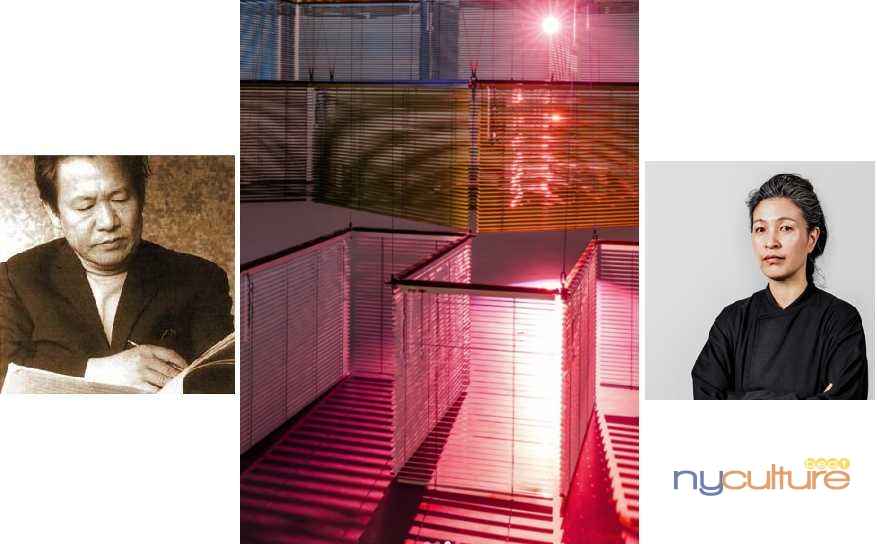
베를린을 기반으로 활동하는 아티스트 양혜규(Haegue Yang,1971- )와 1964년부터 베를린에서 활동했던 작곡가 윤이상(1917-1995)이 만난다.
LA 현대미술관(MOCA) 그랜드애브뉴에선 2월 24일부터 8월 2일까지 양혜규 개인전 '윤이상 이후 엇갈린 랑데부(Star-Crossed Rendezvous after Yun)'가 열린다.
한편, LA필하모닉은 3월 10일 월트디즈니콘서트홀에선 윤이상 작곡 '견우와 직녀 이야기'(Double Concerto for oboe, harp, and small orchestra, 1977) 콘서트를 연다. '견우와 직녀' 설화를 모티프로 오보에, 하프, 소관현악을 위한 더블 콘체르토는 남북 분단의 비극과 재회의 염원을 은하수를 건너는 연인에 비유해 표현한 작품이다. 1977년 하인츠 홀리거(Heinz Holliger, 오보에)와 부인 어술라 홀리거(Ursula Holliger, 하프)가 베를린필하모닉과 이곡을 세계 초연했으며, 이들은 KBS 교향악단과 1982년 프란시스 트래비스(Francis Travis) 지휘로, 2007년엔 구자범 지휘로 협연했다. 디즈니홀 콘서트는 무료이나, 이미 매진됐다.
디즈니홀 콘서트는 얼 리(Earl Lee)의 지휘로, LA필 뉴뮤직그룹, 에마누엘 세이손(Emmanuel Ceysson, harp), 라이언 로버츠(Ryan Roberts, oboe)가 연주하며, 양혜규 작가가 조명 서곡을 맡는다.
양혜규의 'Star-Crossed Rendezvous after Yun'은 '견우와 직녀'에서 영감을 받아 제작한 블라인드 설치작이다. 윤이상의 한국 설화 기반으로 동서양을 잇는 음악적 시도를 양혜규는 블라인드의 상승/하강, 빛과 그림자의 조화로 시각화하여 분단과 망명의 한을 재조명한다. 양혜규 작가는 지난 10년간 20세기 식민주의, 냉전시대를 망명작가로 살아간 국제적, 디아스포라적 인물로 예술적인 진화를 이룬 선구적인 아방가르드 작곡가 윤이상을 연구해왔다.
이 두 이벤트에 앞서서 지난해 11월 22일 MoCA 그랜드애브뉴에선 음악학자, 작곡가, 역사학자들이 참가해 '운명의 만남: 윤이상의 음악적 유산'을 주제로 심포지엄이 열렸다. 이 전시는 MOCA의 부큐레이터 폴라 크롤(Paula Kroll)과 수석 큐레이터 클라라 김(Clara Kim)이 공동으로 기획했다.
Haegue Yang: Star-Crossed Rendezvous after Yun
February 24, 2026 - August 2, 2026
MOCA Grand Avenue, Los Angeles
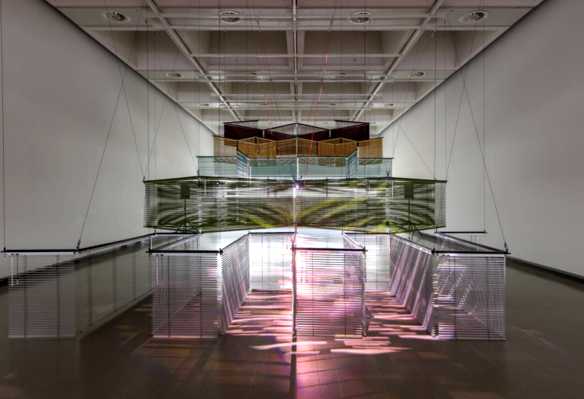
Haegue Yang, Star-Crossed Rendezvous after Yun, 2024, aluminum venetian blinds, powder-coated aluminum hanging structure, steel wire rope, moving spotlights, DMX controller, speaker, tripod. 400 x 530 x 1274 cm. Courtesy of the artist. Installation view of Leap Year, Hayward Gallery, London, United Kingdom, 2024. Photo by Mark Blower.
A unique collaboration between MOCA and the Los Angeles Philharmonic, this presentation brings together the work of the internationally acclaimed visual artist Haegue Yang (b. 1971, Seoul) and her interest in and engagement with the experimental composer Isang Yun (1917-1995). Yang is celebrated for her distinctive abstract visual language, often articulated through structures made of venetian blinds and accompanied by choreographed sequences of light and movement that create heightened sensory experiences.
Over the last decade, she has devoted herself to extensive archival and artistic research on the musical legacy and political inheritance of Isang Yun, a pioneering avant-garde composer whose artistic evolution as a transnational, diasporic figure unfolded amid the major political upheavals of the twentieth century. The sprawling installation Star-Crossed Rendezvous after Yun (2024) marks a major breakthrough in this sustained engagement. The institutional collaboration unfolds over two distinct presentations: an exhibition featuring aStar-Crossed Rendezvous after Yun (2024) at MOCA Grand Avenue, for its U.S. debut; and a concert at the Walt Disney Concert Hall for a special one evening performance of Yun’s Double Concerto (1977) by the LA Philharmonic on March 10, 2026. This project bridges two distinguished cultural organizations and their unique architectural sites, connecting them through time and space in an immersive sonic and visual experience.
Prior to this special joint presentation, Yang and MOCA organized a day-long symposium Star-Crossed Rendezvous: The Musical Legacy of Isang Yun, gathering leading musicologists, composers and historians on November 22, 2025 at the Ahmanson Auditorium in MOCA Grand Avenue. This event marks the first academic convening devoted to Yun in North America, a testament to his overlooked status outside of German and Korean academic circles.
Haegue Yang: Star-Crossed Rendezvous is organized by Paula Kroll, Assistant Curator, with Clara Kim, Chief Curator & Director of Curatorial Affairs, The Museum of Contemporary Art, Los Angeles.
THE MUSEUM OF CONTEMPORARY ART
About MOCA: Founded in 1979, MOCA is the defining museum of contemporary art. In a relatively short period of time, MOCA has achieved astonishing growth; a world-class collection of nearly 8,000 objects, international in scope with deep holdings in Los Angeles art; hallmark education programs that are widely emulated; award-winning publications that present original scholarship; groundbreaking monographic, touring, and thematic exhibitions of international repute that survey the art of our time; and cutting-edge engagement with modes of new media production. MOCA is a not-for-profit institution that relies on a variety of funding sources for its activities.
*뮤지엄의 한인 작가들 (4)양혜규(Haegue Yang)의 '살림(Sallim)'@MoMA, 2015
*양혜규, 박가희, 바바라 크루거 등 JFK 공항 제 6터미널 공공미술 작가 18인 선정, 2024
Star-Crossed Rendezvous
Tue / Mar 10, 2026 - 8PM
WALT DISNEY CONCERT HALL
PROGRAM
Iang YUN:
Double Concerto for oboe, harp, and small orchestra, 1977, 34min.
ARTISTS
LA Phil New Music Group
Earl Lee, conductor
Haegue Yang, lighting prelude
Emmanuel Ceysson, harp
Ryan Roberts, oboe
Double Concerto for oboe, harp, and small orchestra
Isang YUN
The Double Concerto is part of the series of concertante works which the composer started in 1972 with the Konzertante Figuren. In the Double Concerto, Yun goes back to a Korean fairy tale: The harping princess falls in love with the shawm-playing cowherd. The king, annoyed about a choice which is at discord with her social class, bans both of them as stars to the opposite ends of the Galaxy. As an only favour, they are allowed to meet once a year, on July 7, in the middle of the Galaxy. The form corresponds to the narrated subject and follows principles of succession rather than of development. According to European form categories, the piece evolves the principle of several movements in a one-movement form, like Franz Liszt in his symphonic poems. It could be characterized like this: A rather vivid first movement is followed by a slow movement that merges into the fast third movement. It opens out to a solo cadenza of the harp which, however, does not yet sign the end of the composition, because additionally a “Duo” of the solo instruments is inserted into the third movement.
The first part can roughly be divided into two sections (which are themselves organized in two parts) and starts with the presentation of the court. The introduction chord of the brasses is not only meant as an opening but also aims at the inhumane severity of the Royal court or the society. The harp belongs to the sphere of the court, and the oboe answers “von fern” (from far). This process of the first meeting is repeated in a more intense form—and this time, the oboe answers from “nah” (near). In the following part, the active wooing of the oboe dominates, being answered in the first phase mainly by strings and woodwind, in the second by the harp.
The two-piece slow movement, a solo episode, expresses the joyous encounter of the lovers. Here, the solo instruments are accompanied by the orchestra oboe in an agitated first phase, and by the violoncello and the percussion section in the second. These accompanists are, as the composer says, “sympathisers of the Court,” among which the orchestra oboe symbolizes the bird, Phoenix.
The following Tutti drifts jubilantly towards the harp cadenza. Strings and woodwind “paint” the flight of the magpies that escort the loving couple, while the admonishing objections of the brass cannot prevail. During an orchestra intermezzo, which on the whole is turbulent, the brasses are supposed to remind us of the fact that the lovers will have to part. The “Duo,” this time in the sequence calm–agitated, presents the farewell scene. A connecting intermezzo drives towards the end that is marked by the return of the introductory chord of the brasses.
The subject matter of the composition relates to the real phenomenon of the moult: In Korea there aren’t hardly any magpies to be seen on the days before July 7, and when they come back after the seventh, they have lost their feathers. On this occasion, children are told the fairy tale of the stars: The magpies were on their way to unite the lovers and lost a few feathers at this hard labour. Choosing this subject, Isang Yun means to express more than just this story: He wants to remind us of the division of Korea in 1945, decided by foreign powers. The sky grants the favour of reunification at least once a year, whereas the negotiations in Korea have remained without success until now.
— Walter-Wolfgang Sparrer (translated by Frank Heibert)
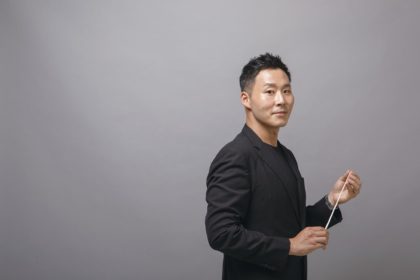
Earl Lee
Winner of the 2022 Sir Georg Solti Conducting Award, Korean-Canadian conductor Earl Lee has emerged as one of the most compelling and versatile artists of his generation. He has led many of the world’s foremost orchestras, including the New York Philharmonic, Boston Symphony Orchestra, San Francisco Symphony, Pittsburgh Symphony Orchestra, Toronto Symphony Orchestra, Atlanta Symphony Orchestra, and the Seoul Philharmonic Orchestra. In August 2025, Lee stepped in on short notice to replace Zubin Mehta in the Boston Symphony Orchestra’s performance of Beethoven’s Symphony No. 9 at Tanglewood, where The Boston Globe praised his interpretation as “an unhurried, momentous ritual...the finale nothing short of spectacular.”
In the 2025–26 season, Lee’s engagements include return appearances with the Toronto Symphony Orchestra, Boston Symphony Orchestra, and Calgary Philharmonic Orchestra, as well as debuts with the Korean National Symphony Orchestra and the Los Angeles Philharmonic in a special project with the Museum of Contemporary Art (MOCA).
As Music Director of the Ann Arbor Symphony Orchestra, Lee has revitalized the ensemble’s artistic vision with programming that bridges tradition and innovation. His leadership blends a deep respect for the symphonic canon with a curiosity for new and diverse forms of expression, bringing a fresh sense of energy and purpose to the orchestra’s seasons. Under his direction, the Ann Arbor Symphony has presented bold repertoire alongside genre-crossing collaborations with artists such as Jacob Collier and Chris Thile, broadening the ensemble’s reach and musical scope. Beyond Ann Arbor, Lee has worked with many composers including Unsuk Chin, Tod Machover, Donghoon Shin, Katherine Balch, and Carlos Simon, conducting works by these leading voices of our time and giving world premieres of new compositions by Machover and Balch. Through these collaborations, he continues to champion music that expands the expressive range of the modern orchestra.
Lee has been mentored by Andris Nelsons, Manfred Honeck, Hugh Wolff, Peter Oundjian, Kurt Masur, and Bernard Haitink. At Masur’s invitation, he studied privately with him in Leipzig, focusing on the life and music of Felix Mendelssohn — an experience that profoundly shaped his artistic identity.
A former cellist trained at the Curtis Institute of Music, The Juilliard School, and the Marlboro Music Festival, Lee brings a chamber musician’s sense of communication, listening, and shared purpose to every performance, seeking to create music that is both unified and deeply expressive.
About this Performance
LA Phil Insight and MOCA partner to present internationally acclaimed artist Haegue Yang (Seoul, 1971) and her ongoing interest in and engagement with the late Korean composer Isang Yun (1917–1995). Yang is celebrated for her unique abstract visual language accompanied by choreographies of sensory experience. Often grounded in deep archival research, Yang’s work explores the life and musical legacy of Yun through this presentation.
The evening will be centered around Yun’s musical composition, Double Concerto for oboe, harp, and small orchestra (1977), which audiences will encounter twice. First for a special preview of Yang’s sprawling installation Star-Crossed Rendezvous after Yun (2024) in the galleries at MOCA, then for a live performance by the LA Phil New Music Group at Walt Disney Concert Hall. In doing so, Yang connects the physical sites of MOCA and LA Phil while bridging genres and histories. Activating our senses to travel across disparate places and time, the presentation will create a full body and sound journey that will unfold across the partner institutions.
Enjoy extended museum hours at MOCA Grand Avenue from 5 to 8pm for a viewing of Haegue Yang: Star-Crossed Rendezvous then head over to Walt Disney Concert Hall for the 8pm concert. Admission to both is free with RSVP. Food and drinks will be available for purchase at MOCA and Walt Disney Concert Hall.
LA Phil Insight is generously supported by Linda and David Shaheen.
Support for Star-Crossed Rendezvous is provided by the Hillenburg Family.
Please note: This event takes place at both MoCA Grand Avenue and Walt Disney Concert Hall, beginning with the installation viewing at MOCA before the 8pm performance at Walt Disney Concert Hall.
https://www.laphil.com/events/performances/4261/2026-03-10/star-crossed-rendezvous
 뉴욕 아시아 위크(AWNY, 3/19-27), 본햄스 박수근 회화 2점 경매