

KOREA Achieves EGOT
The First Non-English-Speaking Nation to Do So
*한국 EGOT (BIG 4) 국가 공인...골든(케데헌) K팝 사상 최초 그래미상 수상 <Korean version>
https://www.nyculturebeat.com/?document_srl=4175588&mid=Zoom

Rosé Opens the Grammys with “APT.” as “Golden” Wins Best Song Written for Visual Media
South Korea has become the first non-English-speaking nation to complete an unprecedented sweep of the world’s four most prestigious entertainment awards—often described as the global “EGOT”: the Academy Awards (Oscar), Emmy Awards, Tony Awards, and Grammy Awards.
This historic milestone was finalized at the 68th Grammy Awards, held on February 1, 2026, at the Crypto.com Arena in Los Angeles, when the K-pop track “Golden” from the animated film K-Pop Demon Hunters won Best Song Written for Visual Media.
The achievement completes a remarkable cultural arc:
-
Academy Awards (Oscar, 2020): Bong Joon-ho’s Parasite won four Oscars, including Best Picture, famously breaking the “one-inch barrier” of subtitles.
-
Emmy Awards (2022): Hwang Dong-hyuk’s Squid Game demonstrated the global power of Korean television storytelling.
-
Tony Awards (2025): Maybe Happy Ending captured six Tony Awards, including Best Musical, affirming the international viability of K-musicals.
-
Grammy Awards (2026): “Golden” secured Best Song Written for Visual Media, marking K-pop’s long-awaited Grammy victory.
The Grammy ceremony itself underscored this cultural turning point. The show opened with a high-energy performance of “APT.” by Rosé of BLACKPINK and Bruno Mars, placing a K-pop artist at the very forefront of American pop’s most prestigious night.
Rosé also made history as the first K-pop solo artist nominated in major Grammy categories, including Song of the Year, Record of the Year, and Best Pop Duo/Group Performance. Although she did not take home a trophy, her presence on the Grammy main stage—and her multiple top-tier nominations—represented a decisive breakthrough for K-pop within the Recording Academy’s most competitive fields.

A historic Grammy milestone came with “Golden,” created by an international songwriting team including Ejae, Park Hong Jun (Teddy Park), Joong Gyu Kwak, Yu Han Lee, Hee Dong Nam, Jeong Hoon Seo, and Mark Sonnenblick. In addition to its Grammy win, the song received nominations in three other categories: Song of the Year, Best Pop Duo/Group Performance and Best Remixed Recording. Also the soundtrack was nominated for Best Compilation for Visual Media. The win follows the song’s success at the Golden Globe Awards and precedes its upcoming campaign for the 2026 Academy Awards.

Meanwhile, the multinational K-pop girl group KATSEYE earned a nomination for Best New Artist, though the award ultimately went to British-Jamaican singer Olivia Dean, reflecting the Grammys’ increasingly global and diverse musical landscape.
For years, the Grammy Awards were widely regarded as the final frontier for K-pop. The genre had already dominated the American Music Awards, MTV Video Music Awards, and Billboard Music Awards, yet Grammy recognition remained elusive. Even BTS—despite earning five Grammy nominations over the years, including a nod for Album of the Year as featured artists on Coldplay’s Music of the Spheres—had never secured a win.

That barrier has now been breached.
According to The New York Times, in August 2025 the Recording Academy announced that a group of artists, producers, and songwriters who have made significant contributions to K-pop had joined its voting body, including Supreme Boi, Wonderkid, Bumzu, Slow Rabbit, Huh Yunjin, Jungwon, Yeonjun, Zico, Woozi, and Vernon. The move was widely interpreted as part of a broader effort to better reflect the global realities of contemporary music.
With “Golden”’s Grammy win and Rosé’s historic nominations, the long-standing glass ceiling at the Grammys has finally cracked. South Korea has now officially completed the global “Big Four” of entertainment—Cinema, Television, Theater, and Music—becoming the first non-English-speaking nation to do so.

The final frontier remains symbolic rather than structural: a win in one of the Grammy’s four general categories—Album of the Year, Record of the Year, Song of the Year, or Best New Artist. Given the trajectory now firmly in place, that milestone feels less like a question of if than when.
<Updated, Feb. 2, 2026>
KOREA: Toward the EGOT Grand Slam (Emmy–Grammy–Oscar–Tony)
Rosé, KPop Demon Hunters, KATSEYE (K-pop)
Maybe Happy Ending (musical), Hannah Cho (opera)
*2026 그래미상 한류 열풍: 로제·'케데헌'·캣츠아이·'메이비 해피엔딩'·한나 조 후보 <Korean version>

K-pop, K-musical, and K-classical artists are shaking up the 68th Grammy Awards. Blackpink’s Rosé, Netflix’s animation KPop Demon Hunters (KPDH), the Korean-origin Broadway musical Maybe Happy Ending, and violinist Hannah Cho have all been nominated for the 2026 Grammys. Notably, K-pop artists have broken new ground by being nominated in the "Big Four" categories—Album, Record, Song, and Best New Artist—marking a milestone moment for K-culture on the global stage.
Rosé Nominated in Three Major Categories with "APT."
Blackpink’s Rosé earned nominations in three categories for "APT.", her duet with Bruno Mars: Song of the Year, Record of the Year, and Best Pop Duo/Group Performance. She is the first K-pop solo artist ever to be nominated in two of the Grammys’ Big Four categories. Earlier this year, Rosé also won Song of the Year at the MTV Video Music Awards.
"Golden" from KPop Demon Hunters Earns Four Nominations
Maggie Kang’s animated film KPop Demon Hunters also made Grammy history. Its theme song "Golden" was nominated for Song of the Year alongside Rosé’s "APT." The trio Huntrix (Ejae, Audrey Nuna, Rei Ami) earned a nod for Best Pop Duo/Group Performance.
In addition, “Golden” was nominated for Best Song Written for Visual Media and Best Remixed Recording, while the soundtrack received nods for Best Compilation Soundtrack for Visual Media —a total of five nominations.
KATSEYE Nominated for Best New Artist
The six-member girl group KATSEYE, produced by HYBE and Geffen Records, earned two nominations: Best New Artist (one of the Big Four) and Best Pop Duo/Group Performance for their single "Gabriela." With Rosé, Huntrix, and KATSEYE all competing in the same Pop Duo/Group category, three of the five nominees this year come from the K-pop sphere.
BTS’s Grammy Legacy
While BTS has not yet been nominated in the Big Four, they received three consecutive nominations for Best Pop Duo/Group Performance — with "Dynamite"(2021), "Butter"(2022), and "My Universe"(2023). They were also nominated for Album of the Year as featured artists on Coldplay’s Music of the Spheres in 2023, though not as lead artists.
The Big Four and K-pop’s Mainstream Breakthrough
The Grammys’ highest honor, Album of the Year, is awarded jointly to the artist, songwriters, and production team (producers, engineers, mixers, mastering engineers). Record of the Year goes to the performer and production team for a single track, while Song of the Year honors the songwriters of a composition. Although artists usually appear on stage to accept these awards, the credits extend to all contributors.
Last year, Beyoncé finally won her first Album of the Year trophy—her 35th Grammy overall—after two decades of nominations, a moment hailed as historic.
For Korean artists to now break into the Grammys’ Big Four symbolizes not just individual triumphs but the expanding cultural influence of K-pop. Major U.S. music awards have already recognized the genre: MTV’s Video Music Awards introduced Best K-Pop in 2019; the American Music Awards launched Favorite K-Pop Artist in 2022; and the Billboard Music Awards began honoring Top Global K-Pop Artist, Top K-Pop Album, Top Global K-Pop Song, and Top K-Pop Touring Artist in 2023. Yet it is the Grammys—where K-pop competes directly within mainstream categories—that marks a new frontier.
K-Musical Maybe Happy Ending Enters the Grammys
Following its six Tony Awards in 2025, the Korean-origin musical Maybe Happy Ending has been nominated for Best Musical Theater Album. The other nominees in this category are Buena Vista Social Club, Death Becomes Her, Gypsy, and Just in Time.
Written by Will Aronson and Hue Park, with music by Aronson, the musical first premiered in Seoul in 2016 and opened on Broadway at the Belasco Theatre in November 2024. The story of two helper robots seeking human connection, Maybe Happy Ending won six Tony Awards—including Best Musical, Book, Score, Direction, Lead Actor, and Scenic Design—and also swept six Drama Desk Awards.
Violinist Hannah Cho for Best Opera Recording
In classical music, Korean violinist Hannah Cho (조수진) was nominated for Best Opera Recording for Huang Ruo: The American Soldier. The work was composed by Chinese-born American composer Huang Ruo and produced by the American Composers Orchestra with playwright David Henry Hwang, conducted by Carolyn Kuan.
The recording features Hannah Cho alongside Alex DeSocio, Nina Yoshida Nelsen, Brian Vu, Adam Abeshouse, Silas Brown, and Doron Schachter. Cho became the first Korean violinist to join the Vienna Philharmonic in 2024, after graduating from Juilliard and Manhattan School of Music and training at the Vienna Philharmonic Academy.
Korean classical musicians have previously excelled at the Grammys: violist Richard Yongjae O’Neill won Best Classical Instrumental Solo in 2021, and violinist Jennifer Koh won the same category in 2022.
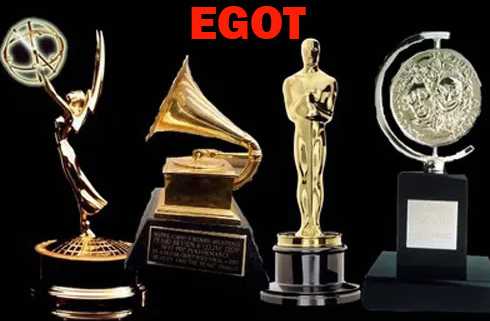
Toward Korea’s EGOT Moment
In the United States, artists who have won all four major awards—Emmy (TV), Grammy (Music), Oscar (Film), and Tony (Theater/Musical)—are known as EGOT winners. Notable members include Audrey Hepburn, Liza Minnelli, Barbra Streisand, Elton John, Andrew Lloyd Webber, and John Legend.
After Bong Joon-ho’s Parasite swept four Oscars in 2020, Hwang Dong-hyuk’s Squid Game won Best Directing and Best Actor at the 2022 Emmys, and Maybe Happy Ending captured six Tony Awards in 2025. Now, if a Korean artist takes home a Grammy, South Korea could become the first non-English-speaking country to achieve national EGOT status—a triumph not only of individuals but of a nation powered by K-culture.
The 68th Annual Grammy Awards, where a new chapter in K-pop and the Korean Wave is expected to unfold, will be held on February 1, 2026, at the Crypto.com Arena in Los Angeles.
*33 Keys to Understanding the Korean Wave: Beyond BTS, Parasite and Squid Game
https://www.nyculturebeat.com/?mid=Focus&document_srl=4165053