

클로이스터뮤지엄 '욕망의 스펙트럼(Spectrum of Desire: Love, Sex, and Gender in the Middle Ages, 10/17-3/29, 2026)'
Spectrum of Desire: Love, Sex, and Gender in the Middle Ages
철학자 아리스토텔레스의 굴욕과 필리스의 유혹...
October 17, 2025 – March 29, 2026
The Met Cloisters, 99 Margaret Corbin Drive, NYC
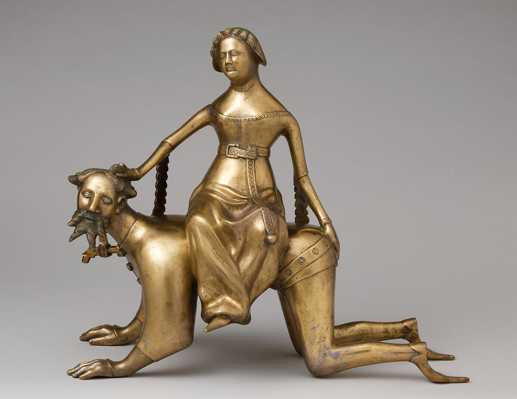
Aquamanile in the Form of Aristotle and Phyllis, late 14th or early 15th century, South Netherlandish, Bronze; Quaternary copper alloy
(아쿠아마닐은 중세 시대 손 씻을 때 사용한 청동 기구. 아름다운 여인 필리스가 무릎꿇은 철학자 아리스토텔레스의 등에 올라탄 모습을 묘사하고 있다. 아리스토텔레스가 자신의 지혜를 과시했다가 굴욕당하는 중세 설화를 바탕으로 한 작품.)
Set in the stunning atmosphere of The Met Cloisters, this exhibition explores the often-overlooked themes of desire, sexuality, and gender in the medieval past, a period of time when most artistic production served religious purposes.
Desire in the Middle Ages was multifaceted. It could be courtly or carnal, sacred or subversive, and expressed as a kind of longing, suffering, or joy. Medieval artists could be both deeply serious and comical in their evocations of these feelings. Drawing on decades of scholarship, Spectrum of Desire opens up new ways of seeing the past through stirring works of art that inspire us to think more expansively about people who lived in the Middle Ages, their relationships, and the artworks they produced.
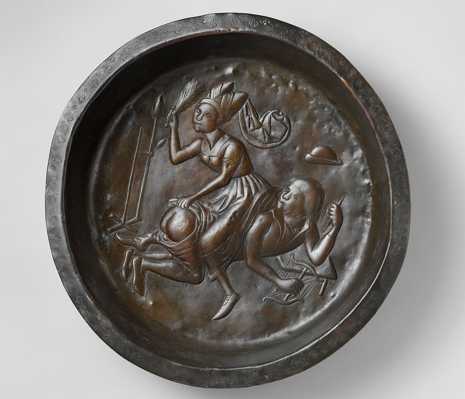
Plate with Wife Beating Husband, ca. 1480, Netherlandish, Copper alloy, wrought (남편의 엉덩이를 두드려패는 아낙네)
Featuring more than fifty works—from gold jewelry and ivory sculptures to stained glass, illuminated manuscripts, and woven textiles—this exhibition showcases the richness of visual expression in western Europe from the 13th to the 15th century, drawing primarily from The Met collection. This exploration of the visual language of desire in its many forms invites us to reflect on our own ideas of love, identity, and kinship today.
The exhibition is made possible by the Michel David-Weill Fund and Kathryn A. Ploss.
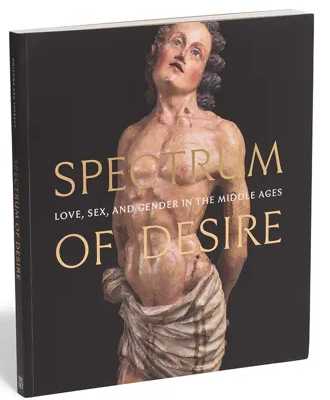
This pioneering volume explores concepts of gender, sexuality, and love as portrayed in sculptures, paintings, manuscripts, and personal items to reveal the hidden sexuality and sensuality of medieval art. Using the critical approach known as queer theory, which offers a way to think more expansively about the past, the book interrogates aspects art and culture of the Middle Ages that are often overlooked, such as nonconformist sexual practices, gender variance, and power plays within human and divine relationships. Focused essays on topics and motifs such as the erotics of Saint Sebastian, transgender expression, and the underside of courtly love propose new readings of beloved masterpieces. Featuring more than 40 works of art from the fourteenth to the sixteenth century, this volume not only encourages readers to reflect on the ways that sex, gender, and relationships structured medieval lives and identities, but also prompts contemplation of how such attitudes affect our understanding of these subjects in the present day.
Melanie Holcomb is Curator and Manager of Collection Strategy, in the Department of Medieval Art and The Cloisters at The Metropolitan Museum of Art.
Nancy Thebaut is Associate Professor in the Department of History of Art at St. Catherine's College in the University of Oxford.
 전소정 작가 '구미호' 공연(I Do Nine-Tailed Fox)@아시아소사이...
 메트오페라: 스팅(Sting) 작곡, 극본, 주연 뮤지컬 '마지막 배(Th...