

'KPop Demon Hunters' and the Spirit of Bibimbap
A Symphony of Flavors
Bibimbap Philosophy in KPop Demon Hunters
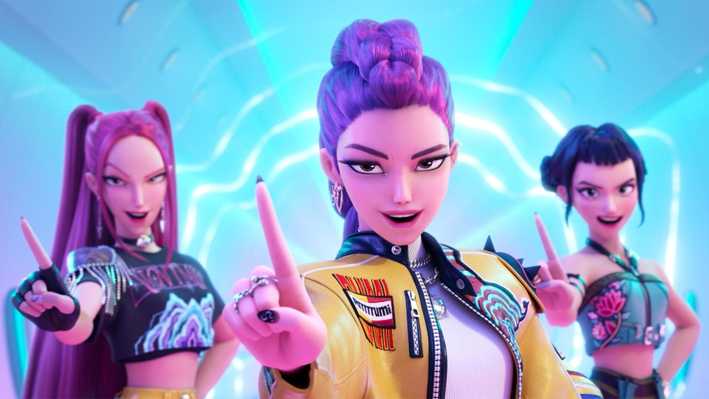
KPop Demon Hunters, Netflix
“We mix and eat together, enjoying individual flavors and harmonious tastes.
It’s like the difference between a solo and a symphony in music.
Bibimbap is a ‘Symphony of Flavors.’”
— Lee O-young (1934–2022), former Minister of Culture
The Korean Wave has always been about balance amid diversity — a harmony of contrasts. From Bong Joon-ho’s Parasite and Hwang Dong-hyuk’s Squid Game to BTS and chef David Chang, Korea’s global creatives excel at blending the traditional with the modern, the local with the universal.
Netflix’s animated blockbuster KPop Demon Hunters (케이팝 데몬 헌터스, “케데헌”) is the latest embodiment of this spirit — the “Spirit of Bibimbap.” Like the iconic Korean dish that mixes vivid ingredients into one harmonious meal, the film fuses K-pop, shamanism, mythology, and contemporary storytelling into a dazzling cultural symphony.
A Cultural Bibimbap: Mixing Genres, Myths, and Melodies
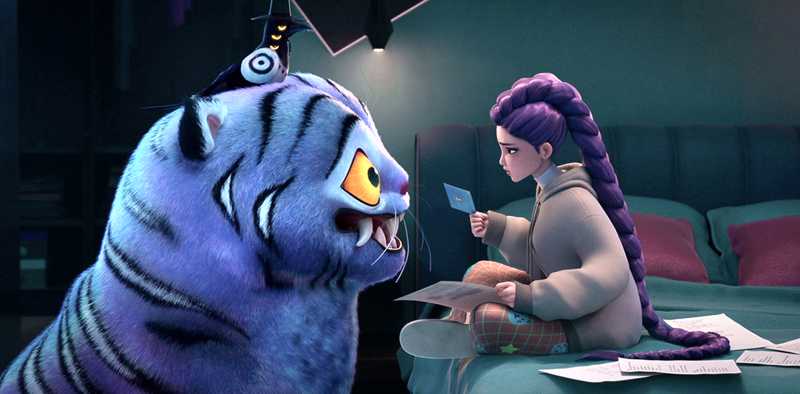
KPop Demon Hunters, Netflix
Co-directed by Maggie Kang, a Korean-Canadian filmmaker, KPDH blends animation, fantasy, musical, action, and meta-comedy into a kaleidoscopic experience. By day, Huntr/x dazzles fans on stage as a K-pop girl group; by night, they battle supernatural demons threatening Seoul. Their rival, the Saja Boys, introduces competition and humor, while the character Jin-u is modeled after actor-singer Cha Eun-woo.
Beyond a typical hero’s journey, the film celebrates cultural coexistence and fusion: traditional hanbok-inspired costumes, norigae pendants, and gat hats seamlessly mingle with EDM beats, feminist storytelling, and street-savvy choreography by BLACKPINK’s choreographer LEEJUNG. Folk art motifs like the magpie-and-tiger (jak-hodo) appear alongside shamanistic symbols, all reimagined through the lens of pop culture.
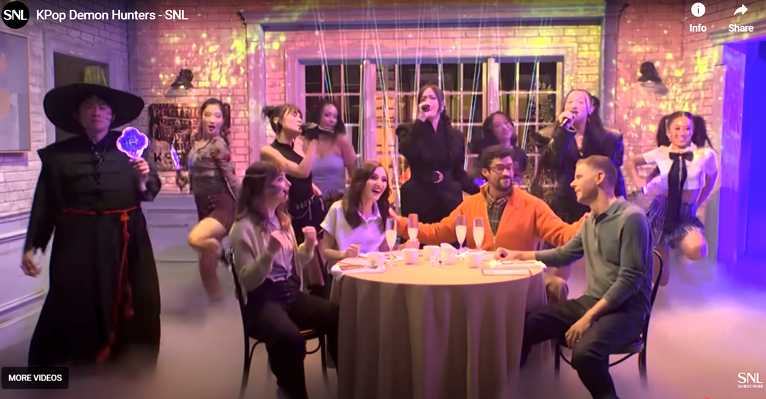
KPop Demon Hunters - SNL
Produced by Teddy Park (BLACKPINK), the soundtrack is a kaleidoscope of K-pop sounds — from trap and hyperpop to orchestral ballads — reflecting the genre’s astonishing diversity. Like bibimbap, each musical element retains its own flavor while contributing to a harmonious whole.
K-Pop’s genre fluidity has always been one of its defining strengths — and KPop Demon Hunters extends that sensibility to film. The movie targets not only children but also adults, weaving humor, heart, and self-awareness that transcend age groups. A recent Saturday Night Live skit featuring Bad Bunny poked fun at the cultural ubiquity of K-pop, reflecting how the genre — and by extension, Korean creativity — has entered mainstream Western consciousness.
Much like bibimbap, each element retains its own flavor while contributing to a unified whole. The film’s world feels at once ancient and futuristic — and unmistakably Korean.
Not Just for Kids — Pop Satire for All Generations
KPop Demon Hunters - SNL
Saturday Night Live parody with Bad Bunny shows KPDH’s cross-generational appeal. While family-friendly in presentation, KPop Demon Hunters resonates deeply with adult viewers. Beneath its high-gloss surface lie reflections on celebrity worship, digital fatigue, and the cost of perfection, themes adults recognize all too well.
It’s no surprise that SNL’s viral Bad Bunny × Huntr/x parody turned the film into a cultural meme. The movie invites both laughter and reflection, it proves that animation can bridge generations, cultures, and emotions — much like a bowl of bibimbap shared at one table.
From Streaming Screens to Billboard Glory

KPop Demon Hunters, Netflix
Huntr/x’s “Golden” tops the Billboard Hot 100 for 8 consecutive weeks. The Spirit of Bibimbap didn’t just flavor the story — it spilled into the real world.
-Netflix: KPDH is now Netflix’s most-viewed film of all time, reaching 325.1 million views in 91 days and holding a Top 10 spot for 15 consecutive weeks.
-Billboard 200: The OST reached No. 1, after debuting at No. 8 and spending seven weeks at No. 2 — a feat achieved by only six other animated films in Billboard history (Encanto, Frozen I & II, The Lion King, etc.).
-Billboard Hot 100: Huntr/x’s breakout anthem “Golden” has now spent eight consecutive weeks at No. 1, making it the longest-running soundtrack No. 1 single in over a decade. Four of the film’s songs are currently in the Hot 100 Top 10 — a record-breaking moment for any animated film, animated or otherwise.
Even though Huntr/x exists only on screen, they have joined the pantheon of real-world chart-toppers — the first fictional female group to do so since Destiny’s Child nearly 25 years ago.
Bibimbap, K-Pop, and the Art of Coexistence
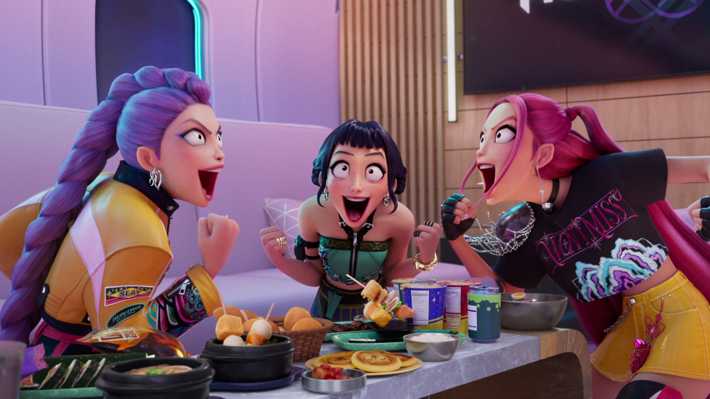
KPop Demon Hunters, Netflix
Bibimbap is both a dish and a philosophy — a metaphor for harmony in diversity. It’s a bowl that embraces difference:
-Five colors, five flavors, one unity
-Individual voices, collective harmony
-Spice and sweetness in the same spoon
KPop Demon Hunters brings this philosophy to life: a cinematic bibimbap, a “Symphony of Flavors,” where K-pop, K-fashion, K-food, and K-art blend into a coherent, joyous whole celebrating multiplicity rather than uniformity. True harmony, the film shows, does not erase individuality — it mixes it beautifully.
From Bibimbap to Netflix’s global screens, from gochujang to “Golden”, KPop Demon Hunters demonstrates how the Spirit of Bibimbap continues to shape the Korean Wave — not as a static tradition, but as a living metaphor for creativity and coexistence.
It is both a love letter to K-pop and a testament to Korea’s genius for synthesis — mixing high and low culture, old and new, East and West — until the result sings in unison. In the end, KPop Demon Hunters is more than an animated blockbuster. It is, like the best of Korean culture itself, a symphony of flavors — from bibimbap to Billboard.
https://www.netflix.com/title/81498621
*'K팝 데몬 헌터스' OST 앨범 빌보드 200 1위...애니메이션 영화 사상 7번째
*K-Culture Panorama: Netflix Hit Animated Film ‘KPop Demon Hunters’
33 Keys to Understanding the Korean Wave:
Beyond BTS, Parasite and Squid Game
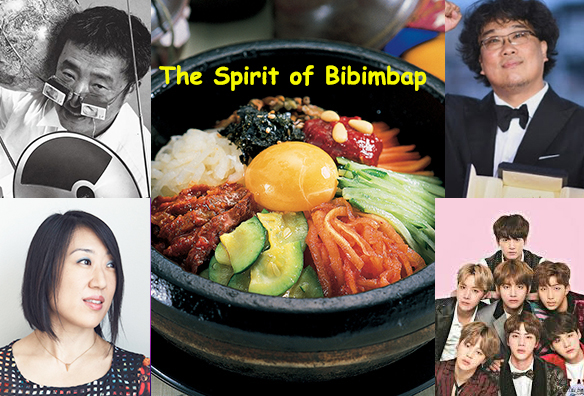
#1 The Spirit of Bibimbap
The secret of K-Wave's success, including K-Pop, "Parasite", "Squid Game", Ik-Joong Kang (artist), Young Jean Lee (the first Asian female playwright in Broadway), Unsuk Chin (composer), Jennifer Koh (violinist) and David Chang (chef), probably originated from the blending of Korean bibimbap. Koreans are good at genre bending. Nam June Paik, "The Pioneer of Video Art," praised Korea's bibimbap spirit a long time ago.
https://www.nyculturebeat.com/?mid=Focus&document_srl=4165053