

독일 추상화가 게르하르트 리히터 회고전 'Gerhard Richter: Exposure'@파리 루이뷔통재단(10.17-2/3, 2026)
Gerhard Richter
Exposure
From 17.10.2025 to 02.03.2026
Fondation Louis Vuitton, Paris
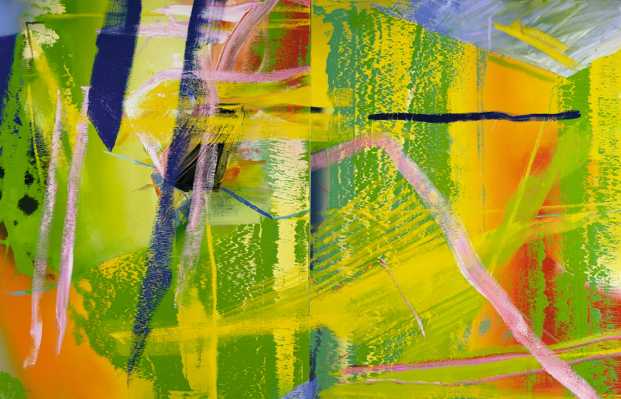
Gerhard Richter, Lilak, 1982 (CR 494), © Gerhard Richter 2025 | Photo credit: © Primae / Louis Bourjac | Oil on canvas, 2 panels, 2 parts 260 x 200 cm each | Fondation Louis Vuitton, Paris
From October 17, 2025 to March 2, 2026, the Foundation presents a retrospective of the work of Gerhard Richter, a German painter born in Dresden in 1932 who fled to Düsseldorf in 1961 before settling in Cologne, where he still lives and works today.
Continuing its monographic exhibitions devoted to major figures in 20th and 21st century art—such as Jean-Michel Basquiat, Joan Mitchell, Mark Rothko, and David Hockney, among others—the Foundation is dedicating all of its spaces to Gerhard Richter, considered one of the most important artists of his generation and enjoying international recognition.
Presented at the Foundation's opening in 2014 with a collection of works from his collection, Gerhard Richter is the subject of a retrospective unprecedented in its scope and temporality, bringing together 275 works from 1962 to 2024—oil paintings, steel and glass sculptures, pencil and ink drawings, watercolors, and painted photographs. For the first time, an exhibition offers a comprehensive panorama spanning sixty years of creation in the practice of a studio painter.
Gerhard Richter has always been interested in both the subject and the language of painting itself, a veritable field of experimentation whose boundaries he has constantly pushed, thus escaping any single categorization. His training at the Dresden Academy of Fine Arts led him to engage with the historical genres of still life, portraiture, landscape, and history painting, and his desire to offer a contemporary interpretation of these is at the heart of the exhibition. Whatever the subject, Richter never paints directly from nature, nor from the scene in front of him: everything is filtered through another medium, such as a photograph or a drawing, from which he creates an independent and autonomous image. Over the years, Richter has explored the genres and techniques of the pictorial medium, developing different ways of applying color to the canvas: with a brush, a palette knife, or a scraper.
This exhibition brings together many of Richter's major works up to his decision in 2017 to stop painting, while continuing to draw. Each section of the exhibition, arranged chronologically, covers approximately a decade and shows the evolution of a singular pictorial vision, between ruptures and continuities, from his early paintings from photographs to his latest abstractions.
THE EXHIBITION ROUTE BY THE CURATORS
Gallery 1: 1962-1970 — Painting from photographs. Photography as a source of imagery.
From the very beginning, Richter's choice of subjects was complex: on the one hand, seemingly banal images from newspapers and magazines, such as the work Richter considered his "number 1," a 1962 image of a table taken from an Italian design magazine and partially erased ( Tisch ), family portraits that referred to his own past ( Onkel Rudi , Aunt Marianne), as well as to the shadows of German history ( Bombers ). Already in the mid-1960s, Richter questioned the illusionist conventions of painting in his sculpture Four Glass Panels and the first Color Charts . With the Cities , he proposed a pseudo-expressionist impasto painting ; with the Landscapes and Seascapes, it was a further attempt to use a classical genre against the grain.
Gallery 2: 1971-1975 — Questioning representation.
The 48 Portraits , painted for the 1972 Venice Biennale, a true tour de force, opened a new chapter: application of the process of drips ( Vermalungen ), progressive stages of the copying and dissolution of an Annunciation by Titian, random distribution of colors in the large Color Charts , and negation of representation and expression in the Gray Paintings .
Gallery 4: 1976-1986 — Exploring abstraction.
During this decade, Richter laid the foundations for his distinctive approach to abstraction: he depicted and enlarged watercolor studies, examined the surface of a painting, and made the brushstroke itself the subject of a work ( Strich ). At the same time, he painted the first portraits of his daughter, Betty , and continued his exploration of landscape and still life.
Gallery 5: 1987-1995 — “The Dark Decade.”
Moved by a deeply skeptical view of artistic and social change, Richter painted the series October 18, 1977 , on exceptional loan from MoMA, the only group of works that explicitly refers to recent German history at the time. He also created some of his most impressive and somber abstractions. Returning to his earlier family paintings, Richter created the sequence Sabine mit Kind.
Galleries 7 and 9: 1996-2009 — New Perspectives in Painting: Chance.
At the end of the 1990s, he entered a very productive period that led him from small-scale figurative and abstract paintings to the severe Silikat , to experiments with chance that resulted in 4900 Colors , and to the serene Cage paintings , in homage to the great composer.
Galleries 9 and 10: 2009-2017 — Latest paintings.
Richter surprised his audience by abandoning painting for several years and experimenting with works on glass as well as digitally produced images of the Strip . He returned to painting with Birkenau , a group of works inspired by four photographs taken at a Nazi extermination camp. The final room features his last masterful abstract canvases, completed in 2017, after which Richter focused on drawings exhibited in Gallery 11.
Sculpture will be present at key moments along the exhibition, and three rooms dedicated to watercolors, drawings, and overpainted photographs will offer an interlude and a change of pace in the 1970s and 1990s, while illustrating the artist's concerns since he stopped painting in 2017.
https://www.fondationlouisvuitton.fr
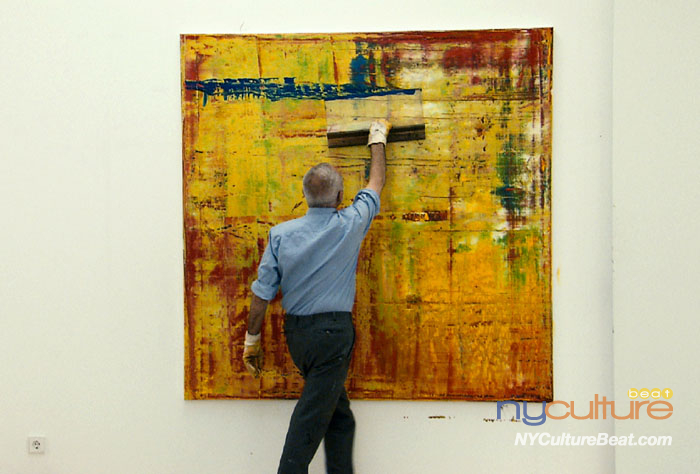
*현존 최고화가 리히터가 그리는 법, GERHARD RICHTER 'PAINTING'
https://www.nyculturebeat.com/?document_srl=63033&mid=Art2
 비엔나 조각가 발리 비젤티어 회고전 'Vally Wieselthier: Sculpt...
 독일 표현주의 다리파(Die Brücke) 화가 에리히 헥켈(Erich Hecke...