

필라델피아에 조각가 알렉산더 칼더 정원 'Calder Gardens' 오픈(9/21)
CALDER GARDENS WILL OPEN TO THE PUBLIC ON SUNDAY, SEPTEMBER 21
INAUGURAL ARTISTS’ PARADE CONCEIVED BY ACCLAIMED ARTIST, COMPOSER AND MUSICIAN ARTO LINDSAY,
TO TAKE PLACE SATURDAY, SEPTEMBER 20, NOON TO 2 PM
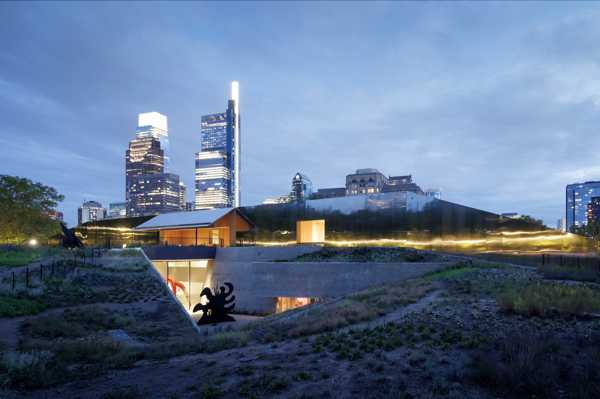
Calder Gardens, 2025. Photograph by Iwan Baan. © 2025 Calder Foundation, New York / Artists Rights Society (ARS), New York
PHILADELPHIA, PA, September 15, 2025—Calder Gardens, a new cultural destination dedicated to the art of Alexander Calder, will open to the public on September 21, 2025. Located on the Benjamin Franklin Parkway between 21st and 22nd Streets, the 1.8-acre site was designed to immerse visitors in a space that catalyzes reflection and renewal, highlighting the interplay between art, architecture, and landscape—an open invitation to interpretation and discovery.
Calder Gardens’ milestone opening moment will be preceded on Saturday, September 20, by Chaos and Kisses: A Grand Opening Parade for Calder Gardens, a free public parade conceived by acclaimed artist, composer, and musician Arto Lindsay and organized by Juana Berrío, Marsha Perelman Senior Director of Programs at Calder Gardens.
Calder Gardens is a unique collaboration between the Calder Foundation, which is providing the curatorial vision, and the Barnes Foundation, which is providing administrative and operational support through an innovative resource-sharing model. The site’s gardens and meadows, featuring native and perennial species, were created by renowned Dutch landscape designer Piet Oudolf. The building—a gently curved structure with a softly shimmering metal-clad north facade and an understated wood south facade reminiscent of Calder’s own bohemian home in Connecticut—was designed by Pritzker Prize–winning firm Herzog & de Meuron. In this setting where architecture and nature commune, visitors will find a wide range of works by Calder both inside and outside. The artworks on display will change over time and include rarely seen masterpieces, some on public view for the first time.
Beginning on Sunday, September 21, Calder Gardens will be open to the public Wednesday–Monday from 11 am to 5 pm. Memberships and tickets are now available at caldergardens.org. Memberships start at $98 annually, providing benefits such as unlimited free admission to Calder Gardens and the Barnes Foundation, exclusive morning access from 10 am to 11 am, guest passes, and discounts at the Calder Gardens Shop. General admission tickets are $18 for adults, $16 for seniors, $5 for college students (with valid ID) and youth (13–18), and free for children 12 and under.
Calder Gardens has received a broad range of generous support and significant underwriting from many dedicated individuals, foundations, and corporations, as well as the Commonwealth of Pennsylvania and the City of Philadelphia.
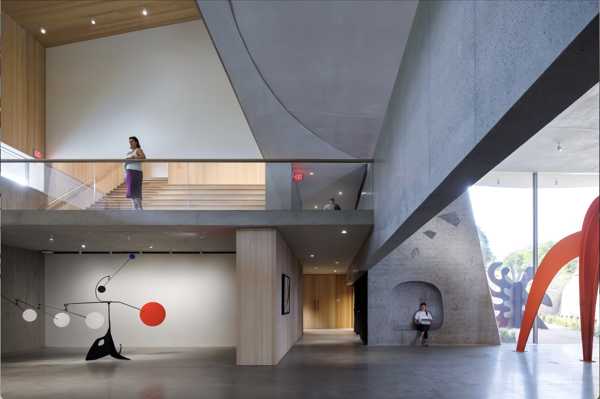
Calder Gardens, 2025. Photograph by Iwan Baan. © 2025 Calder Foundation, New York / Artists Rights Society (ARS), New York
“Calder Gardens is an extraordinary space, and in joining the other cultural treasures along the Parkway—including the Barnes, the Rodin Museum, and the Philadelphia Museum of Art—it will further solidify Philadelphia’s position as one of the world’s most exciting cities in which to experience, and be transformed by, art,” says Marsha Perelman, President of the Trustees of Calder Gardens.
In a departure from the traditional museum approach, wherein didactic information is presented alongside works on view, Calder’s mobiles, stabiles, paintings, and drawings will be presented without labels that provide titles, dates, and texts explaining how best to understand and interpret them. By allowing the artworks to speak for themselves, Calder Gardens proposes an open-ended experience that encourages visitors to take their time and react to Calder’s art in their own way and at their own pace.
“On the surface, my grandfather pushed beyond established norms by collapsing mass and setting sculpture in motion,” says Alexander S. C. Rower, President of the Calder Foundation and grandson of the artist. “But on a deeper level, he explored how art can be experienced in a perpetual present—one that is always unfolding. Calder Gardens does not so much present a story as it offers an opportunity to activate this challenging notion. The architecture and gardens invite us to direct our own journey, to interpret what we see in a uniquely personal way, to use our hearts more than our heads. This is a site for reflection, introspection, and discovery.”
“Calder Gardens is a vision born from passion, persistence, and the belief that Philadelphia deserves this cultural treasure,” says Joe Neubauer, founding board member of the Trustees of Calder Gardens and one of Calder Gardens’ greatest supporters. “In a time of global uncertainty, we came together to create a place where art and nature offer healing, inspiration, and connection—brought to life by three world-class artists: Alexander Calder, Herzog & de Meuron, and Piet Oudolf. I’m deeply proud to have helped bring this to our city for generations to come.”
“The addition of Calder Gardens to the landscape of cultural institutions in Philadelphia is incredibly valuable, and we are delighted to be opening the doors to our community and beyond,” says Thom Collins, Neubauer Family Executive Director and President of the Barnes Foundation. “A key element of the Barnes’s educational mission is to promote the appreciation of the fine arts and horticulture—while Dr. Barnes’s passion was art, his wife Laura’s was horticulture—and we view our role as operational partner of Calder Gardens as a natural extension of this important aspect of our history.”
“In this unique commission in Philadelphia—from the site, to the open brief, to our design process—I focused on space over form, leading me to explore below-grade areas and discover the defining spaces of the structure,” says Jacques Herzog. “Calder Gardens embodies a kind of ‘no-design’ architecture, allowing the works of art to express their diversity and ambiguity across numerous different spatial contexts. It’s a place where you can sit, wander, and observe, whether it’s nature or art, with the ease one has when one sits under a tree.”
“While I have admired Alexander Calder for decades, I never imagined receiving such a remarkable opportunity to engage his work directly,” says Piet Oudolf. “At Calder Gardens, I have designed a landscape that responds not only to the specific conditions of the site but to Calder’s powerful embrace of movement and change as defining elements of his art. Here in Philadelphia, Calder’s sculptures will be placed in dialogue with gardens that are constantly evolving. Those artworks and the plants I have selected and placed, will be moving in time at different speeds, in relationship to one another and the seasons, for many years to come. I look forward to watching this unfold.”
About Programming at Calder Gardens
A slate of ongoing and recurring programs designed to extend Calder’s spirit of experimentation and collaboration will activate Calder Gardens year-round. Offering experiences that are as dynamic and multifaceted as the artist’s work, these programs invite artists, cultural producers, and audiences to encounter Calder Gardens not as a static place, but as a living space for exchange, reflection, and transformation. Programs will include commissioned self-guided audio walks by noted cultural figures, sound- and movement-based performances, listening sessions, film screenings and readings, community-centered events, and horticulture-focused initiatives. All programming is conceived to elevate the mind, body, and spirit, making Calder Gardens a place of both cultural enrichment and personal renewal.
About Chaos and Kisses: A Grand Opening Parade for Calder Gardens
Saturday, September 20, Noon–2 pm
Originating at LOVE Park and concluding in Maja Park near Calder Gardens, Chaos and Kisses is a free public parade commissioned by Calder Gardens and conceived by acclaimed artist, composer, and musician Arto Lindsay. Guided by Lindsay’s conceptual framework, the parade will feature a dynamic ensemble of Philadelphia-based artists and performers—including Pig Iron Theatre, Almanac Dance Circus Theatre, Mad Beatz Philly with youth drumlines, and Brazilian percussion ensemble PHonk!. A free concert at 1 pm by the legendary Sun Ra Arkestra will cap off the event in Maja Park.
“We are thrilled to celebrate the opening of Calder Gardens with Chaos and Kisses, a parade that acknowledges the Calder family’s history in Philadelphia while celebrating the city’s thriving cultural ecosystem,” says Berrío. “It is a gift to the public that embodies the values of collaboration, experimentation, and the ever-changing cycles of life that were central in Calder’s own work and that will guide Calder Gardens’ programming.”
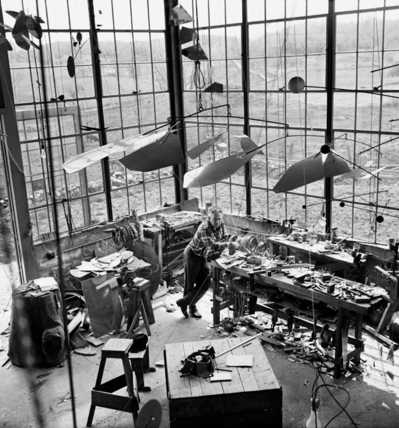
Calder in his Roxbury studio, 1941. Photograph by Herbert Matter, © Calder Foundation, New York. © 2025 Calder Foundation, New York / Artists Rights Society (ARS), New York
About Calder Gardens
Calder Gardens is a new art institution dedicated to Alexander Calder (1898–1976), one of the most acclaimed and influential artists of the 20th century. Building on the artist’s enduring legacy, it is conceived as a place where an evolving interplay between art, architecture, nature, and programming encourages contemplation and self-discovery.
Set within a landscape featuring more than 250 varieties of plants in gardens conceived by Piet Oudolf, Calder Gardens’ 18,000 square-foot building designed by Herzog & de Meuron houses a rotating installation of artworks by Calder. Spanning the artist’s fifty-year career and diverse bodies of work, the objects on view respond to architectural moments rather than art historical narratives. This selection of artworks slowly changes over time, echoing the natural rhythms of the seasons. Some will remain for years, while others are only on view for a few months, creating an ever-changing environment that encourages close looking and repeat visits.
In dialogue with Calder’s own experimental practice, programming at Calder Gardens presents performances, sonic experiences, screenings, lectures, and other events that connect the artist's legacy of innovation to contemporary art. Emphasizing mindfulness and environmental awareness, Calder Gardens is a space that foregrounds the interconnectedness of all elements of life.
Calder Gardens is located on the Benjamin Franklin Parkway in the heart of Philadelphia, a city with deep connections to the Calder family across several generations. It extends this lineage to the present day and joins Philadelphia’s rich artistic and cultural communities.
Calder Gardens has been realized thanks to Philadelphia philanthropists working with the Calder Foundation, with significant support from the City of Philadelphia and the Commonwealth of Pennsylvania. Through an innovative collaboration, the Barnes Foundation provides administrative, operational, and educational programming support for Calder Gardens. The Trustees of Calder Gardens is a section 509(a)(3) supporting organization that provides strategic and artistic direction, as well as financial support, to sustain the vision for Calder Gardens.
Land Acknowledgment
Calder Gardens is located in Lenapehoking, on the unceded land, waters, and air of the Lenape Peoples. We honor that this land and its people are timeless, and we pay respect to their Elders—past, present, and future. We support the sovereignty of the Lenape Peoples and are committed to uplifting their autonomy and rights in their homelands. This commitment exemplifies a reciprocal relationship to all beings and elements, recognizing that we are not separate from Earth.
About Alexander Calder
Alexander Calder (b. 1898, Philadelphia–d. 1976, New York City), whose illustrious career spanned much of the 20th century, is the most acclaimed and influential sculptor of our time. Born into a family of celebrated though more classically trained artists, Calder utilized his innovative genius to profoundly change the course of modern art. He began in the 1920s by developing a new method of sculpting: by bending and twisting wire, he essentially “drew” three-dimensional figures in space. He is renowned for the invention of the mobile, whose suspended, abstract elements move and balance in changing harmony. From the 1950s onward, Calder increasingly devoted himself to making outdoor sculpture on a grand scale from bolted steel plate. Today, these stately titans grace public plazas in cities throughout the world.
Alexander Calder(1898-1976)
본명은 알렉산더 '샌디' 칼더(Alexander 'Sandy' Calder). 1898년 펜실베니아주 론튼에서 태어났다. 스코틀랜드 출신 할아버지도 조각가로 1868년 필라델피아로 이민왔다. 어머니는 파리 소르본느에서 유학한 초상화가였다. 1905년 어머니가 결핵에 걸리자 애리조나 오라클로 이사했다가 2년 후엔 캘리포니아 파사데나로 다시 집을 옮겼다.
칼더는 누나의 인형을 위해 길가에서 주은 구리철사로 액세서리를 만들어 주었으며, 9살 때 파사데나에서 4마리 말이 이끄는 전차 경주를 본 후 서크스에 관심을 갖게 된다. 그리고, 서커스를 주제로 한 철사 조각을 만들었다. 1909년 크리스마스 때는 놋쇠판으로 개와 오리를 만들어 부모에게 선물했다.
뉴저지 호보켄의 스티븐스 공대(Stevens Institute of Technology)와 뉴욕의 아트스튜던트리그(Art Students League)에서 공부했다. 1926년 파리로 이주해 화가들과 교제하면서 파리의 피에트 몬드리안의 스튜디오를 방문했다. 몬드리안의 흰색 스튜디오에서 원색의 직사각형 판자들을 본 후 ‘사각형들이 움직이면 재미있을 것 같다’고 말했다. 여기서 착안한 것이 모빌 조각, 키네틱 아트다. 이후 칼더는 초현실주의에서 영향을 받은 형태와 추상을 결합한 작업을 했다.
1933년 칼더는 커네티컷 록스베리에 정착, 작품 활동을 했으며, 다시 프랑스 사셰로 이주했다. 1976년 11월 휘트니뮤지엄에서 회고전이 개막된 며칠 후 뉴욕에서 사망했다. 2013년 여름 삼성미술관 리움에서 ‘칼더’ 회고전이 열렸다. http://www.calder.org
*알렉산더 칼더: 하이퍼 모빌리티 (Calder: Hipermobility)@휘트니뮤지엄(6/9-10/23, 2017)
*칼더재단 딜러 사기혐의로 고소(The New York Times, 2013/10/30)
 소더비, 레오나드 A. 로더 컬렉션 경매...클림트 작 '엘리자베스 ...