

칸, 베니스, 베를린 대상 석권 이란 거장 자파르 파나히(Jafar Panahi) 영화제 @메트로그라프(7/12-8/3)
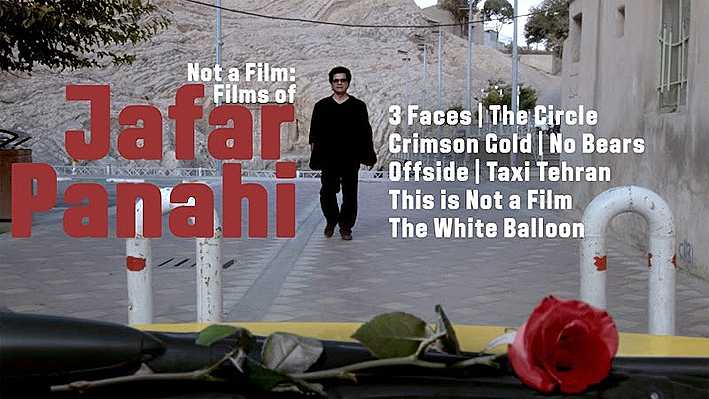
NOT A FILM: FILMS OF JAFAR PANAHI
An 8-Film Survey of the Master Filmmaker's Work, Featuring THE WHITE BALLOON, THE CIRCLE, and OFFSIDE on 35mm
"When I come across a problem in society that pains me, it's my responsibility to make a film to address the problem."
- Jafar Panahi
Metrograph presents Not a Film: Films of Jafar Panahi, an 8-feature program of films by the globally renowned Iranian director, beginning July 12 at Metrograph In Theater.
Panahi’s Palme d’Or win for his It Was Just an Accident at this year’s Cannes Film Festival made him only the fourth filmmaker to take top prizes at all of Europe’s Big Three festivals, and was a rousing victory for cinema-as-dissidence. Beginning his career as an assistant to Abbas Kiarostami, Panahi burst onto the international film scene with 1995’s feature debut, the fable-like, Kiarostami-penned The White Balloon, only to soon find himself in ill-favor with the authorities in his native Iran, who banned his run of socially critical films beginning with 2000’s The Circle from domestic release before legally forbidding him from further filmmaking activity and placing him under house arrest in 2010—not that this did much to slow down the resourceful and irrepressible auteur. A survey of a body of work that brings together profound compassion for those at society’s margins, a neorealist sense of in-the-streets immediacy, and real, indomitable political conviction.
Not a Film: Films of Jafar Panahi runs from July 12 to August 3, with select encore screenings to follow.
Titles include 3 Faces, The Circle, Crimson Gold, No Bears, Offside, Taxi Tehran, This Is Not a Film, and The White Balloon.
3 FACES 3개의 얼굴
2018, 100 min, DCP
Panahi’s fourth post-filmmaking ban feature begins with a smartphone video of a young woman (Marziyeh Rezaei) who, forbidden by her parents to pursue her dream of acting professionally, appears to take her own life. The video is addressed to Behnaz Jafari, who, hoping to discover with certitude the fate of its subject, asks Panahi—both actress and director play themselves—to drive her to the presumably dead woman’s home village, the two hitting the road in his SUV, along the way having a string of unusual encounters that include a meetings with a woman who’s dug her own grave and a stud bull with “golden balls.” An idiosyncratic road movie that gradually reveals itself as a meditation on the plight of actresses in conservative Iran, at once venerated and despised, and a gesture of tender solidarity from Panahi.
THE CIRCLE 서클 *베니스 영화제 황금사자상
2000, 90 min, 35mm
Winner of the Golden Lion at Venice and banned in Iran, dissident director Panahi’s shattering drama brings together the stories of several women—two escaped convicts, a girl in need of an abortion, the new mother of a baby girl—to make the compelling case that, for women living under the suffocating strictures of the Islamic Republic, the experience of incarceration is ultimately inescapable. “A stinging, tautly structured indictment of Iranian society told through its women’s eyes.”—Wesley Morris, The Boston Globe
CRIMSON GOLD 붉은 황금
2003, 95 min, DCP
Opening in the midst of a jewelry story robbery gone awry that ends with the would-be stick-up man taking his own life, Panahi’s seething Crimson Gold, something like a thriller turned inside out, proceeds to backpedal to show the circumstances that led the culprit, a pizza deliveryman by trade, to such a desperate precipice. Making his rounds criss-crossing a Tehran where evidence of yawning inequality gaps and a fraying social fabric are everywhere visible is lead actor Hossain Emadeddin, a nonprofessional who in civilian life shared the occupation of the character that he plays here with a palpable sense of listless, ground-down fatigue, and a weariness beneath which churning rage slowly rises to a boil.
NO BEARS 노 베어즈
2022, 106 min, DCP
Panahi plays himself in this ingeniously imagined and executed, vertigo-inducing rumination on the relationships between art and life, belief and evidence, and much else besides. Living in a rustic border town so as to remotely direct a film about an Iranian couple trying to secure fake passports that’s being shot on the other side of the Turkish border, Panahi gradually comes to the unsettling conclusion that the story of the movie he’s making has uncanny parallels to events he sees happening around him, and is participant in, during his off hours. “Panahi, whose courage and honesty are beyond doubt, has made a movie that calls those very qualities into question, a movie about its own ethical limits and aesthetic contradictions.” —The New York Times
OFFSIDE 오프사이드
2006, 93 min, 35mm
The last feature Panahi made before being banned from further filmmaking activity by the Iranian government finds him again focused on the strictures placed on women in his homeland, here in an unscripted docufiction about a diverse group of female soccer fanatics who, forbidden as all women are from attending the Iran national team’s World Cup qualifying match in Tehran, decide to take their chances by crashing the gate, much to the bafflement of the young soldiers charged with keeping order. A spirited cinematic document of real-life dissent that took home the Silver Bear at the 2006 Berlin International Film Festival, and tender homage to Panahi mentor Abbas Kiarostami’s 1974 feature debut The Traveler. “Part sports-inspirational, part women’s-prison flick, Offside confounds genre as well as gender—the movie is a cinema-verité political allegory that itself is both critical and utopian.” —J. Hoberman, The Village Voice
TAXI TEHRAN 테헤란 택시 *베를린영화제 황금곰상
2015, 82 min, DCP
Panahi directs and stars in this docufiction miracle, which finds him posing as a share taxi driver in Tehran who, rather than demanding cash payment from customers for his services, asks only to hear something about their lives. From shift to shift, Panahi collects a marvelous bounty of quotidian anecdotes and opinions from a parade of passengers who represent the diversity of the Iranian capital, ranging from pirate video vendors to human rights lawyers. One of several films completed surreptitiously by Panahi despite his having been forbidden to practice his trade for 20 years by the Iranian government, Taxi Tehran is the song of a city sung by its residents, and proof positive that you can’t keep a born filmmaker down.
THIS IS NOT A FILM 이것은 영화가 아니다
2011, 75 min, DCP
Placed on house arrest by the Iranian government and forbidden from any further filmmaking activity for the following 20 years, Panahi used the slender resources at his command—his own apartment as a “set,” the aide of friends, including credited co-director Mojtaba Mirtahmasb, who could handle the iPhone camera and thereby keep Panahi from violating his punishment on a technicality—to produce one of the crucial works of the 2010s, a portrait of an artist physically confined but spiritually unbowed, catching up with peers and with his own work, and still passionately engaged with the world from which he’s been cut off. “[A] brave and witty video diary, an essay on the struggle between tyranny and the creative imagination.” —The New York Times
THE WHITE BALLOON 하얀 풍선 *칸영화제 황금카메라상
1995, 85 min, 35mm
Panahi’s mentor Abbas Kiarostami scripted this, his warm, utterly endearing feature debut and Cannes festival Camera d’Or winner, whose title tributes Albert Lamorisse’s The Red Balloon. It’s Persian New Year, and seven-year-old Razieh begs her mother for money to buy a lucky goldfish. This simple task proves less easy than it would seem, however, as Razieh repeatedly loses her funds and finds misadventures, her wandering the streets of Tehran seen in real time, where even minor incidents take on major import from the perspective of a beguiled, curious child.
Metrograph
No. 7 Ludlow
New York City, NY 10002
https://metrograph.com
 2025 메트오페라 섬머 HD 야외 상영회 (8/22-9/1): 아이다, 토스...