

33 Keys to Understanding the Korean Wave #22 “Gangnam Style,” “Parasite,” and Margaret Cho
33 Keys to Understanding the Korean Wave #22 Korean Satire & Humor
#22 “Gangnam Style,” “Parasite,” and Margaret Cho
*Note to Readers
The columns published in the Zoom section of NYCultureBeat contain selected excerpts—typically the opening paragraphs—from each chapter of the book 33 Keys to Understanding the Korean Wave: Beyond BTS, Parasite, and Squid Game (2025). These previews are meant to introduce the book’s themes and tone.
The complete book—featuring 33 updated chapters and new cultural insights—is available in both paperback and hardcover editions:
Paperback: https://www.amazon.com/dp/B0F7HYLVCL
Hardcover: https://www.amazon.com/dp/B0F7HZ34Y3
© Sukie Park. All rights reserved. These excerpts are for preview purposes only and may not be reproduced in full or redistributed.
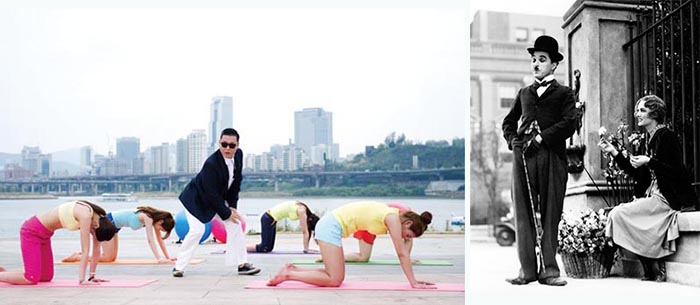
From Psy’s “Gangnam Style” (2012) music video / “City Lights” (1931) starring Charlie Chaplin
Soul music, born in the 1950s and 60s under the influence of gospel and rhythm and blues (R&B), carries the weight of sorrow in its melancholic melodies and rhythms. In contrast, hip-hop, which emerged in the Bronx in the 1970s, channels anger and resistance through rapid-fire beats and direct lyricism. Koreans, however, have a unique talent for expressing anger not through confrontation but by wrapping it in layers of satire and humor.
On July 15, 2012, Psy’s music video “Gangnam Style” took the world by storm, heralding a new era for K-Pop. By its 10th anniversary in 2022, the video had amassed 4.47 billion views on YouTube, making it the 5th most-viewed music video in YouTube’s history.
“Gangnam Style” encapsulates the Korean spirit of satire and humor. In the video, Psy, donning sunglasses and a bow tie, exclaims, “Oppa, Gangnam Style!”—a comical portrayal of a man who aspires to the glitzy lifestyle associated with Seoul’s affluent Gangnam district, often likened to New York’s Upper East Side or LA’s Beverly Hills. Despite his polished appearance, Psy’s behavior is anything but sophisticated. He lounges at a children’s playground, flirts awkwardly on the subway, dances wildly on a tour bus, takes a sauna with gangsters, and sits forlornly on a toilet. Psy is a wannabe—a caricature of a man who yearns to belong to the elite Gangnam culture but remains an outsider.
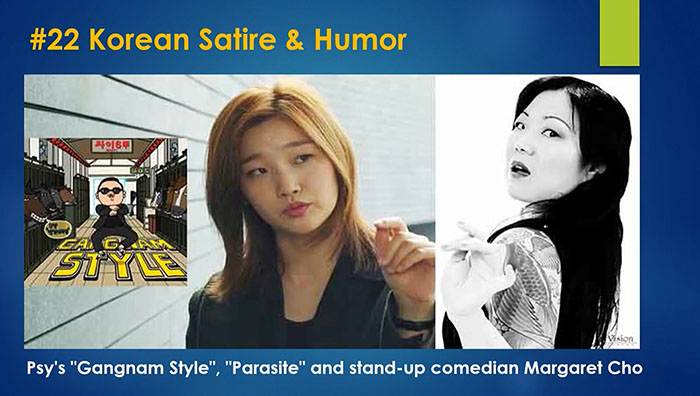
22. Korean Satire and Humor 319
Laughter Brings Blessings Home 319
Psy: The Charlie Chaplin of K-Pop 320
The Dark Humor in Parasite 322
Margaret Cho: The Queen of Stand-up Comedy 324
Descendants of Margaret Cho 325
Satire and Solidarity in Korean Protests 327
The Transformative Power of Korean Humor 328