

33 Keys to Understanding the Korean Wave #20 K-Book and Korean Women's Human Rights
33 Keys to Understanding the Korean Wave #20 The Power of Female Writers
#20 K-Book and Korean Women's Human Rights
*Note to Readers
The columns published in the Zoom section of NYCultureBeat contain selected excerpts—typically the opening paragraphs—from each chapter of the book 33 Keys to Understanding the Korean Wave: Beyond BTS, Parasite, and Squid Game (2025). These previews are meant to introduce the book’s themes and tone.
The complete book—featuring 33 updated chapters and new cultural insights—is available in both paperback and hardcover editions:
Paperback: https://www.amazon.com/dp/B0F7HYLVCL
Hardcover: https://www.amazon.com/dp/B0F7HZ34Y3
© Sukie Park. All rights reserved. These excerpts are for preview purposes only and may not be reproduced in full or redistributed.
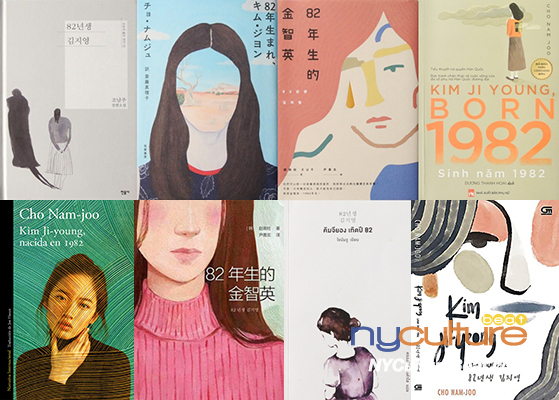
Cho Nam-joo’s bestseller, “Kim Jiyoung, Born 1982,” has been translated and published in thirty-one countries around the world. Korean version (clockwise from top left), Japanese version, Taiwanese version, Vietnamese version, Indonesian version, Thai version, Chinese version, Spanish version. Photo: Minumsa
“I thought of Kim Jiyoung’s character as a vessel that contains experiences and emotions that are common to every Korean woman.”
-Cho Nam-Joo, author of “Kim Jiyoung, Born 1982” -
Cho Nam-Joo’s novel "Kim Jiyoung, Born 1982," published in 2016, has sold over 1.5 million copies in Korea alone. The English edition was released in the UK in February 2020 and in the US in April 2020, becoming a bestseller in Japan, China, and Taiwan. The book has been published in 31 countries and 29 languages, including German, French, Spanish, Russian, Hungarian, and Vietnamese, heralding a new wave of Korean literature, or K-Book. The English version was named one of The New York Times' 100 Notable Books of 2020. Between 2016 and 2020, the novel sold over 300,000 copies in 10 languages, setting a record for any Korean literary work.
Does "Kim Jiyoung, Born 1982" resonate because it reflects the lives of ordinary Korean women and addresses the global issue of gender discrimination? Or is it the specific portrayal of gender inequality in Korea that has captured international attention? Despite being an economically, culturally, and technologically advanced country, Korea ranks surprisingly low in women’s rights globally.

20. K-Book: Han Kang and Korean Human Rights 289
Han Kang: Nobel Laureate in Literature 289
Unveiling Inequality: The Story of Kim Jiyoung 290
Patient and Narrator: Jiyoung and the Psychiatrist 292
Korea: Lagging in Women's Rights 294
“Women’s Rights Are Human Rights” 297
The Evolution of Women’s Rights in Korea 299
Cultural Roots of Gender Inequality 301
But the Most Renowned Korean Writers Are Women 302
Min Jin Lee and Pachinko 305
Global Impact of Korean Female Voices 306