

33 Keys to Understanding the Korean Wave, Hallyu! #5 K-Movies: Country of Trauma, Culture of Drama
33 Keys to Understanding the Korean Wave, Hallyu
#5 K-Cinema: Country of Trauma, Culture of Drama
Han (恨) and the Renaissance of Korean Cinema
*Note to Readers
The columns published in the Zoom section of NYCultureBeat contain selected excerpts—typically the opening paragraphs—from each chapter of the book 33 Keys to Understanding the Korean Wave: Beyond BTS, Parasite, and Squid Game (2025). These previews are meant to introduce the book’s themes and tone.
The complete book—featuring 33 updated chapters and new cultural insights—is available in both paperback and hardcover editions:
Paperback: https://www.amazon.com/dp/B0F7HYLVCL
Hardcover: https://www.amazon.com/dp/B0F7HZ34Y3
© Sukie Park. All rights reserved. These excerpts are for preview purposes only and may not be reproduced in full or redistributed.

Standing ovation for director Bong Joon-ho, who won the Best International Feature Film award for “Parasite” at the Academy Awards ceremony on February 9, 2020.
"Arirang, Arirang, Arariyo/ You're crossing over Arirang Hill/ If you leave me here like this/ Your feet will ache before ten miles still.
Arirang, Arirang, Arariyo/ You're crossing over Arirang Hill/ As countless stars fill the night sky/ So too do dreams our hearts fulfill.
Arirang, Arirang, Arariyo/ You're crossing over Arirang Hill/ That distant mountain is Baekdu/ Where flowers bloom in winter's chill."
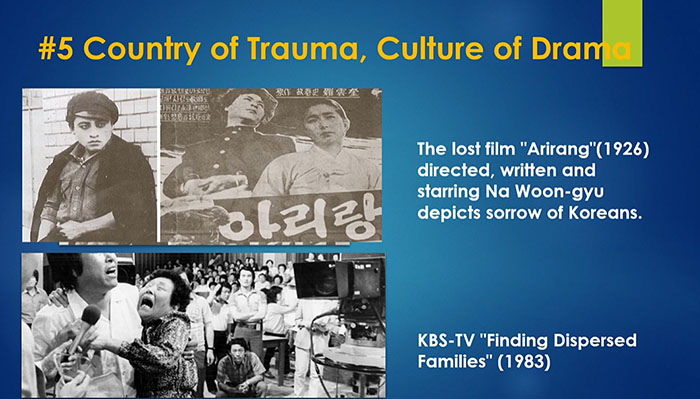
We have our own emotions and illnesses that only Koreans understand. They are “Han(恨)” and “Hwabyeong(火病).” The Korean people have gone through all kinds of battles in their 5,000 year history since Dangun Joseon. As we lived through that hard life, Koreans' hearts were filled with sorrow called Han. The feeling of Han comes from historical events (foreign invasion, civil war, colonization, war, divided country, displacement, separated families, adopted children, etc.); political oppression (dictatorship, corruption, deprivation of freedom, etc.); social (class, Confucian culture of gender inequality, wealth gap, etc.); and personal frustration (college entrance exams, military service, employment, divorce, filial piety, etc.). The emotions of anger, resentment, grief, regret, depression, anxiety, and a sense of defeat accumulated in the heart for a long time. That is, it is the feeling of the weak.
When this Han accumulates in the heart, it becomes a “Hwa-Byeong.” Hwa means "fire" and byeong means "syndrome" or "illness" in Korean.
Hwabyeong is often experience by immigrants. Uprooted from their homeland, making a nest in an unfamiliar land, and starting a second life, they always encounter language barriers, cultural obstacles, and racial discrimination. Here, they live with infinite stress, including permanent residency, rent, medical insurance, and the generation gap with their children. In 1995, the American Psychiatric Association mentioned Hwabyeong as a cultural syndrome that appears in Korean immigrants in the Statistical Manual of Mental Disorders. In English, it is called Somatization Disorder.
5. K-Cinema: Country of Trauma, Culture of Drama 68
Arirang: The Ballad of Han (恨) 68
Arirang: The Birth of Korean Cinema 69
Han and the Renaissance of Korean Film 71
Brief History of Korean Film 72
The Dark Age of the 1970s 72
The “3S” Policy in the 1980s 73
Hong Kong Cinema’s Influence on Korea 75
June 1987 Uprising and the New Waves 76
Post-Olympics Shift and Corporate Investment 77
Seopyeonje and the Rise of Artistic Cinema 79
Han Seok-kyu: The Box Office King 80
Korean Cinema Renaissance: 2000s 80
Global Recognition: The 2000s and Beyond 81
Rise of Gangster Movies as Blockbuster Hits 82
Art Films vs. Action Epics: The 2010s 83
After Parasite: Minari, Squid Game, and Beef 84