



하이라인공원 대형 비둘기 조각 'Dinosaur' 영구보존 청원에 5천여명 서명
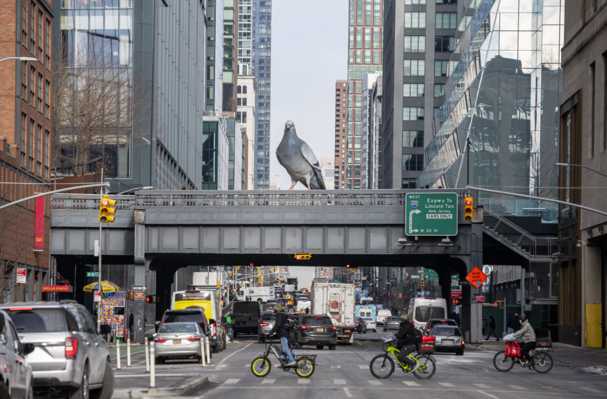
Dinosaur by Iván Argote Photo: Timothy Schenck/ High Line
2024년 10월부터 오는 4월까지 하이라인 공원 전시를 마치고 철거될 초대형 비둘기 조각 '다이노소어(Dinosaur, 공룡)'을 영구 보존해달라는 온라인 청원에 5천여명이 서명했다.
콜롬비아 출신 조각가 이반 아르고테(Iván Argote)가 제작한 21피트 높이의 알루미늄 비둘기 조형물은 하이라인 공원 스퍼(Spur, 30스트릿 & 10애브뉴)에 설치된 후 뉴요커들의 사랑을 받았으며, 이들에게 비둘기에 대한 편견을 재고해볼 것을 상기시켰다. 브렛 튤립(Brett Tulip)씨가 시작한 청원은 3월 23일 현재 약 5천400여명이 서명했다. 튤립씨는 청원에서 "이 비둘기 조형물은 회복력과 인내의 상징이자, 뉴욕시와 도시가 지향하는 모든 가치를 대변한다"고 영구 전시를 호소했다.
"뉴욕 하이라인에 거대한 비둘기 조형물 "다이노소어"를 영구 설치하세요!
비둘기는 뉴욕(그리고 뉴저지) 사람들의 정신을 상징합니다! 적응력, 영리함, 재치, 온화함, 친절함까지. 이 거대한 비둘기를 이곳에 영구히 전시하여 우리 모두의 가장 좋은 모습을 기억하게 해주세요!"
-Julia-
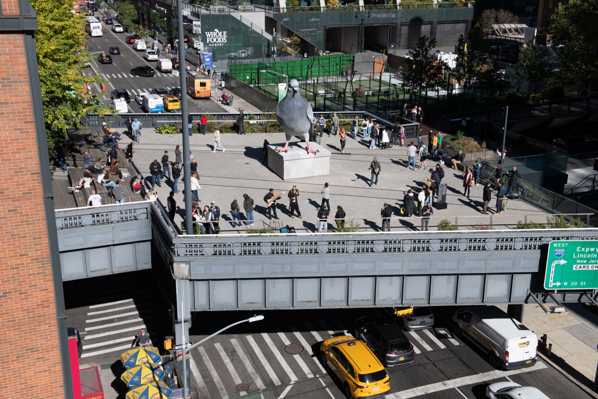
Dinosaur by Iván Argote Photo: Timothy Schenck/ HIgh Line
Make “Dinosaur” the Colossal Pigeon Statue a Permanent NYC Fixture on the High Line
The Issue
The iconic giant art fixture known as “Dinosaur” created by artist Iván Argote which was installed in October 2024, is planning to be removed in Spring 2026.
“Dinosaur” the giant pigeon quickly became a well beloved and appreciated staple of the High Line. Keeping watch overlooking 10th Avenue and 30th Street, the pigeon is a symbol of resilience, perseverance, and represents NYC and all it stands for.
Removing the sculpture would eliminate a piece of art that has already become deeply meaningful to the community in a short period of time.
We call on the High Line, NYC Parks, and relevant partners to work collaboratively with the artist to extend the installation or to designate the pigeon sculpture as a permanent public artwork.
By signing this petition, you can affirm your support for preserving this beloved piece of New York City’s cultural landscape.
https://www.change.org/p/make-dinosaur-the-colossal-pigeon-statue-a-permanent-nyc-fixture-on-the-high-line
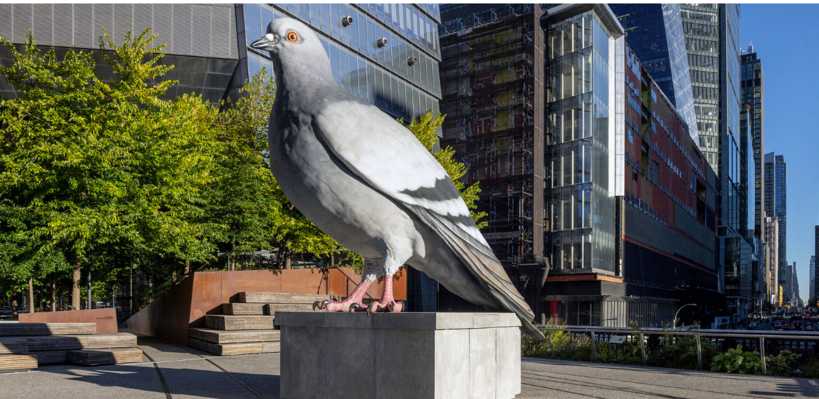
Dinosaur by Iván Argote Photo: Timothy Schenck/ High Line
Iván Argote
Dinosaur
October 2024 – early April 2026
Location: On the High Line at the Spur, at 30th St. and 10th Ave.
For the fourth High Line Plinth commission, Iván Argote presents Dinosaur (2024), a colossal, hyper-realistic sculpture of a pigeon cast in aluminum. Dinosaur was first submitted as a proposal for the High Line Plinth in 2020, among 80 proposals that included the third High Line Plinth commission, Pamela Rosenkranz’s Old Tree (2023). The meticulously hand-painted, humorous sculpture challenges the grandeur of traditional monuments celebrating significant historical figures, instead choosing to canonize the familiar New York City street bird. Posed on a concrete plinth that resembles the sidewalks and buildings that New York’s pigeons call home, Dinosaur reverses the typical power dynamic between bird and human, towering 21 feet above the Spur, over the countless pedestrians and car drivers that travel down 10th Avenue.
Reflecting on the work’s title, Argote notes, “The name Dinosaur makes reference to the sculpture’s scale and to the pigeon’s ancestors who millions of years ago dominated the globe, as we humans do today… the name also serves as a reference to the dinosaur’s extinction. Like them, one day we won’t be around anymore, but perhaps a remnant of humanity will live on—as pigeons do—in the dark corners and gaps of future worlds. I feel this sculpture could generate an uncanny feeling of attraction, seduction, and fear among the inhabitants of New York.”
Dinosaur, like the pigeons that inspired it, bears witness to the city’s evolution and confronts us with our ever-changing relationship with the natural world and its inhabitants. The oft-overlooked and derided creatures that seem to over-populate the city first arrived in the US via Europe, likely in the 1800s. They were kept as domesticated animals and were most notably used as reliable message carriers. Pigeons have an internal GPS, known as “homing,” that allows them to always find their way back home. This skill once made the bird indispensable in war—they served as military messengers in both World War I and World War II, saving hundreds of soldiers’ lives by transporting messages quickly to both the trenches and front lines. Many of these pigeons received gallantry awards and were celebrated as war heroes, before technology eventually rendered them obsolete.
Dinosaur recognizes this seemingly prosaic figure and celebrates its anonymity amongst the urban landscape, while also taking aim at classic monuments erected in honor of great men, who all too often are neither honorable nor great. Argote humorously suggests that, in fact, the not-wild—but no longer domesticated—birds are likely more deserving of being placed on a pedestal and celebrated for their contributions to society than most. Further, by highlighting their origins, Argote reminds viewers that, to some degree, everyone is an immigrant. Even the pigeon, a New York fixture, initially migrated here and made the city their home, like millions of other “native” New Yorkers.
Iván Argote is the first Plinth artist from the global south, and the youngest yet. His work as an artist and filmmaker is heavily focused on social justice issues and historical processes, sometimes inspired by his childhood in Bogotá, as he grew up in a family with a long tradition of political and social activism, from the 1950s to the present. Through his sculptures, installations, films, and interventions, Argote questions our intimate relationship with others, institutions, power, and belief systems. His work foregrounds tenderness and humor, through which he is able to present a critical approach to dominant historical narratives and patterns. In his interventions on monuments, large-scale installations, and performances, Argote proposes new symbolic uses of public space, and challenges our traditional and accepted ideas of whom and what we memorialize, revere, and remember.
Artist bio
Iván Argote (b. 1983, Bogotá, Colombia) lives and works in Paris, France. He has held solo exhibitions at institutions including SCAD Museum of Art, Savannah, Georgia (2024); KØS Museum, Denmark, Copenhagen (2024); Museo del Banco de la República, Bogotá, Colombia (2023); Centre Pompidou, Paris, France (2022); Kunstverein Dortmund, Dortmund, Germany (2021); ASU Art Museum, Tempe, Arizona (2019); Museo de Arte Latinoamericano de Buenos Aires (MALBA), Buenos Aires, Argentina (2018); Museo de Arte Moderno de Bogotá (MAMBO), Bogotá, Colombia (2017); MuseumsQuartier, Vienna, Austria (2015); and Palais de Tokyo, Paris, France (2012); CA2M, Madrid, Spain (2012). He has participated in major international group exhibitions, including Quizá mañana (Maybe Tomorrow), 16th Cuenca Biennial 2023, Cuenca, Ecuador (2023); Off the Pedestals, Kunsthalle Münster, Münster, Germany (2023); Intención poética, MACBA, Barcelona, Spain (2022); L’Avvenire appartiene ai fantasmi, Accademia di Belle Arte di Brera, Milan, Italy (2022); Prix Marcel Duchamp, Centre Pompidou, Paris, France (2022); Ires y venires, Banco de la República, Bogotá, Colombia (2021); Global(e) Résistance, Centre Pompidou, Paris, France (2020); A point of view, in situ installation made for Desert X 2019, Salton Sea – Coachella Valley, California (2019); The Street. Where the World Is Made, MAXXI, Rome, Italia (2018); BIENALSUR, Museo de la Inmigración, Buenos Aires, Argentina (2017); among many others. In 2024, he participated in the 60th International Art Exhibition of La Biennale di Venezia: Stranieri Ovunque – Foreigners Everywhere, curated by Adriano Pedrosa, with an ambitious outdoor installation in the Giardini. His work is featured in the collections of major institutions around the world, including the Guggenheim Museum (New York, US); Centre Pompidou (Paris, France); ASU Art Museum (Phoenix, US); Cisneros Fontanals Art Foundation (Miami, US); Colección de Arte del Banco de la República (Bogotá, Colombia); Kadist (San Francisco, US); MACBA (Barcelona, Spain). Argote is the youngest recipient of the High Line Plinth after Simone Leigh, Sam Durant, and Pamela Rosenkranz, and the first from the global south.
https://www.thehighline.org/art/projects/ivan-argote
 NYT: 비행이 끔찍한 이유 This Is Why Flying Is So Awful
 NYT, 해외여행에 꼭 필요한 앱: 우버, 옐프, 구글 맵보다 나은 AP...