

링컨센터 1970년대 한국영화제 'Korean Cinema’s Celluloid Fever: The 1970s' 상영일정(5/15-26)
FILM AT LINCOLN CENTER AND SUBWAY CINEMA
ANNOUNCE “KOREAN CINEMA’S CELLULOID FEVER:
THE 1970s,” MAY 15–26
27 restored classics, cult favorites, and genre titles highlight an
explosively creative decade in Korean Cinema
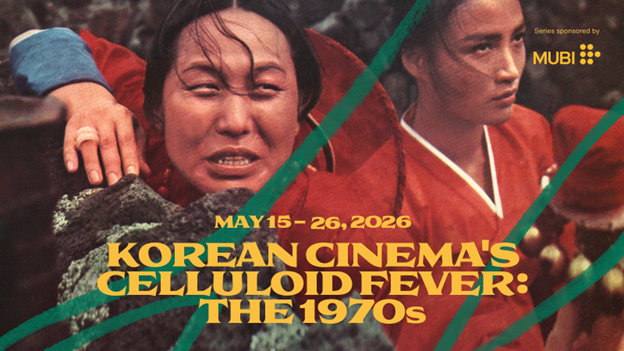
New York, NY (April 21, 2026) – Film at Lincoln Center (FLC) and Subway Cinema present “Korean Cinema’s Celluloid Fever: The 1970s,” a wide‑ranging retrospective running from May 15 through 26, charting one of the most volatile and inventive eras in Korean film history. With 19 features and eight short films, the series includes newly restored classics, rare cult favorites, and landmark genre films, including many premieres of new digital remasters.
The 1970s appeared to be devastating for Korean cinema: television decimated theatrical attendance, while Park Chung-hee’s military government imposed a complex censorship system that rejected scripts and tore apart completed films. Yet within this repressive climate, a generation of filmmakers devised bold visual styles, smuggled sharp social critique into commercial genres, and quietly laid the groundwork for the global prominence Korean cinema enjoys today. The program spans this “dark decade,” from Kim Ki-young’s Woman of Fire (1970), starring Academy Award winner Youn Yuh-jung in her debut role, to Lee Doo-yong’s The Last Witness (1980), capturing a cinematic landscape shaped by repression, innovation, and transformation.
A central focus is “The Era of the Image,” Korea’s first film art movement, whose directors drew inspiration from European New Waves to depict a changing Korean society through stories of youth, urbanization, and social tension. Films such as Lee Jang-ho’s Heavenly Homecoming to Stars (1974), Kim Ho-sun’s Yeongja’s Heydays (1975), and Ha Gil-jong’s The March of Fools (1975) and The Pollen of Flowers (1972) reflect the aspirations and frustrations of a generation navigating rapid industrialization and cultural shifts.
During this period, leading directors were working at the height of their creative powers—from Kim Ki-young’s audacious, genre-blending works Ieodo (1977) and A Woman After a Killer Butterfly (1978) to Kim Soo-yong’s psychologically probing Night Journey (1977) and A Splendid Outing (1977). The program also spotlights visionary directors at the moment their brilliance begins to emerge—among them Im Kwon-taek with his quietly introspective masterworks Wangsimni, My Hometown (1976) and Genealogy (1978). Alongside these features, a shorts program showcases experimental filmmakers such as Han Okhi and Kaidu Club, Korea’s first feminist film collective, whose formally radical works reject narrative in favor of texture, repetition, and performance, transforming film itself into a medium of feminist resistance.
This era produced some wild genre experiments and international collaborations, notably action star Park No-sik’s absurdist comedy Why? (1972) and Jang Il-ho’s manga-inspired horror A Remodeled Beauty (1975), which screens in a world premiere new 4K remaster. The Korean Connection, part of the tae kwon do action cycle Lee Doo-yong made with Han Yong-cheol, reveals an industry looking outward even as the state tightened control at home. Paired with Kim Jee-woon’s Cobweb (2023)—a satirical portrait of a 1970s director battling censorship—these films show how directors reworked melodrama, horror, and political thrillers to probe power and survival in a decade of rapid, disorienting change.
The generation responsible for these films mentored the Korean New Wave directors of the 1980s and ’90s and paved the way for contemporary auteurs like Bong Joon Ho, Park Chan-wook, and Kim Jee-woon, underscoring that the “celluloid fever” of the 1970s never truly broke.
Following the May 16 screening of Lee Jang-ho's seminal Heavenly Homecoming to Stars, audiences will be treated to a discussion about the Korean film industry and major trends and filmmakers in Korean cinema in the 1970s, a primer for the series as a whole. Two additional free screenings will be held at the Korean Cultural Center New York on May 21: Lee Man-hee’s Break the Chain (1971) and the 2008 Kim Jee-woon film that it heavily influenced, The Good, the Bad, the Weird.
Organized by Young Jin Eric Choi, Goran Topalovic, and Madeline Whittle.
Co-presented by Subway Cinema in collaboration with the Korean Cultural Center New York (KCCNY) and the Korean Film Archive (KOFA).
Additional support provided by the Korean Film Council (KOFIC).
“Korean Cinema’s Celluloid Fever: The 1970s” is sponsored by MUBI, the global streaming service, production company, and film distributor dedicated to elevating great cinema.
Special thanks to: Choi Jee-Woong / PROPAGANDA, Shin Haeok and Shin Donghyeok / Shin Shin, Yasu Inoue, Park Kyung-ae, Hah Myung-joong, Hah Jun-won, Kim Hong-joon, Darcy Paquet, Kim Kyungmi, Goh Taekyung, Chae Yunsun, Han Ok-hi, Kim Jiha / Asian Culture Center, Jang Hey-yeun, and Oh Miseon.
Tickets will go on sale on Wednesday, April 22 at 2pm, with an early access period for FLC Members starting at noon. Tickets are $18; $15 for students, seniors (62+), and persons with disabilities; and $13 for FLC Members. See more and save with a 3+ Film Package ($16 for GP; $13 for students, seniors (62+), and persons with disabilities; and $11 for FLC Members) or All Access Pass for $150; $120 for FLC Members). Find information on attending the free Korean Cultural Center screenings here.
Experience Opening Night on May 15, featuring the 6:15pm screening Woman of Fire followed by a party with Korean bites and drinks and Korean ’70s funk music, with an Opening Night Film + Party ticket: $25 for GP; $22 for students, seniors (62+), and persons with disabilities; and $20 for FLC Members. Film + Party ticket is included with All Access Pass and excluded from 3+ Film Package or Member benefit tickets.
FILM DESCRIPTIONS
All films screen at the Walter Reade Theater (165 W. 65th Street)
2K Remaster
Woman of Fire / 화녀
Kim Ki-young, 1970, South Korea, 100m
Korean with English subtitles
Kim Ki-young’s delirious riff on his own The Housemaid (1960) takes the domestic powder keg and relocates it to a sweltering poultry farm, then lights a match. A maid (Minari’s Oscar-winning Youn Yuh-jung in her debut role) moves in, the wife starts seeing red, and pretty soon the poultry isn’t the only thing getting butchered, as class resentment, erotic obsession, and murderous jealousy spiral out of control. The camera lunges, the colors scream, and baroque décor plus claustrophobic framing push melodrama into the realm of the grotesque, turning the home into a pressure cooker of postwar ambition and anxiety. Part art film, part grindhouse nightmare, Woman of Fire is a cornerstone of 1970s Korean cinema that still plays like the wildest midnight movie you’ve never seen. Digitally mastered in 2011 under the supervision of the Korean Film Archive. Digitization sourced from the only surviving 35mm print, which is in poor condition and includes embedded French subtitles.
Friday, May 15 at 6:15pm – post-screening Opening Night Party (party ticket required)
Friday, May 22 at 3:30pm
Monday, May 25 at 8:30pm
2K Remaster
The Pollen of Flowers / 화분(꽃가루)
Ha Gil-jong, 1972, South Korea, 90m
Korean with English subtitles
Welcome to a rich man’s villa, where everyone is gorgeous, bored, and headed for disaster. With influences ranging from Kim Ki-young to Pasolini, Ha Gil-jong’s debut feature blooms into a transgressive chamber piece, trapping a powerful businessman, his mistress, and his young male secretary (Ha’s brother Hah Myung-joong) in a slow-burn game of seduction, domination, and betrayal. The camera glides, the décor is lush, and the film’s languid surfaces quietly smuggle in a subversive treatment of sexuality and class, all set to a drifting, psychedelic score by rock legend Shin Joong-hyun. Ha refuses to crown simple victims or villains, mirroring a society where power circulates through bodies as much as institutions. Long marginalized and now reclaimed as a landmark of Korean queer cinema, The Pollen of Flowers also plays as a coolly furious allegory of Park Chung-hee–era power and complicity. Digitally mastered in 2013 under the supervision of the Korean Film Archive.
Sunday, May 17 at 1:45pm
Sunday, May 24 at 1:30pm
North American Premiere of 2K Remaster
Why? / 왜?
Park No-sik, 1972, South Korea, 85m
Korean with English subtitles
By the early 1970s, Park No-sik had appeared in hundreds of films and become one of Korea’s go-to tough guys, headlining a whole mini-franchise built around his bumpkin-hero Yong-pal. In Why?, the actor-director goes all in: Yong-pal heads to Japan in the wake of a young woman searching for the father she’s never met, and both tumble into a Chongryon-linked gangster maze where Park also plays the cold-blooded Korean-Japanese boss running the show. The result is rough, loud, over-the-top anti-Communist pulp filtered through Park’s eccentric, anything-goes filmmaking—a mix of barroom brawls, gags, tonal swerves, and bruised patriotism that feels like a 1970s grindhouse movie from a parallel Korea. This is popular cinema at street level, and the work of a rugged genre star who, by sheer force of personality, turns himself into an auteur with his own scrappy vision of the world. Digitally mastered in 2011 by the Korean Film Archive.
Tuesday, May 19 at 8:45pm
Friday, May 22 at 1:30pm
North American Premiere of 4K Remaster
A Girl Who Looks Like the Sun / 태양 닮은 소녀
Lee Man-hee, 1974, South Korea, 79m
Korean with English subtitles
One of the strangest and most luminous films of the Korean 1970s, from one of Korean cinema’s great humanist directors. A young woman on her way to the sea meets a man suspected of murder, and what follows blows past the rules of both romance and thriller. Rock legend Shin Joong-hyun’s score, kicked off by the soaring title track, gives the film a buoyancy that never quite disappears—even as the plot tightens around its characters. Shin Seong-il plays the fugitive with coiled, star-wattage intensity, but the film belongs to Moon Sook (in her film debut), whose character dances in a Namsan amphitheater, pops open a red umbrella in the rain, and moves through the film the way the music does: lightly, on her own terms, against the grain of everything. The “sun” of the title is less a metaphor for innocence than a reminder of the warmth—and burn—of idealization. Digitally mastered in 2022 by the Korean Film Archive.
Sunday, May 17 at 3:45pm
Tuesday, May 19 at 1:30pm
2K Restoration
Heavenly Homecoming to Stars / 별들의 고향
Lee Jang-ho, 1974, South Korea, 111m
Korean with English subtitles
The film that broke Korean box office records and launched a generation. Lee Jang-ho’s debut arrived at the moment when youth culture, acoustic guitars, blue jeans, and draft beer were reshaping Korean urban life under the Yushin dictatorship. Based on Choi In-ho’s sensation of a serialized novel, it follows an ordinary young woman whose serial betrayals by men push her toward the bar hostess life. Lee infuses the melodrama with jagged editing, pop songs, and documentary-like glimpses of the city’s underbelly—an indictment of industrialization and the human wreckage capitalism leaves behind, carried by one of the great Korean pop soundtracks, featuring Lee Jang-hee’s songs that became instant anthems. An In-sook is heartbreaking in the lead role, and Shin Sung-il smolders as the painter who watches it all happen. Restored in 2015 by the Korean Film Archive.
Saturday, May 16 at 6:00pm – panel with Young Jin Eric Choi and Goran Topalovic
Monday, May 25 at 2:00pm
The Korean Connection / 돌아온 외다리
Lee Doo-yong, 1974, South Korea, 86m
Korean with English subtitles
A Korean street fighter famed for his lethal kicks decides to go straight for the woman he loves—then takes one last job that blows everything up—in 1930s Harbin. He discovers the gold carriage he’s agreed to rob belongs to his girlfriend’s brother, and guilt drives him to cripple his own leg and disappear into drink. Then the Japanese villain takes the gold, takes the girl, and our hero comes back—on a steel prosthetic—to destroy them all. This is the high-water mark of the six tae kwon do action films Lee Doo-yong and Korean American star Han Yong-cheol cranked out in 1974 alone, a collaboration built on one simple revelation: Han could slap villains in the face with his foot, left and right, at speed, and nobody in Korean cinema had ever seen anything like it. Hong Kong had the One-Armed Swordsman. Japan had Zatoichi. Korea answered with Han Yong-cheol’s right foot.
Saturday, May 16 at 4:00pm
Tuesday, May 26 at 3:30pm
North American Premiere
You Become a Star Too / 너 또한 별이 되어
Lee Jang-ho, 1975, South Korea, 35mm, 101m
Korean with English subtitles
A salaryman, his wife, and their young daughter win the lottery and move into a newly built suburban home, living the capitalist dream. But after the father embarks on an illicit encounter with a nightclub singer, his daughter is suddenly seized by violent fits and hallucinations as an unseen presence begins to take hold. Drawing clear inspiration from The Exorcist, Lee Jang-ho fuses supernatural horror with melodrama, veering between the two to produce a bewildering sense of tonal dissonance. Disorienting montages, boldly saturated colors, and a restless sonic landscape accumulate into a sensory overload that approaches delirium. The result is a film that feels possessed in its own right, a cacophony of audiovisual sensations echoing the anxieties of a society in the grip of rapid change. A singular and audacious work, You Become a Star Too anticipates the formal experimentation that would come to define Lee’s cinema in the decade to follow. 35mm print courtesy of the Korean Film Archive.
Tuesday, May 19 at 6:30pm
Sunday, May 24 at 3:45pm
U.S. Premiere of 2K Remaster
The March of Fools / 바보들의 행진
Ha Gil-jong, 1975, South Korea, 103m
Korean with English subtitles
Two philosophy students drift through campus life under the Yushin dictatorship: blind dates, drinking contests, long-hair crackdowns, a love that goes nowhere—and nowhere to go anyway. Ha Gil-jong trained at UCLA and co-founded Young Sang Shi Dae (The Era of the Image), the movement that pumped New Wave restlessness and American New Cinema energy into Korean commercial filmmaking. The March of Fools is where that sensibility cracks Korean cinema widest open: jagged, funny, despairing, formally alert, shot through with a self-mockery that bites harder than anger. More than 30 minutes were lost to censorship at the script and print stages, yet the film became a generational touchstone, and Song Chang-sik’s songs “Why Are You Calling” and “Whale Hunting” were banned for their association with student protest. The fools keep marching—until they can’t. Digitally mastered in 2013 under the supervision of the Korean Film Archive.
Friday, May 15 at 3:30pm
Saturday, May 23 at 6:00pm
North American Premiere of 2K Restoration
Yeongja’s Heydays / 영자의 전성시대
Kim Ho-sun, 1975, South Korea, 108m
Korean with English subtitles
A young woman arrives in Seoul from the countryside with nothing but ambition and ends up with less than that. Maid, factory worker, bar girl, bus conductor—Yeongja climbs every rung the city offers and gets knocked off each one, losing an arm to a bus accident before the city claims her entirely. Kim Ho-sun, part of the Young Sang Shi Dae generation alongside Ha Gil-jong and Lee Jang-ho, brings their sensibility—fresh editing rhythms, documentary-textured locations, sharp social observation—to one of the key films in the 1970s “hostess melodrama” cycle. The film pairs crowd-pleasing sentiment with a refusal of melodramatic softening, indicting patriarchy, economic precarity, and the myth of meritocratic uplift, even as it becomes one of the decade’s biggest hits. What makes it indelible is Yeom Bok-soon’s performance—funny, proud, heartbreaking, never begging for sympathy—and the insistence that Yeongja’s story isn’t a fall from grace, but what the economic miracle looked like from the bottom. Restored in 2018 by the Korean Film Archive and Pino Entertainment.
Monday, May 18 at 12:45pm
Wednesday, May 20 at 6:15pm
World Premiere of 4K Remaster
A Remodeled Beauty / 정형미인
Jang Il-ho, 1975, South Korea, 71m
Korean with English subtitles
A family is cursed: their firstborn daughter is born with the face of a cat. Her plastic-surgeon father swaps her at birth with another infant and walks away. Twenty years later, the cat-girl comes back, demanding he fix what he’s done. Adapted from a manga by Japanese horror master Kazuo Umezu, the film casts Yu Ji-in—one of the decade’s great screen beauties—and hides her under cheerfully grotesque makeup for most of the runtime, making her final unmasked appearance hit that much harder. Director Jang Il-ho, a veteran of Shaw Brothers co-productions, brings a brisk, pulpy snap to the material: the effects are gloriously bargain-basement, miles from the technical polish of better-known Japanese horror, but the premise—a surgeon who treats beauty as a defect to be corrected and then runs from the fallout—cuts deeper than the threadbare production suggests. Digitally mastered in 2026 by the Korean Film Archive. Digitization sourced from the 35mm original negative, the only known surviving film element, which is missing the sixth reel containing approximately 11 minutes of coverage.
Saturday, May 16 at 12:15pm
Tuesday, May 26 at 9:15pm
North American Premiere of 2K Remaster
Wangsimni, My Hometown / 왕십리
Im Kwon-taek, 1976, South Korea, 112m
Korean with English subtitles
A man returns to his Seoul neighborhood after 14 years abroad and finds everything changed—real estate is booming, old friends have scrambled up the social ladder, the woman he loved is married to someone else. Im Kwon-taek later described it as his first attempt to put images and impressions into the frame rather than dialogue, a turning point in his understanding of the possibilities of cinema. Shot at the height of the 1970s development boom, the film records Wangsimni’s transformation with documentary precision, while Shin Seong-il’s returning exile drifts through it like a ghost, shadowed throughout by Choi Byeong-geol’s melancholy theme song. The film closes on the ancient Salgojidarigyo stone bridge, with Seongdong Bridge and the rushing city beyond: two men stranded between an irrecoverable past and an indifferent present. That closing image is one of the decade’s most haunting: before Mandala, before Sopyonje, this is where Im Kwon-taek the artist begins to emerge. Digitally mastered in 2011 under the supervision of the Korean Film Archive.
Sunday, May 24 at 8:30pm
Tuesday, May 26 at 1:00pm
2K Restoration
Ieodo / 이어도
Kim Ki-young, 1977, South Korea, 113m
Korean with English subtitles
A haunted-island mystery where the ghost might be a person, a place, or an entire way of life. When a zealous hotel developer names his new Jeju resort after the mythical submerged rock Ieodo—said to appear only to the souls of drowned fishermen—he is accused of murder and drawn to an off‑the‑map island community ruled by women and guarded by shamanic ritual. Kim Ki‑young fuses folk horror, corporate hubris, and raw erotic anxiety into a jagged, nested flashback structure that slips between memory and hallucination, while legendary cinematographer Jung Il‑sung’s lurid color gels, violent close‑ups, and storm‑lashed imagery turn sea, fog, and wind into attacking forces. The matriarchal society of haenyeo divers—harvesting the sea floor and answering to no man—gives the film an anthropological strangeness that feels at once documentary-like and fever‑dreamed. Long overshadowed by The Housemaid, Ieodo stands as one of Kim’s most audacious works: a deranged coastal noir and headlong dive into primal desire, anxious masculinity, and the death drive.
Wednesday, May 20 at 3:30pm
Friday, May 22 at 6:00pm
2K Restoration
Night Journey / 야행
Kim Soo-yong, 1977, South Korea, 79m
Korean with English subtitles
A bank clerk—Yun Jeong-hee (Lee Chang-dong’s Poetry), with Shin Sung-il as her complacent lover—drifts through a life of accumulating restlessness: an affair that leaves her unsatisfied, late-night wandering, desires the world around her has no category for. Rare in 1970s Korean cinema for treating its female protagonist as a full subject, the film embeds her psychological unraveling within the broader symptoms of the era—Vietnam War fallout, the hollowness of Yushin-era social conformity, ordinary people who need alcohol just to feel alive. Kim Soo-yong uses editing, cinematography, and sound not simply to carry a story but to render interior states, pushing Korean cinema’s expressive range into new territory. Made in 1973 and suppressed by censors for four years, it was finally released with dozens of cuts. Quiet, elliptical, unsettling: a film out of time, waiting for its time. Restored in 2011 by the Korean Film Archive.
Wednesday, May 20 at 8:35pm
Monday, May 25 at 4:30pm
North American Premiere of 4K Remaster
A Splendid Outing / 화려한 외출
Kim Soo-yong, 1977, South Korea, 94m
Korean with English subtitles
North American Premiere of 4K Remaster
One of the decade’s great enigmas. A successful executive, plagued by strange visions and intimations of a buried past, leaves the city for the coast—only to be abducted and taken to a remote island, where a man insists she is his vanished wife. Shot by legendary cinematographer Jung Il‑sung, the film unfolds in a fractured, dreamlike flow, reality and hallucination spliced together without signposts, its dissonant music and distorted imagery tracking the heroine’s psychological unraveling. Kim Soo‑yong is said to have chosen the innocuous title to ease the film past the censors while smuggling in a darker social portrait; contemporary critics saw in it an unflattering reflection of 1970s Korea. Regarded as one of the most challenging Korean films of its year, it also proved a word‑of‑mouth success. Anchored by an extraordinary performance from Yun Jeong‑hee, star of Kim’s Night Journey and later acclaimed internationally for Lee Chang‑dong’s Poetry, A Splendid Outing culminates in an ending that pointedly refuses to resolve. Digitally mastered in 2023 by the Korean Film Archive.
Wednesday, May 20 at 1:15pm
Friday, May 22 at 8:30pm
North American Premiere of 4K Restoration
Maruchi Arachi / 태권동자 마루치 아라치
Lim Jeong-gyu, 1977, South Korea, 77m
Korean with English subtitles
Before K-animation went cute, it went full tae kwon do. Two feral kids, Maruchi and Arachi, grow up in a mountain cave after their grandfather is murdered by the villainous Blue Skull 13, until a kindly master drags them off to Seoul and turns them into unstoppable kicking machines. From there it’s tae kwon do tournaments, underwater science parks, killer robots, and a final showdown with Blue Skull’s plan for world domination. Adapted from a wildly popular MBC children’s radio serial, this was director Lim Jeong-gyu’s debut and a proudly original Korean production at a moment when most homegrown animation was lifting heavily from Japan. On release it set a Korean animation box-office record that held for more than a decade, and its theme song lodged itself permanently in the national brain. Restored in 2022 by the Korean Film Archive and Image Power Station.
Thursday, May 21 at 4:00pm
Saturday, May 23 at 1:30pm
North American Premiere of 4K Remaster
A Woman After a Killer Butterfly / 살인나비를 쫓는 여자
Kim Ki-young, 1978, South Korea, 118m
Korean with English subtitles
Among Kim Ki-young’s most unclassifiable films, A Woman After a Killer Butterfly spirals from chance encounter to metaphysical odyssey, as a suicidal man becomes entangled with a mysterious woman and a professor obsessed with death, insects, and ancient tombs. Genre and tone mutate restlessly: noir drifts into horror, eroticism into absurdism, philosophy into pulp. Kim’s wild visual imagination—extreme close-ups, symbolic props, and disorienting shifts in space—renders interior states with feverish intensity. Frequently cited as a pinnacle of 1970s Korean cult cinema, the film stages mortality and desire as a delirious chase after something as fragile and dangerous as a “killer butterfly.” You don’t watch A Woman After a Killer Butterfly to follow the plot—you let it crawl into your brain and start laying eggs. Digitally mastered in 2023 by the Korean Film Archive.
Saturday, May 16 at 9:00pm
Saturday, May 23 at 3:30pm
North American Premiere of 2K Remaster
Genealogy / 족보
Im Kwon-taek, 1978, South Korea, 107m
Korean with English subtitles
During the final years of the Japanese colonial era, Koreans were required to adopt Japanese names as part of an assimilation policy known as Sōshi-kaimei (창씨개명). Resistance to this erasure of Korean identity was widespread, prompting increasingly coercive and punitive measures from the colonial government to enforce compliance. Based on a short story by Korea-born Japanese author Kajiyama Toshiyuki, Genealogy tells one such story: a proud patriarch who refuses the decree in honor of his ancestors, seen through the eyes of a sympathetic Japanese official. As pressure mounts and the lives around him begin to unravel, the patriarch is faced with an impossible choice. With remarkable stillness that invites introspection, Im Kwon-taek avoids grandstanding patriotism in favor of a solemn meditation on conviction, heritage, and identity. Long focused on commercial filmmaking, Im would later describe this work as an important artistic turning point. Genealogy is indeed an understated masterpiece that marks the beginning of Im’s ascent to greatness. Digitally mastered in 2011 under the supervision of the Korean Film Archive.
Monday, May 18 at 3:00pm
Sunday, May 24 at 6:00pm
4K Restoration
The Last Witness / 최후의 증인
Lee Doo-yong, 1980, South Korea, 157m
Korean with English subtitles
Straddling the end of the 1970s and the dawn of a new military regime, Lee Doo-yong’s The Last Witness turns a murder case into a full-scale excavation of Korea’s buried history. Detective Oh (Ha Myung-joong), tracking the killing of a brewery owner, hits the road across wintry landscapes and remote villages, uncovering a chain of Korean War–era atrocities, partisan guerrillas, betrayals, and cover-ups that bind the present to crimes long suppressed. Better known at the time for hard-edged action films, Lee crafts a patient, sprawling procedural that also plays like a bleak road movie, its snowbound vistas and austere compositions giving the journey an almost existential weight. Once seen only in heavily cut form, The Last Witness now emerges in restoration as a towering masterpiece of Korean cinema: genre turned into a searing allegory of a society built on unacknowledged ghosts. Restored in 2016 by the Korean Film Archive.
Saturday, May 23 at 8:15pm
Tuesday, May 26 at 6:00pm
Cobweb / 거미집
Kim Jee-woon, 2023, South Korea, 132m
Korean with English subtitles
Kim Jee-woon time-travels back into the 1970s Korean film industry with Cobweb—and promptly sets it on fire. A director (Parasite’s Song Kang-ho) becomes convinced that if he can just reshoot the ending of his already-censored melodrama over one frantic weekend, he’ll finally reveal the masterpiece trapped inside. Producers, censors, actors, and crew all think he’s lost it, and the soundstage dissolves into pure chaos. The film constantly jumps between on-set battles and lush black-and-white footage from the movie-within-the-movie, blurring the line between reality, performance, and runaway ego. Fast, funny, and meticulously staged, Cobweb channels the spirit of 1970s Korean cinema—its censorship battles, genre inventiveness, and last-minute improvisations—into a self-reflexive love-hate letter to the very era this series celebrates, and a reminder that chasing the “perfect cut” can become its own beautiful madness.
Sunday, May 17 at 5:45pm
Tuesday, May 19 at 3:30pm
Personal Cinema: Korean Experimental Shorts, 1974–1977
Han Okhi, Kim Hong-joon, Hwang Ju-ho, South Korea, 76m
Han Okhi and Kaidu Club, Korea’s first feminist experimental film collective, pioneered a boldly radical practice. Founded in 1974 by Han and fellow Ewha Womans University graduates, the group rejected patriarchal and commercial conventions through collective, amateur 16mm production. Their works employ avant-garde techniques—flicker effects, Dutch angles, dialectical montage, double exposure, altered speeds, and performative gestures—to explore confinement, inner desire, liberation, and resistance to social repression and film censorship. Often blending abstraction, symbolism, and feminist rebellion, their cinema functioned as both artistic protest and formal experimentation, laying vital groundwork for later women’s and experimental film practices.
In contrast, Kim Hong-jun and Hwang Ju-ho (then Seoul National University students) created intimate, personal shorts using small-gauge 8mm cameras. Their works captured the rhythms of everyday life and rapid urbanization through observational and structural approaches—dynamic city symphonies, tender records of disappearing traditional crafts, and subtle sonic explorations—offering quiet, poetic reflections on modernization without overt political confrontation. These “personal films” emphasized direct, unscripted documentation and rhythmic editing.
Together, the shorts in this program represent crucial precursors to Korean independent cinema: one strand fiercely collective and formally subversive, the other quietly personal and observational. Raw, defiant, and visionary, they opened alternative paths for filmmaking outside the mainstream.
Saturday, May 16 at 2:00pm
Monday, May 25 at 6:30pm
Hole / 구멍
Han Okhi, 1974, South Korea, 8m
The Middle Dog Days / 중복
Han Okhi, 1974, South Korea, 7m
2minutes40seconds
Han Okhi, 1975, South Korea, 10m
Color Of Korea / 색동
Han Okhi, 1976, South Korea, 8m
Untitled 77-A / 무제 77-A
Han Okhi, 1977, South Korea, 6m
Seoul 7000 | 서울 7000
Kim Hong-joon, Hwang Ju-ho, 1976, South Korea, 8m
Straw Shoes | 짚신
Kim Hong-joon, Hwang Ju-ho, 1977, South Korea, 16m
Sound of Laughter | 웃음소리
Kim Hong-joon, Hwang Ju-ho, 1977, South Korea, 13m
Free Screenings at Korean Cultural Center New York
North American Premiere of 4K Remaster
Break the Chain / 쇠사슬을 끊어라
Lee Man-hee, 1971, South Korea, 99m
Korean with English subtitles
1930s Manchuria. A Tibetan Buddha statue holding the names of Korean independence fighters becomes the obsession of three self-serving rogues: a bandit, a mercenary, and a Japanese collaborator. None care about ideology—all want the payoff. Lee Man-hee, at the tail end of the Manchurian Western genre and his own golden period, delivers something unexpectedly playful and lighter than anything he’d made before. These opportunistic outlaws, ready to betray each other at the drop of a hat, gradually find themselves pulled toward something larger. It’s essentially The Good, the Bad and the Ugly refracted through the Korean anti-colonial lens—scrappy, sun-baked, and strange—and a key precursor to Kim Jee-woon’s The Good, the Bad, the Weird (2008). What binds them isn’t abstract nationalism, but raw, horizontal solidarity with the suffering right in front of them. Digitally mastered in 2022 by the Korean Film Archive. Part of KCCNY’s Korea on Screen series.
Thursday, May 21 at 5:30pm at Korean Cultural Center New York
The Good, the Bad, the Weird / 좋은 놈, 나쁜 놈, 이상한 놈
Kim Jee-woon, 2008, South Korea, 132m
Korean with English subtitles
Three outlaws. One treasure map. The Manchurian steppe in flames. Kim Jee-woon’s delirious genre explosion is rooted in Korea’s tradition of Manchurian Westerns and takes direct inspiration from Lee Man-hee’s cult 1971 film Break the Chain. It seizes Sergio Leone’s title, his triangulated tension, and his operatic cruelty—then detonates them across a dust-choked frontier of Japanese imperial cavalry, Korean desperadoes, and a MacGuffin that keeps slipping away. Parasite’s Song Kang-ho brings his rogue genius to the Weird, Lee Byung-hun (No Other Choice) delivers one of Korean cinema’s great villain turns as the icy, preening Bad, and Jung Woo-sung’s stoic Good completes the deadly trio. With kinetic action choreography by Heo Myeong-haeng and Jung Doo-hong, the sequences are staggering in scale and invention, yet Kim never lets spectacle bury the melancholy underneath: these men are stateless, hunted, fighting over a map to nowhere. Pure cinema, furiously alive. Part of KCCNY’s Korea on Screen series.
Thursday, May 21 at 7:30pm at Korean Cultural Center New York
<Updated, April. 22, 2026>
Korean Cinema’s Celluloid Fever: The 1970s
May 15–26
Film at Lincoln Center
In the years following South Korea’s widely celebrated cinematic renaissance of the 1960s, a new generation of filmmakers inherited an industry under siege. Television had decimated theatrical attendance, and Park Chung Hee’s Yushin regime transformed state censorship into a stranglehold over what could be made, shown, or said on screen. Yet despite these constraints—or because of them—the 1970s yielded some of the most daring and emotionally charged filmmaking in Korean history.
This long-dismissed decade produced extraordinary works by Ha Gil-jong(하길종), Kim Ki-young(김기영), Kim Soo-yong(김수용), Lee Doo-yong(이두용), Lee Jang-ho(이장호), and Lee Man-hee(이만희), alongside genre innovations that permanently reshaped the industry’s DNA. The era witnessed the emergence of two prominent artistic movements: the Visual Age, a cohort of directors inspired by the French New Wave; and Kaidu Club, Korea’s first feminist film collective, founded by Han Okhi.
Contemporary Korean cinema’s extraordinary genre sophistication and its affinity for embedding social critique within the forms of popular entertainment, as exemplified by the works of Bong Joon Ho and Park Chan-wook, were forged under duress over this turbulent period. This May, Film at Lincoln Center and Subway Cinema are proud to present rare archival prints and new restorations of films whose significance to world cinema is only now being fully recognized.
Organized by Young Jin Eric Choi, Goran Topalovic, and Madeline Whittle. Co-presented by Subway Cinema in collaboration with the Korean Cultural Center New York and the Korean Film Archive.
Korean Cinema’s Celluloid Fever: The 1970s is sponsored by MUBI, the global streaming service, production company, and film distributor dedicated to elevating great cinema.
*한류를 이해하는 33가지 코드: BTS, 기생충, 오징어 게임을 넘어서
#5 한(恨)과 한국영화 르네상스 Country of Trauma, Culture of Drama
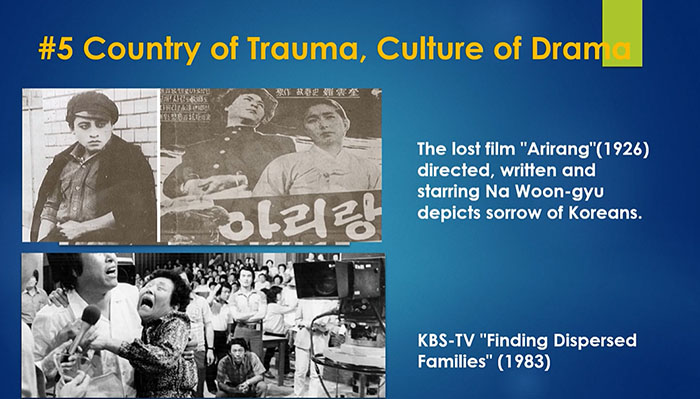
Koreans have a unique sentiment of 'han'. The ethnic trauma of Koreans, such as separated families due to the division of the two Koreas after the war and the Ferry Sewol disaster, were more dramatic reality than the movies. Koreans who share their national sad feelings want more dramatic narratives and unforgettable characters. We are hungry for that. It is also the reason why Korean directors such as Park Chan-wook, Bong Joon-ho and Hwang Dong-hyeok have developed brutal aesthetics.
http://www.nyculturebeat.com/index.php?mid=Zoom&document_srl=4072876
*한국영상자료원 유튜브 채널 1930-90년대 한국 고전영화 100여편 무료
https://www.nyculturebeat.com/?mid=Film2&document_srl=4102921
5. K-Cinema: Country of Trauma, Culture of Drama 68
Arirang: The Ballad of Han (恨) 68
Arirang: The Birth of Korean Cinema 69
Han and the Renaissance of Korean Film 71
Brief History of Korean Film 72
The Dark Age of the 1970s 72
The “3S” Policy in the 1980s 73
Hong Kong Cinema’s Influence on Korea 75
June 1987 Uprising and the New Waves 76
Post-Olympics Shift and Corporate Investment 77
Seopyeonje and the Rise of Artistic Cinema 79
Han Seok-kyu: The Box Office King 80
Korean Cinema Renaissance: 2000s 80
Global Recognition: The 2000s and Beyond 81
Rise of Gangster Movies as Blockbuster Hits 82
Art Films vs. Action Epics: The 2010s 83
After Parasite: Minari, Squid Game, and Beef 84
 마이클 잭슨 전기영화 'Michael' 대박...개봉 첫주말 세계 2억1천...
