

2026 프리츠커상(Pritzker Prize) 칠레 건축가 스밀얀 라디치 클라크(Smiljan Radić Clarke) 수상
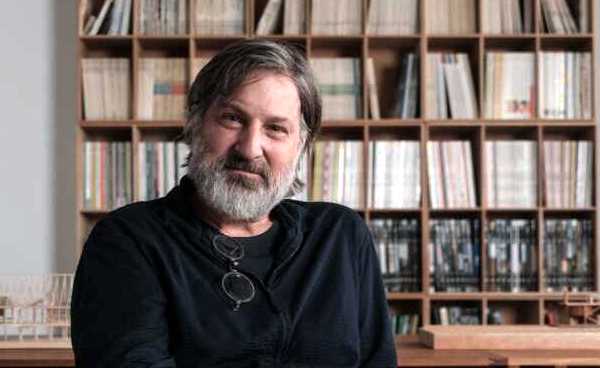
칠레 산티아고를 기반으로 활동하는 크로아티아계 건축가 스밀얀 라디치 클라크(Smiljan Radić Clarke, 60)가 '건축계의 노벨상'으로 불리우는 제 55회 프리츠커 건축상(Pritzker Architecture Prize) 수상자로 선정됐다. 상금 10만 달러.
심사위원단은 "그의 건축물들은 임시적이고 불안정하거나 의도적으로 미완성된 것처럼 보인다. 마치 사라질 듯 위태로워 보이지만, 그럼에도 불구하고 구조적이면서도 낙관적이고 조용히 기쁨을 주는 안식처를 제공하며, 취약성을 삶의 경험에 내재된 조건으로 받아들인다"라고 평했다. 뉴욕타임스는 "위압적이거나 웅장하지 않고, 오히려 절제되고 조용하며, 버스 정류장, 와이너리, 조각가의 작업실 등 본래의 목적에 충실하다"면서 "소박한 조화와 꾸밈없는 우아함이 특징"이라고 설명했다.
라디치는 타임스와의 인터뷰에서 "이 모든 건축물에 공통적으로 흐르는 것이 있다면, 그것은 예산, 규모, 프로그램, 재료의 다양성에도 불구하고 모두 특정한 절제미를 추구한다는 점이다"라고 말했다. 또한, "내가 말하는 절제미란 불필요한 요소를 제거하고, 본질만 남기는 것을 의미한다"고 강조했다.
그의 주요 프로젝트로 레스토랑 메스티조(산티아고, 2006), 피테 하우스(파푸도, 2005), 빅 밀라휴 와이너리(밀라휴, 2013), 서펜타인 파빌리온(런던, 2014)가 있다. 칠레 출신 건축가로서는 2016년 알레한드로 아라베나 (Alejandro Aravena, 당시 49세)에 이어 두번째 프리츠커상 수상자다.
2026 프리츠커상은 재단 이사장 톰 프리츠커와 제프리 엡스타인의 친분 사실이 드러나면서 지연됐다. 톰 프리츠커는 지난달 하얏트 호텔 코퍼레이션 회장직에서 사임했지만, 프리츠커 재단의 이사 및 부회장직은 유지하고 있다. 시상식은 2026년 하반기에 열린다.
Smiljan Radić Clarke Receives the 2026 Pritzker Architecture Prize
The Pritzker Architecture Prize announces Smiljan Radić Clarke, of Santiago, Chile, as the 2026 Laureate of the Pritzker Architecture Prize, the award that is regarded internationally as architecture’s highest distinction.
“Architecture exists between large, massive, and enduring forms—structures that stand under the sun for centuries, waiting for our visit—and smaller, fragile constructions—fleeting as the life of a fly, often without a clear destiny under conventional light. Within this tension of disparate times, we strive to create experiences that carry emotional presence, encouraging people to pause and reconsider a world that so often passes them by with indifference,” expresses Radić.
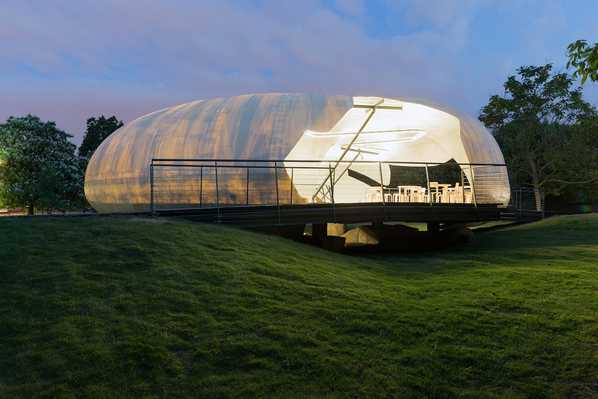
Serpentine Gallery Pavilion, photo courtesy of Iwan Baan
Radić refuses a repeatable architectural language; instead, each project is approached as a singular inquiry, grounded in first principles and informed by noncontinuous history. Context, use and anthropological awareness take precedence. Site is understood not only in physical terms, but also as a convergence of history, social practice, and political circumstance.
The 2026 Jury Citation states, in part, “Through a body of work positioned at the crossroads of uncertainty, material experimentation, and cultural memory, Smiljan Radić favours fragility over any unwarranted claim to certainty. His buildings appear temporary, unstable, or deliberately unfinished—almost on the point of disappearance—yet they provide a structured, optimistic and quietly joyful shelter, embracing vulnerability as an intrinsic condition of lived experience.”
Across his work, site-specific strategies recur in varied forms, allowing each building to emerge from its particular conditions rather than a signature formula. Buildings may be partially embedded in the ground rather than placed upon it as at Restaurant Mestizo (Santiago, Chile 2006), oriented to shelter from prevailing winds or harsh light such as in Pite House (Papudo, Chile, 2005), or shaped through adaptive reuse rather than replacement as with Chile Antes de Chile, the extension of the Chilean Museum of Pre-Columbian Art (Santiago, Chile, 2013).
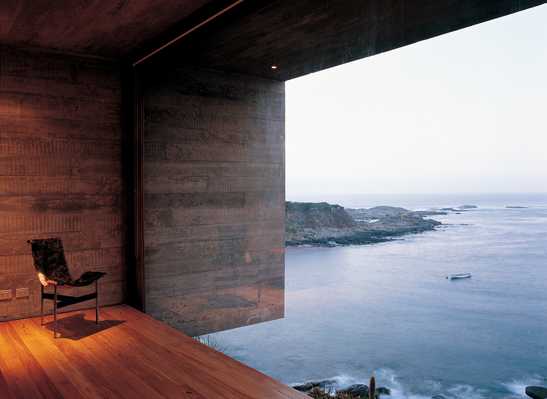
Pite House, photo courtesy of Cristobal Palma
“In every work, he is able to answer with radical originality, making the unobvious obvious. He reverts back to the most irreducible basic foundations of architecture, exploring at the same time, limits that have not yet been touched. Developed in a context of unforgiving circumstances, from the edge of the world, with a practice of just a few collaborators, he is capable of bringing us to the innermost core of the built environment and the human condition,” comments Alejandro Aravena, Chair of the Jury and 2016 Pritzker Prize Laureate.
Radić’s architecture reveals its rigor not through formal assertion, but through the discipline of its construction. His work often appears austere or elemental, yet this impression conceals precise engineering and construction. Materials such as concrete, stone, timber, and glass are deployed in deliberate relation to one another to shape weight, light, sound, and enclosure. At the Serpentine Gallery Pavilion (London, United Kingdom, 2014), a translucent fiberglass shell rests on immense load-bearing, locally-sourced stones. Light is filtered rather than displayed and enclosure remains partial, allowing visitors to experience shelter without complete separation from the surrounding park. At Teatro Regional del Biobío (Concepción, Chile, 2018), a carefully engineered semi-translucent envelope modulates light and supports acoustic performance through restraint. Construction becomes a kind of storytelling, where texture and mass carry as much meaning as form.
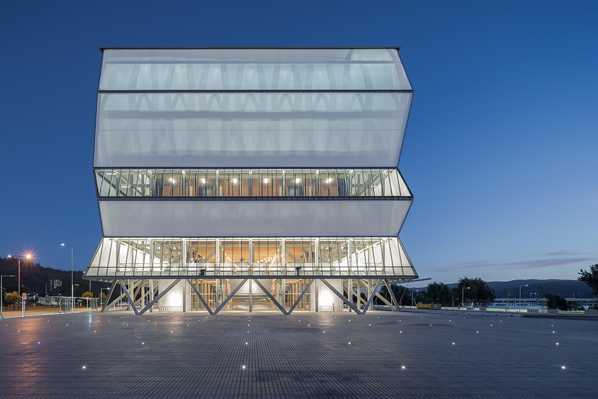
Teatro Regional del Biobío, photo courtesy of Iwan Baan
As the Jury Citation further notes, “To render the qualities of his architectural work in spoken language is intrinsically difficult, for in his designs he works with dimensions of experience that are immediately palpable but escape verbalization—like the perception of time itself: immediately recognizable, yet conceptually evasive. His buildings are not conceived simply as visual artifacts; rather, they demand embodied presence.”
His works are marked by a quiet emotional intelligence, informed by empathy for the human experience and calibrated to shape how architecture is felt over time. His buildings feel protective, inwardly focused, and attentive to human fragility. House for the Poem of the Right Angle (Vilches, Chile, 2013) signifies contemplative retreat, with thoughtfully placed openings, oriented upward to capture light and time, encouraging stillness and introspection.
At his home studio, Pequeño Edificio Burgués (Santiago, Chile, 2023), the residence provides shelter and privacy while maintaining an expansive relationship to the city below. From within, residents overlook urban landscape below, while from the outside, the interior remains concealed behind chain-link curtains. Single-pane glass walls invite rain, sound, and shifting light into the space, allowing daily weather to be felt as much as seen. Below, the subterranean studio occupies a quieter register, as the same walls are tempered by an earthen berm that filters sunlight, brings nature into view, and creates a protected environment for work.
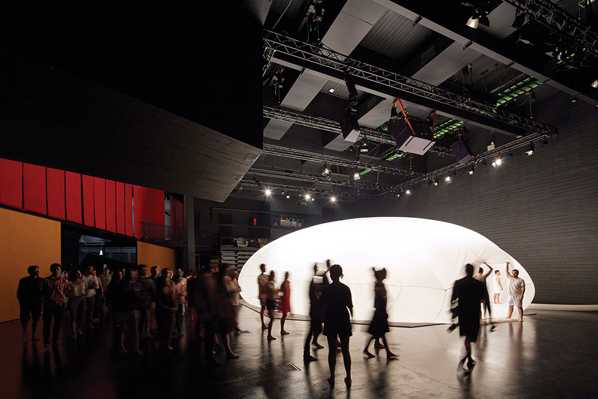
NAVE, Performing Arts Center, photo courtesy of Cristobal Palma
Interventions are neither restoration nor replacement, rather intentional calculations of scale and use. At NAVE (Santiago, Chile, 2015), Radić reframes an early-twentieth-century residential heritage building damaged by natural disaster, retaining the existing structure while inserting new volumes dedicated to open-ended performance, rehearsal, and workshop spaces. Above, a rooftop terrace capped by a circus tent introduces an unexpected lightness and an atmosphere of provisional celebration programmed with community events, that contrasts with the grounded intimacy below. Previous layers remain visible, treating adaptation as continuity rather than compromise.
This attentiveness to layers extends beyond construction. In 2017, Radić established Fundación de Arquitectura Frágil in Santiago, conceived as both a platform for public exchange and a working archive. The foundation’s collection, comprised of experimental works, studies, and references from other architects, forms a body of inquiry that often informs his own projects. The work of others becomes another layer through which architecture continues to evolve.
Developed over more than three decades, Radić’s practice spans cultural institutions, civic spaces, commercial buildings, private residences, and installations throughout Albania, Austria, Chile, Croatia, France, Italy, Spain, Switzerland, and the United Kingdom, with additional defining works including Guatero, for the XXII Chilean Architecture Biennial (Santiago, Chile, 2023); London Sky Bubble (London, United Kingdom, 2021); Chanchera House (Puerto Octay, Chile, 2022); Prism House (Conguillío, Chile, 2020); Vik Millahue Winery (Millahue, Chile, 2013); The Boy Hidden in a Fish, with Marcela Correa, for the 12th International Architecture Biennale of Venice (Venice, Italy, 2010); and CR House (Santiago, Chile, 2003).
Smiljan Radić Clarke is the 55th Laureate of the Pritzker Architecture Prize and the founder of the practice, Smiljan Radić Clarke, established in 1995. Born in Santiago, Chile, he resides and works in his native city with upcoming projects in Albania, Spain, Switzerland, and the United Kingdom.
https://www.pritzkerprize.com/laureates/smiljan-radic-clark
 '영국계 로스앤젤레스인(English Los Angeleno)’ 화가 데이빗 호...
 2026 베니스 비엔날레 독일관 대표작가 헨리케 나우만(41) 사망