

Arirang's Journey: From 'The Howard Seven' to Na Woon-gyu and BTS
BTS ARIRANG: Rediscovering Korean Roots and Self
1896·1926·2026: Three Eras Intertwined by 'Arirang'
*아리랑(Arirang)의 여정: 하워드대 7인에서 나운규를 거쳐 BTS까지 <Korean version>
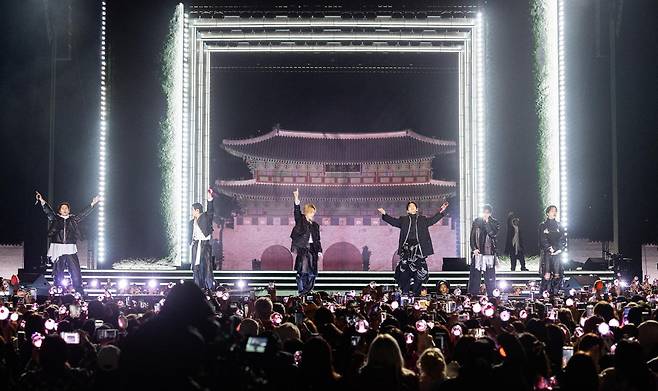
BTS THE COMEBACK LIVE | ARIRANG, Netflix
The Magnificent Seven: BTS Is Back
The “Kings of K-pop,” BTS, have made their long-awaited return after a hiatus of three years and nine months.
On March 21, they released their album Arirang, followed by a historic reunion performance, BTS Comeback Live: Arirang, at Gwanghwamun Square in Seoul on March 23. The concert was streamed live to 190 countries via Netflix, drawing 18.4 million viewers. It topped charts in 24 countries and reached the weekly streaming Top 10 in 80 countries.
The seven members—RM, Jin, Suga, J-Hope, Jimin, V, and Jungkook—then flew to New York, where they staged a SWIMSIDE concert at Pier 17 in partnership with Spotify, performed their title track SWIM at the Solomon R. Guggenheim Museum, and appeared on The Tonight Show Starring Jimmy Fallon for two consecutive nights (March 25–26).

BBC described the album as a “cultural moment,” while Rolling Stone awarded it a perfect five-star rating, calling it “a perfect comeback.” Notably, The New York Times offered a more nuanced take: “Rather, it feels borderline experimental, as close to risky as a project engineered for minimal risk can be.”
Regarding the Gwanghwamun concert, The Guardian wrote that “having lost none of their chemistry, this is a comeback of epic proportions,” while Le Monde highlighted their reinterpretation of a 600-year-old folk song into EDM, noting, “It is marvelous to see them presenting the most trendy music while preserving their Korean roots.”
ARIRANG: What Is Your Love Song?
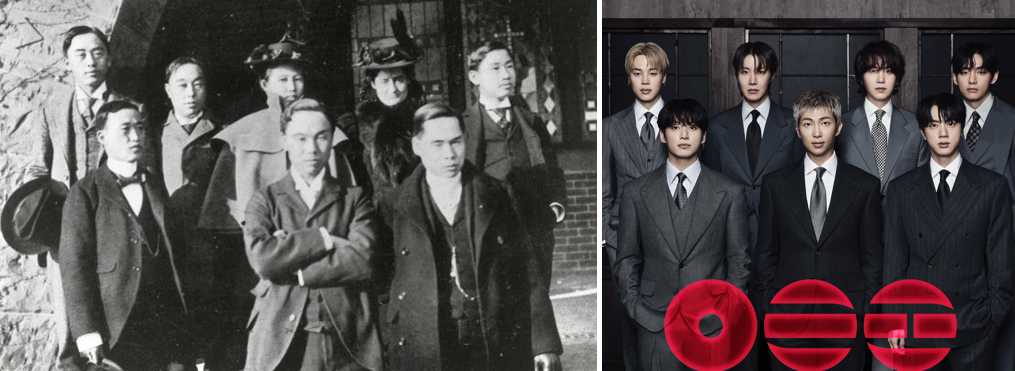
Seven Howard University students from Korea in front of Howard's chapel in 1897. The students are pictured with Edith Rankin, daughter of former Howard president Jeremiah E. Rankin and niece of Andrew Rankin, for whom the chapel is named. Photo courtesy of the Howard University Moorland Spingarn Research Center. (left) / Cover of BTS's 5th album 'Arirang'
BTS has declared the beginning of its second chapter with its fifth album, Arirang. In the lead-up to the release, beginning in February, the group launched a global campaign titled “WHAT IS YOUR LOVE SONG?” across major cities including Seoul, New York, and London.
Large-scale posters appeared on digital billboards in Times Square and throughout neighborhoods such as the East Village, SoHo, and Brooklyn. Fans were invited to scan QR codes linking to a dedicated website, where they could share their own “love songs.” According to their agency, Big Hit Music, these were meant to be “more than simple romantic ballads,” but rather songs through which people could reflect on their memories and find solace and strength.
The album Arirang, marking what the group calls its “BTS 2.0” era, comprises 14 tracks that explore their roots and foreground questions of identity. The title itself is drawn from the Korean folk song Arirang, designated as both a UNESCO Intangible Cultural Heritage of Humanity (inscribed in 2012) and a National Intangible Cultural Heritage of Korea.
The album’s logo draws on the initial consonants of “Arirang” in Hangul (ㅇㄹㄹ), as well as the four trigrams—Geon, Gon, Gam, and Ri—featured in the corners of the Taegeukgi, South Korea’s national flag.
'The Howard Seven' 130 Years Ago and BTS
*The Seven Young Men of 130 Years Ago and BTS: Why Is Their Comeback Stage "Arirang"?
Tracing back through Korean history, we encounter Arirang and a group of seven young men at Howard University some 130 years ago. In 1896—following the Agwan Pacheon, when Gojong of Korea sought refuge in the Russian legation in the aftermath of the Eulmi Incident—seven young men from Joseon, then studying in Japan, left for the United States out of concern for their safety. They enrolled at Howard University, a historically Black institution in Washington, D.C. One day, their singing drew attention on campus, an episode reported at the time by The Washington Post.
That summer, Alice Cunningham Fletcher (1838–1923), an anthropologist known for collecting Indigenous music, invited three of the students—Jong Sik Ahn, He Chel Ye, and Son Rong, as identified in notes accompanying the original wax cylinder recordings—to her home. There, she recorded 11 Korean folk songs, including Arirang (titled Love Song: Ar-ra-rang), onto wax cylinders. These recordings mark the earliest known instance of Korean voices captured on American soil and the first recording of Arirang, now preserved at the Library of Congress.
In this sense, the “Love Song” version of Arirang recorded in 1896 finds an unexpected echo in BTS’s Arirang more than a century later.
*BTS 'ARIRANG' Animation Trailer: What is your love song?
However, following the release of an animated trailer for Arirang on YouTube on March 12, criticism emerged from both Black communities and K-pop fans. Critics argued that the trailer distorted historical reality—engaging in a form of “whitewashing”—by portraying the 1896 Howard campus as predominantly white.
A deeper irony underlies these modes of representation. Howard University, where Arirang was sung in 1896, was a central space for Black intellectual life. Within that context, the Korean students occupied yet another position of otherness—aliens, in a double sense that resonates uncannily with BTS’s own vocabulary. It was a moment in which different margins briefly intersected.
And yet, in both a 2010 KBS documentary and BTS’s animated trailer, the surrounding students are depicted as white, flattening this layered historical context. A song that once resonated within a space of otherness is, in its contemporary retelling, recast through the face of the center. What may be intended as an appeal to universality simultaneously reveals how that universality is constructed—and for whom.
Arirang (1926) to ARIRANG (2026): From Han to Heung
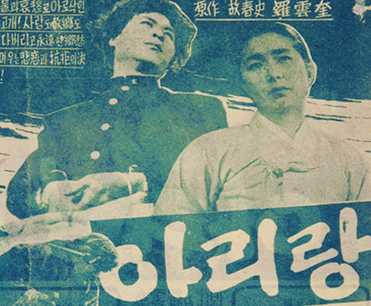
A poster for Arirang, directed by Na Woon-gyu, released at the Dansungsa Theater in 1926.
Arirang—a melody steeped in the sorrow of parting lovers—has been handed down for centuries as a folk song of the Korean people. Through a turbulent modern history marked by colonial rule, war, and national division, it has endured not only as a song of longing and grief—han—but also as a quiet emblem of resistance.
You Hong June, Director of the National Museum of Korea, who attended BTS Comeback Live: Arirang, reflected in an interview with The Chosun Ilbo: “It sounded as though Arirang was no longer merely a melody of the past, but a song of the future.” He added, “What struck me most was that the melody felt vibrant and alive, rather than sorrowful.”
Through BTS, a song long associated with han—the collective emotional register of the Korean people—has been recast as one of heung, a form of exuberant, life-affirming energy.
Exactly one hundred years ago—in 1926, during the Japanese colonial period—the film Arirang was produced. The song served as the theme music for this silent film, created by "Chunsa" Na Woon-gyu (1904–1937) when he was just twenty-two. Na Woon-gyu—an independence activist himself—took on multiple roles as producer, screenwriter, director, and lead actor. The film tells the story of Young-jin, a university student driven to madness after being tortured for participating in the March 1st Movement. The plot reaches a tragic climax when Young-jin, wielding a sickle, kills a pro-Japanese collaborator who attempts to assault his younger sister, leading to his arrest by the Japanese police. In the final scene, the villagers sing Arirang as Young-jin is led away.
Audiences were reportedly so moved by this scene that they wept openly while singing along. The theme song spread across the country, sung almost like a national anthem. The film endured as a cinematic touchstone for Korea, with over 800 revival screenings in Seoul alone during the two decades following its release. Though the original film has been lost, its legacy remains vivid.
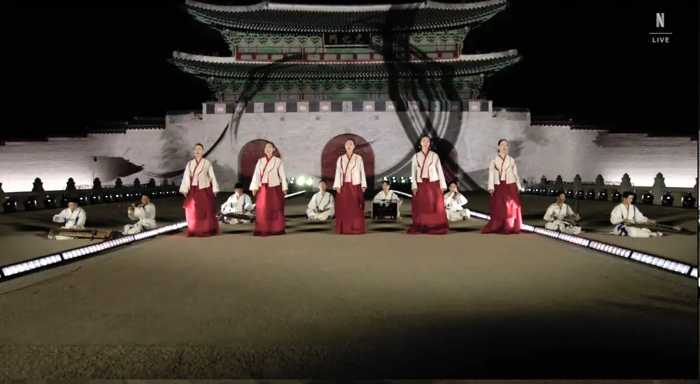
BTS THE COMEBACK LIVE | ARIRANG, Netflix
Na Woon-gyu—often hailed as the "Orson Welles of Korean Cinema"—revealed in a 1937 interview with Samcheolli magazine that he had composed Arirang himself:
"I am the one who created it. When I was a young elementary school student, construction began on a railway line stretching from Cheongjin to Hoeryeong. At that time, laborers arriving from the south would sing a sorrowful tune—chanting 'Arirang, Arirang'—as they laid the tracks. For some reason, it struck a deep chord within me; whenever I heard that melody while walking along the road, I would stop in my tracks and listen intently for a long while. Afterward, I would try to memorize that melody—with its poignant, beautiful cadence—all by myself... I recalled that melody I had heard in my youth, wrote the lyrics to accompany it, and then commissioned the musical score from the Danseongsa Orchestra."
— Arirang Archive
In the film, Young-jin famously exclaims, "I was born in this land of three thousand ri..." (ri being an old Korean measure of distance, roughly 0.4 km or 0.25 miles). Here, "three thousand ri" symbolizes the expanse of the Korean peninsula. Though the term may seem obscure to non-Korean readers, it evokes a profound sense of homeland and belonging.
Like a melody echoing across generations, Arirang became a cultural phenomenon, capturing the spirit, grief, and aspirations of a nation. Over a century later, BTS carries that same spirit of han onto the global stage, transforming it into a shared celebration of identity and exuberant joy—a song of heung that resonates with millions worldwide.
Arirang in Body to Body
Gwanghwamun, the venue for BTS’s comeback concert, is a space of great symbolic significance. Set against the backdrop of Gyeongbokgung Palace and flanked by statues of King Sejong the Great and Admiral Yi Sun-sin, the square serves as a public forum for democratic citizens—a site for massive gatherings ranging from World Cup street celebrations to large-scale candlelight vigils, such as those held during the impeachment crisis. The concert opened with a sweeping drone shot that traced a path from beyond Mt. Bugaksan, through the Geunjeongjeon Hall of Gyeongbokgung Palace and Heungnyemun Gate, finally arriving at Gwanghwamun. The performance began with Body to Body, a track incorporating the melody of the folk song Arirang, which also serves as the opening track of their new album.
The performance unfolded amidst a sea of lights created by ARMY—the global BTS fan base. The exterior walls of Gwanghwamun were brought to life with dynamic media art featuring brushstrokes inspired by traditional Korean ink painting. Body to Body features a sustained electronic beat layered with vocals and rap. In the latter half of the song, the phrase "Somebody like you" repeats while a five-member female ensemble in hanbok sings, "Arirang, Arirang, Arariyo—Crossing over Arirang Pass..." Behind them, an eight-member male gugak ensemble, wearing traditional gat hats and dopo robes, performs on janggu and haegeum. The verse "The one who leaves me behind shall not make it even ten li before their feet begin to ache..." follows, and the song gradually fades back into its electronic rhythm.
By seamlessly blending electronic music with traditional Korean sounds, the track showcases BTS’s artistic maturity while emphasizing their roots and Korean identity. Through this performance, the centuries-old folk melody of Arirang resonates anew, bridging history and modernity for millions of fans around the world.
*Peruvian ARMYs' Sing-along of 'Arirang
Track Insights: From the Emille Bell to SWIM
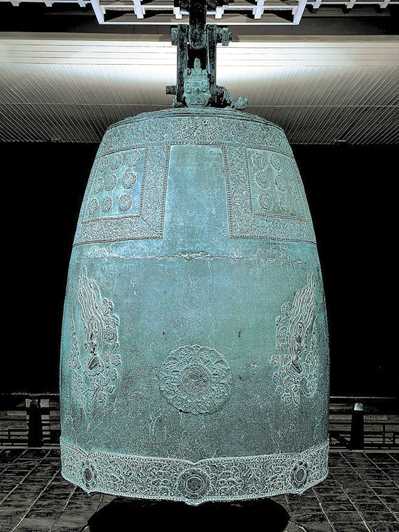
National Treasure No. 29: the Sacred Bell of Great King Seongdeok. Photo: Gyeongju National Museum
The sixth track on the album, "No. 29," functions as an interlude—a connecting link within the 14-track collection. It features the actual striking sound of National Treasure No. 29: the Sacred Bell of Great King Seongdeok (cast in 771), also known as the Emille Bell. The deep, resonant tone reverberates for one minute and 38 seconds. By incorporating an audio recording provided by the National Museum of Korea, BTS once again embeds Korean culture directly into their music. Standing 3.66 meters tall and weighing 18.9 tons, the bell is the largest in Korea.
In his bestseller My Exploration of Cultural Heritage Sites, You Hong June wrote of the Emille Bell's sound:
"It simultaneously embodies both solemnity and clarity, and a form that is at once dignified and gracefully fluid in its appearance. It seemed unlikely that such an instrument would ever exist again in this world."
While the first five tracks of Arirang (Body to Body, Hooligan, Aliens, FYA, and 2.0) chronicle BTS's journey and milestones as global superstars, the latter half of the album (SWIM, Merry Go Round, NORMAL, Like Animals, they don't know about us, One More Night, Please, and Into the Sun) expresses the members’ diverse human emotions—including anguish, determination, and love.
The title track, SWIM, is an alternative pop song blending warm guitar melodies with retro beats, symbolically capturing the ethos of continuing to move forward—never stopping—even amidst life’s hardships. Billboard described SWIM as "a track that firmly anchors the album," noting that "the direct message of scattered rivers gathering into the ocean is the source of the song's power."
BTS Fashion: Roots Meet Modernity
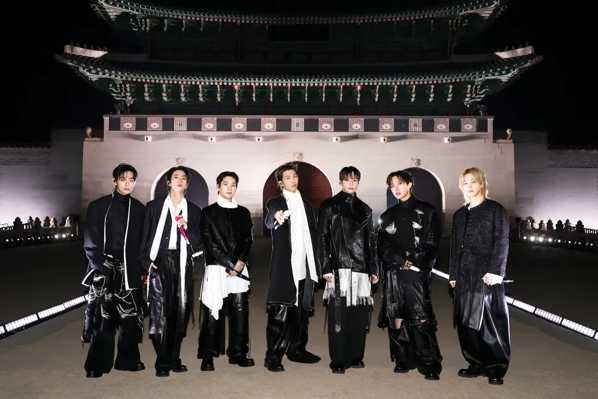
BTS THE COMEBACK LIVE | ARIRANG, Netflix
Just as BTS reimagines Arirang by blending centuries-old Korean folk melodies with modern electronic beats, their visual presentation reflects a similar dialogue between tradition and innovation. The group's aesthetic choices—whether on stage, in music videos, or in live performances—extend the narrative of identity, history, and artistic maturity. Fashion, like music, becomes a medium through which BTS interprets and projects their Korean roots to a global audience, turning every stage appearance into a statement of cultural resonance.
The New York Times also highlighted the fashion showcased at BTS’s Gwanghwamun concert. The members—Jin (Gucci), Suga (Valentino), J-Hope (Louis Vuitton), RM (Bottega Veneta), Jimin (Dior/Tiffany), V (Celine), and Jungkook (Calvin Klein/Hublot)—have served as ambassadors for luxury brands, and their mere presence in front rows generates millions in promotional value. Their outfits for the concert, designed by Songzio, reinterpret Korean traditional elements through a contemporary lens.
Songzio developed a unique keyword for each member, fusing the fluidity of traditional hanbok with the structure of armor to embody each member’s persona: RM (Hero), Jin (Artist), Jimin (Poet), Suga (Architect), Jungkook (Vanguard), J-Hope (Sorigun/Storyteller), and V (Doryeong/Young Nobleman). For the upcoming "Arirang" world tour, Songzio is conceptualizing a new set of costumes that offer a fresh interpretation of the South Korean national flag, the Taegeukgi.
Boys to Men: Beyond the “Boy Band” Label
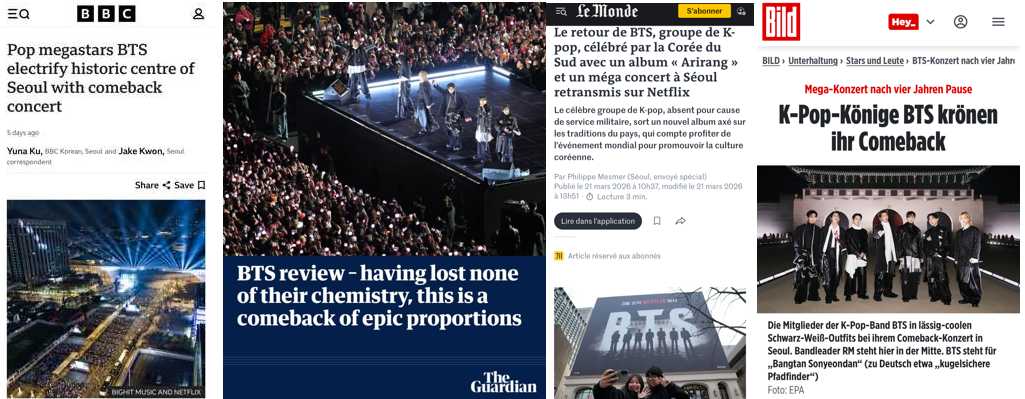
In March alone, The New York Times published over 20 articles related to BTS’s comeback, reflecting the enormous global attention the group continues to command. Public sentiment in the West appears to be shifting, as reflected in NYT reader comments:
Excited to have BTS back, particularly because Stray Kids' military enlistment phase is beginning this year (though I'm sure they have planned accordingly). I believe and hope that Kpop's journey is just beginning. But is it even "Kpop" anymore? With Huntrix's Golden, Jungkook's 3D and Rose's Apt. dominating pop radio in the US, can we recognize now that Kpop artists belong in the global pop category?
-Leo, Cincinnati, OH
The use of boy band to describe BTS is intentionally demeaning, don't you know? I am certain it is used deliberately. But members of BTS have been men for a long time now. They were never really a "boy" band which usually rely heavily on "bubblegum pop" sounds and lyrics. Especially in kpop. BTS lyrics addressed universal themes of alienación, exclusion, youth suicide, pressure to perform in an unforgiving and rigidly hierarchical society. Their fans have felt seen and heard through their music and words and forged deep soulful connections with the band and each other as Army. The westernised music authority does not understand or connect with them, viewing them as a threat to their established favs. Because yes, the music is rich and diverse, lyrics compelling, production and execution flawless. Western musicians rarely expend on album song the same resources, talent and time as BTS does on one song.
-Adriana, Mexico City
The Journey Continues: World Tour and 'BTS-nomics'
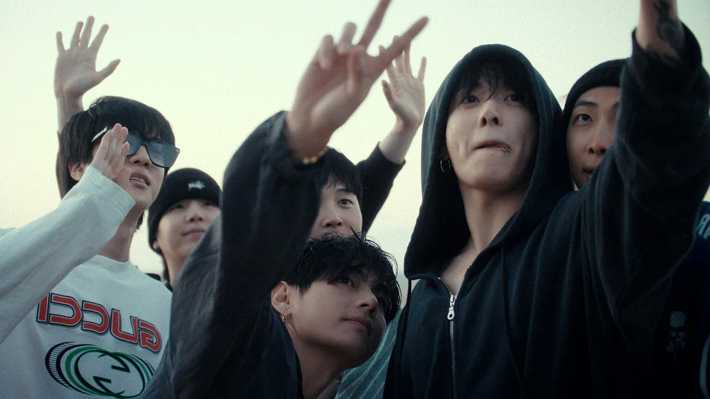
BTS: The Return, Netflix
On March 27, Netflix released BTS: The Return—a documentary directed by Bao Nguyen that chronicles the group's journey to discover the artistic vision behind their album Arirang. The film captures BTS—reunited after a four-year hiatus—as they set up a "song camp" in Los Angeles in August 2025 to create the album Arirang. Sparked by leader RM's central question—"What makes BTS truly BTS?"—the members open up about their existential struggles regarding their identity.
He reflects, "We are still just country kids from South Korea," and confesses, "We wear a big, magnificent crown, but sometimes it feels too heavy—and even frightening." The documentary also captures glimpses of their daily lives, ranging from dinners accompanied by soju to moments of relaxation by the pool and at the beach.
BTS is set to embark on their Arirang World Tour, commencing on April 9 at the main stadium of the Goyang Stadium Complex in Gyeonggi Province and continuing through March 2027, spanning 34 cities across 23 countries. Comprising a total of 82 performances, this tour is planned on an unprecedented scale—the largest in the group’s history—and features a 360-degree stage setup. Industry experts project that the tour will attract over 5 million attendees and generate at least $1 billion in revenue. This scale rivals Taylor Swift’s The Eras Tour (2023–24), which drew over 10 million attendees across 149 shows, grossed more than $2 billion, revitalized local economies, and gave rise to the term “Taylornomics.” It is now natural that terms such as “BTS-nomics” and “ARMY-nomics” (ARMY + economics) are beginning to emerge.
Yet their impact cannot be measured in economic terms alone. More than a century ago, Arirang was sung softly on foreign soil. Today, it resounds across the world, carried by millions of voices. BTS’s Arirang is not a return to tradition, but its living present. It no longer lingers in sorrow. Han has not vanished. It has simply found a new voice in Heung.
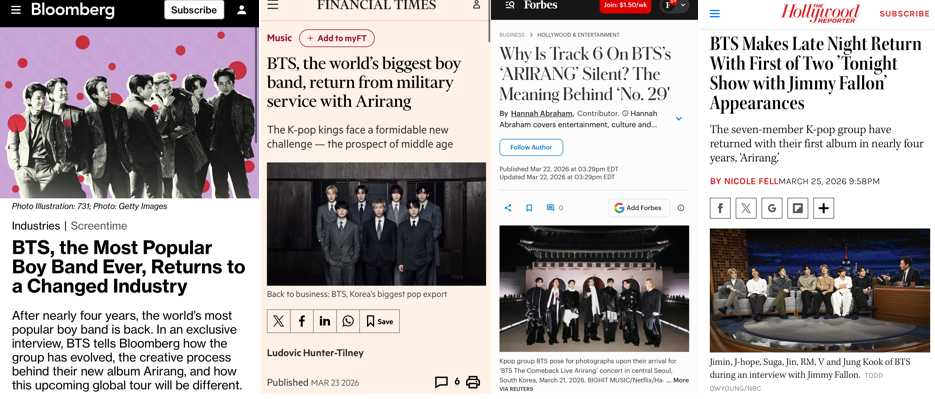
*Reunited BTS: Schedule for the Largest-Scale Global K-Pop Tour in History (34 Cities)
https://www.nyculturebeat.com/?mid=Music2&document_srl=4174043
한류를 이해하는 33가지 코드: BTS, 기생충, 그리고 오징어 게임을 넘어서
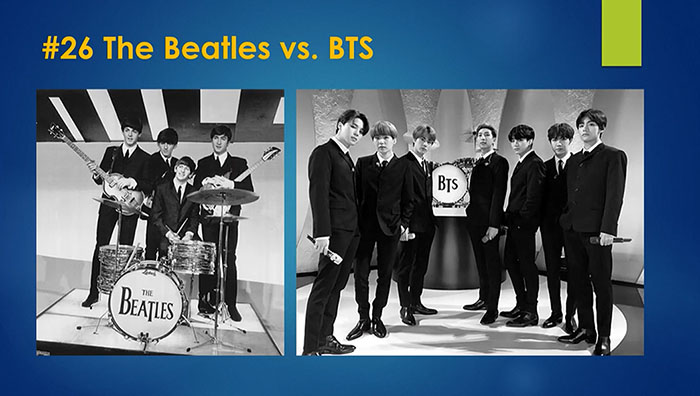
#26 비틀즈 Vs. 방탄소년단 The Beatles vs. BTS
1960년대 비틀즈(The Beatles)와 오늘의 보이밴드 BTS를 비교한다. 빌보드 No. 1, HOT 100, 베스트셀링 앨범, 비틀 매니아와 BTS 팬클럽 ARMY까지. 그리고, 2022년 6월 휴지기 선언 후 홀로서기 프로젝트에 박차를 가하며 정국, 제이홉, RM, 슈가, 뷔, 지민, 진은 새로운 챕터를 열었다.
https://www.nyculturebeat.com/?mid=Focus&document_srl=4087049
33 Keys to Understanding the Korean Wave: Beyond BTS, Parasite and Squid Game
#26 비틀즈 Vs. 방탄소년단 The Beatles vs. BTS
A comparison between the 1960s Beatles and today's boy band BTS. Billboard No. 1, HOT 100, best-selling album, lyrics, and Beatlemania & BTS ARMY.
https://www.nyculturebeat.com/?mid=Zoom&document_srl=4100896
'33 Keys to Understanding the Korean Wave: Beyond BTS, Parasite and Squid Game'